
Binary Options for Beginners: How They Work, How to Learn, and What Not to Do (2026)


Binary options are short-duration contracts where you predict whether an asset will be above or below a strike price at expiry. Get the direction right and you receive a fixed payout (typically 70–90%); get it wrong and you lose the amount staked. There is no leverage, no margin call, and no open-ended downside — every trade is sized and capped before you click. That simplicity is exactly why beginners are drawn to the product, and exactly why the regulated landscape in 2026 is small. Most major regulators have either restricted or banned binary options for retail traders, so the realistic options for a UAE-based beginner today are offshore platforms like IQ Option, Quotex, and Pocket Option. This guide explains how the contracts work, what to learn first, how much money to risk, and how to avoid the mistakes that wipe out new accounts in the first month.
What a binary option actually is
A binary option is a yes/no contract on the direction of an asset over a defined period. You pick an asset (EUR/USD, gold, BTC, an index), you pick a duration (60 seconds up to a few hours on most platforms), and you choose higher or lower. At expiry the platform compares the closing price to the strike price you opened at. Correct call: your stake returns plus the advertised payout. Wrong call: you lose the stake. There are no partial outcomes, no trailing stops, and no margin top-ups. Every contract resolves at zero or one.
This structure has two implications beginners should internalise immediately. First, your maximum loss per trade equals your stake — never more — which makes position sizing trivially mechanical. Second, because payouts are typically 70–90% (not 100%), a 50/50 win rate loses money. You need to win clearly more often than you lose just to break even, and the breakeven win rate depends on the payout offered on each contract.
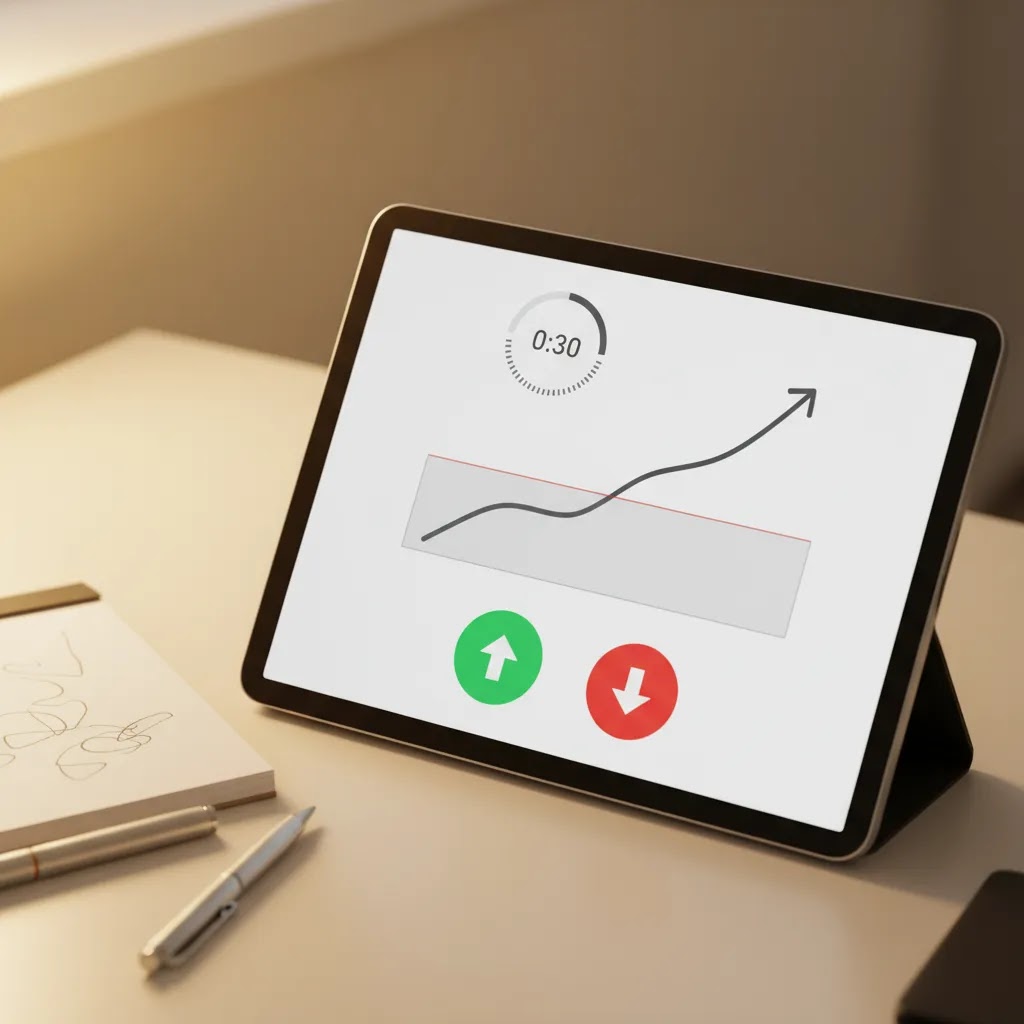
The breakeven math you need before placing a single trade
On every binary contract the platform shows the payout percentage. If the payout is 80%, a winning $10 trade returns $18 (your $10 back plus $8 profit) and a losing $10 trade returns $0. To find the win rate you need just to break even, divide 1 by (1 + payout). At 80% that is 1 / 1.80 = 55.6%. At 70% it is 58.8%. At 90% it is 52.6%. Any sustainable strategy needs to clear that bar after costs and slippage, not just match it.
Breakeven win rate by payout
| Payout offered | Breakeven win rate | Implied edge needed |
|---|---|---|
| 70% | 58.8% | +8.8 percentage points over coin-flip |
| 75% | 57.1% | +7.1 percentage points |
| 80% | 55.6% | +5.6 percentage points |
| 85% | 54.1% | +4.1 percentage points |
| 90% | 52.6% | +2.6 percentage points |
| 95% | 51.3% | +1.3 percentage points |
Most brokers display 80–85% as the headline payout but only deliver it on a handful of liquid pairs in normal market hours. Exotic pairs, weekend crypto, and 60-second contracts often pay 70–75%. Plan your strategy around the payout you actually receive, not the marketing number on the homepage.
The five things to learn first
- Candlestick basics. Open, high, low, close. What a doji, a hammer, and an engulfing candle look like. You do not need to memorise 50 patterns — three or four reliable ones on a clean chart beat a wall of indicators.
- Support and resistance. Horizontal levels where price has previously reversed. Most beginner-friendly strategies are some form of "bounce off support" or "rejection at resistance" — learn to draw clean levels first.
- Trend identification. Higher highs and higher lows = uptrend. Lower highs and lower lows = downtrend. Trading with the trend on a higher timeframe and entering on a lower timeframe is the foundation of almost every working approach.
- Session structure. Forex liquidity peaks during the London open (11:00–13:00 UAE) and the London/New York overlap (16:00–20:00 UAE). Crypto runs 24/7 but is most volatile during US hours. Asian session is quieter and ranges more.
- Risk per trade. A fixed percentage of your account on every contract — typically 1–2% for beginners. This single rule is what keeps a losing streak from being an account-killer.
How much to risk per trade
The single biggest predictor of whether a beginner survives the first three months is not strategy — it is position sizing. New traders almost universally risk too much per contract because the dollar amount feels small, then a normal six-trade losing streak takes 60% of the account. The math: at 2% per trade, ten consecutive losses leaves you with 81.7% of the starting balance. At 10% per trade, ten consecutive losses leaves you with 34.9%. The same strategy survives one and destroys the other.
- Conservative starting size: 1% of account balance per contract. A $500 account trades $5 contracts. Boring, sustainable, gives you 100+ trades to learn before drawdown becomes a problem.
- Standard size after 3+ months of profitable trading: 2% per contract. Still survives a 10-loss streak with ~82% of capital intact.
- Maximum size most professionals use: 3% per contract on highest-confidence setups only. Anything above this is gambling, not trading.
- What to never do: martingale (doubling stake after a loss). It feels mathematically clever and ends accounts faster than any other behaviour. A six-loss streak at 2x doubling needs 64x the original stake to recover.
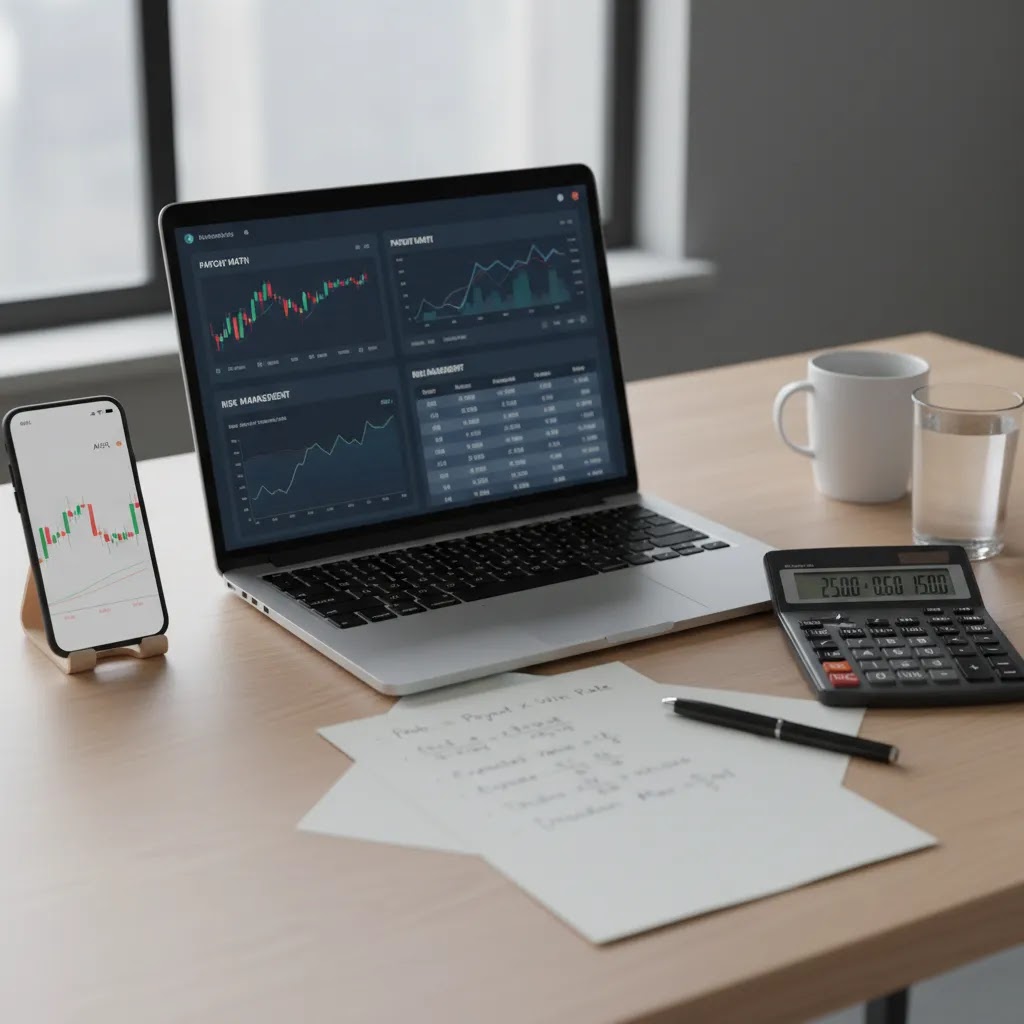
A realistic first-month plan
You do not start with real money. You start with a demo account, you trade it like real money, and you measure results before depositing anything. Most beginners skip this step and learn the same lessons in cash a month later. The plan below is what works for the people who are still trading 12 months in.
- Week 1 — demo, no strategy. Open a demo on IQ Option, Quotex, or Pocket Option. Place 50 trades on a single asset (EUR/USD or BTC/USDT) at a single timeframe (5-minute candles, 5-minute expiry). No system. The point is platform fluency: speed of entry, how the chart redraws, what happens at expiry.
- Week 2 — demo, one setup. Pick one setup and trade only that. Example: bullish engulfing candle at a clean horizontal support level on the 15-minute chart, with the higher timeframe (1-hour) in an uptrend. Reject every chart that does not show all three conditions. Aim for 20 trades in the week, log every one.
- Week 3 — demo, measure. Continue the same setup. Calculate your win rate after 30+ trades. Compare to the breakeven rate for the payout you are getting. If you are above breakeven on demo, proceed. If not, do another two weeks of demo before any deposit.
- Week 4 — minimum live deposit. Deposit the platform minimum (usually $10–$50). Trade 1% of balance per contract. Same setup, same rules. Goal: prove the strategy still works when real money is on the line. Most beginners experience a 10–20 percentage point drop in win rate when going from demo to live, purely from emotional pressure. If you survive a month of live trading without blowing the account, you have done better than 80% of new entrants.
Picking a beginner-friendly broker
For UAE beginners in 2026, broker selection is constrained by what is actually available and willing to take retail clients. There is no SCA-regulated binary options broker — the product is not licensed onshore. The realistic shortlist is offshore platforms with strong localisation, fast withdrawals, and a usable demo. Three names dominate the beginner segment.
- IQ Option — the most polished platform for new users, free $10,000 demo, $10 minimum deposit, AED-friendly payment methods. Best balance of ease-of-use and feature depth for someone learning the product.
- Quotex — clean fixed-time interface, payouts up to 95% on majors, $10 minimum, fast withdrawals on crypto. Slightly steeper learning curve than IQ Option but better economics on winning trades.
- Pocket Option — accepts more payment methods than the others (including local bank transfers in many cases), social trading features, $50 minimum. Largest user base of the three, which means more community resources and signal channels (most of which you should ignore — see below).
For a side-by-side comparison see our best brokers list or the head-to-head IQ Option vs Quotex breakdown. Avoid any platform that promises guaranteed wins, blocks withdrawals behind verification "premium tiers", or asks for a manager to "trade for you" — these are universal red flags.
The mistakes that destroy beginner accounts
Five behaviours show up in nearly every blown account, in roughly the same order. Recognising them is more useful than any chart pattern.
- Position size escalation after a loss. You take a loss, feel the need to "win it back", and double the next contract. The next loss hurts twice as much, the urge to double again is stronger, and within four trades you are at 8x your original size on tilt. Fixed sizing — same percentage every trade — exists to prevent exactly this.
- Trading every signal from a Telegram channel. Free signal groups exist to funnel users to broker affiliate links and to harvest your trade data. Win-rate claims are unverifiable. Even a genuinely good signal source is useless if you do not understand why the trade is being taken — when it stops working you will not know to stop following it.
- 60-second contracts as a starting point. 1-minute expiries have the worst payouts (often 70%), the highest variance, and the least signal-to-noise. They feel exciting and they are the fastest way to lose money. Start at 5- or 15-minute expiries minimum.
- Trading high-impact news. NFP, CPI, FOMC, ECB statements — these create the spreads and slippage that pad broker P&L at retail expense. Beginners should treat the calendar as a "do not trade" list, not an opportunity. News trading is a specialised approach that takes years to do well.
- No journal. You cannot improve what you do not measure. A spreadsheet with date, asset, direction, expiry, payout, result, and one-line reason is enough. Without it, the strategy you "remember working" probably has a 47% win rate and you have not noticed.
How long until you actually know if you can trade
A statistically meaningful sample size for a binary strategy is around 100 trades. At 5 trades a day that is a month. At 2 trades a day it is over two months. Anything fewer than 50 trades and the result is noise — a 70% win rate over 20 trades has the same predictive value as a 50% win rate over 20 trades. Most beginners declare themselves profitable after 15 winners and ruined after 5 losers; both conclusions are equally meaningless.
The honest expectation is that the first 3–6 months are tuition, not income. If you can survive that period with the account intact and a positive equity curve over 100+ trades, you have something worth scaling. Most people cannot, which is why retail trader survival rates are publicly disclosed by EU CFD brokers as 70–85% of accounts losing money — and binary options retail outcomes are widely understood to be similar or worse.
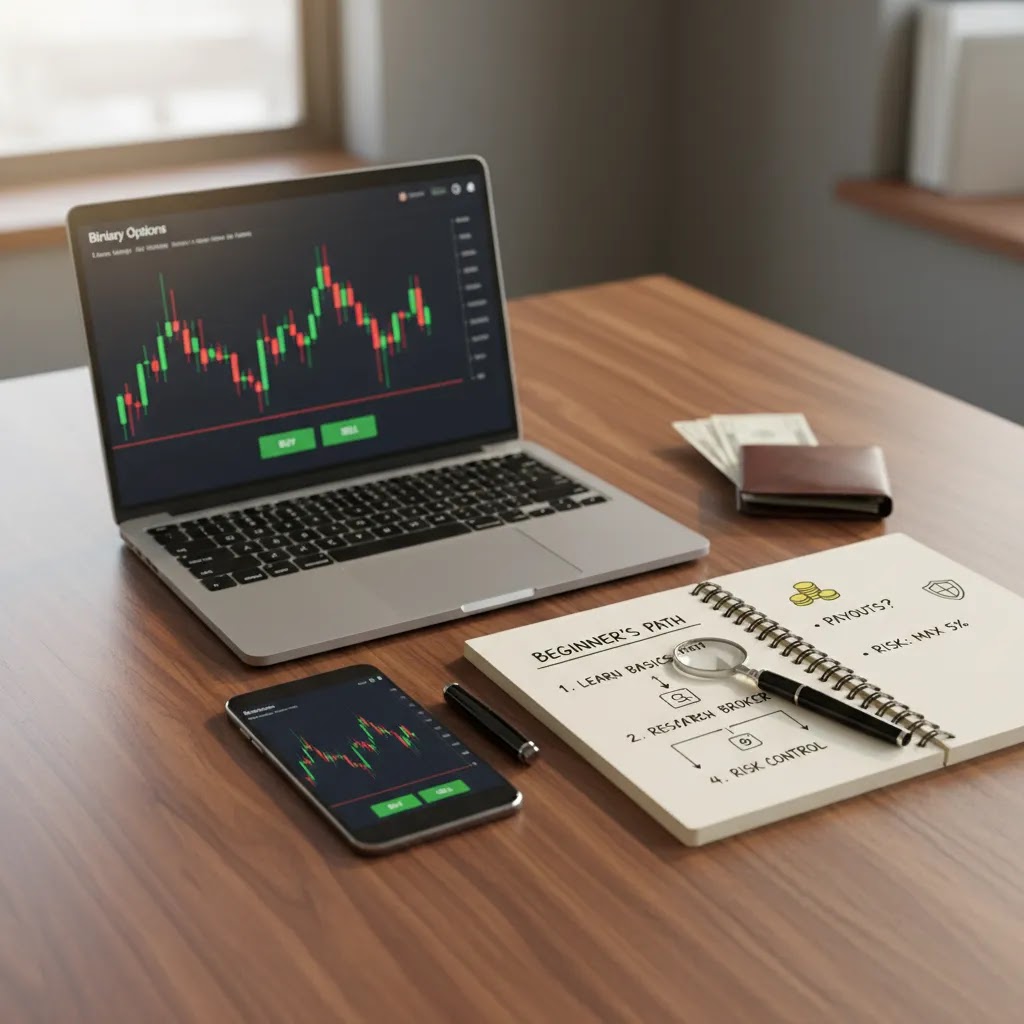
Where to learn next
Once you have the basics — payout math, position sizing, one or two setups, a journal — the next step is depth on the things you already use. There is far more value in trading the same setup 200 times than in learning ten new ones. The links below are the in-house resources our beginner readers progress to most often.
- Binary options strategies hub — read three beginner-appropriate strategies (price action, support/resistance, trend-following) and ignore the rest until you have traded one for a month.
- Risk management deep dive — position sizing, drawdown limits, daily stop rules. The single most important reading on this site for someone with a real account.
- Trading fundamentals — technical and fundamental analysis basics, candlestick patterns, indicators that actually carry information.
- How binary options brokers make money — understanding the counterparty side of every trade you take is the fastest path to spotting platforms that do not have your interest in mind.
- Best binary options brokers — the full broker shortlist if you want to compare more than the three names above.
Bottom line
Binary options are a simple product with a hard-to-beat structure. The contracts are easy to understand; the math required to trade them profitably is not difficult; the discipline required to apply that math consistently is what separates the few who survive from the many who do not. Start on demo, fix your position size before you fix your strategy, expect the first six months to teach you more about yourself than about markets, and pick a broker on the basis of withdrawal reliability rather than payout marketing. The traders still doing this in five years all started exactly the same way: small accounts, slow expiries, one setup, and a journal.
About the Author
Braden Chase is a trading specialist and former research specialist at Forex.com. He writes about market mechanics, trading instruments, and the regulatory landscape to help readers research financial markets with a clearer understanding of risk. Braden has previously served as a registered commodity futures representative for domestic and internationally-regulated brokerages. Articles are educational analysis and do not constitute investment advice. Binary options are high-risk speculative instruments and are not regulated in the UAE.