
Every Type of Binary Option a Trader Should Know


You may have seen a binary options platform advertise fast trades, high payouts, or a simple up or down decision, then realized the platform offers several contract types that all look slightly different. That is where many first-time UAE traders get stuck. A High/Low contract is not the same as a One-Touch trade, and a 30 second binary options contract does not carry the same risk profile as a longer-expiry setup. If you do not understand the differences, you could pick a trade type that does not match your experience level, risk tolerance, or trading plan.
This guide explains the main types of binary options in plain English, including how they work, where the risks usually increase, and what to check before using them on a live account. If you are still learning the basics, it helps to start with what is binary trading before moving into specific contract structures. The goal here is not to tell you what to trade. It is to help you recognize how each option type behaves, what many traders overlook, and why platform quality matters just as much as the contract itself.
Table of Contents
What binary option types actually change
All binary options share the same core idea. You take a view on whether a condition will or will not be met by expiry. If the condition is met, the contract pays a fixed return. If it is not met, you typically lose the amount staked on that trade. That fixed-risk, fixed-reward structure is one reason binary options look simple at first glance.
Here is the thing, the simplicity can be misleading. The types of binary options available on a platform change three important things: the condition that must be met, the time available for that condition to happen, and the probability of success relative to the payout offered. In practice, this means two trades with similar-looking payout percentages may involve very different risk.
For example, a simple direction trade only asks whether price ends above or below a level at expiry. A One-Touch trade asks whether price reaches a target level at any point before expiry. A range trade asks whether price stays inside or breaks outside a price band. Those are not minor variations. They require different market behavior.
Before using any contract type, you should also understand the binary options payout structure. A quoted payout may look attractive, but higher potential return often reflects a lower probability event, not a better opportunity. Binary options remain highly speculative, and losses can build quickly if you trade frequently or use very short expiries.
Break-even math, pricing, and why payout percentages matter
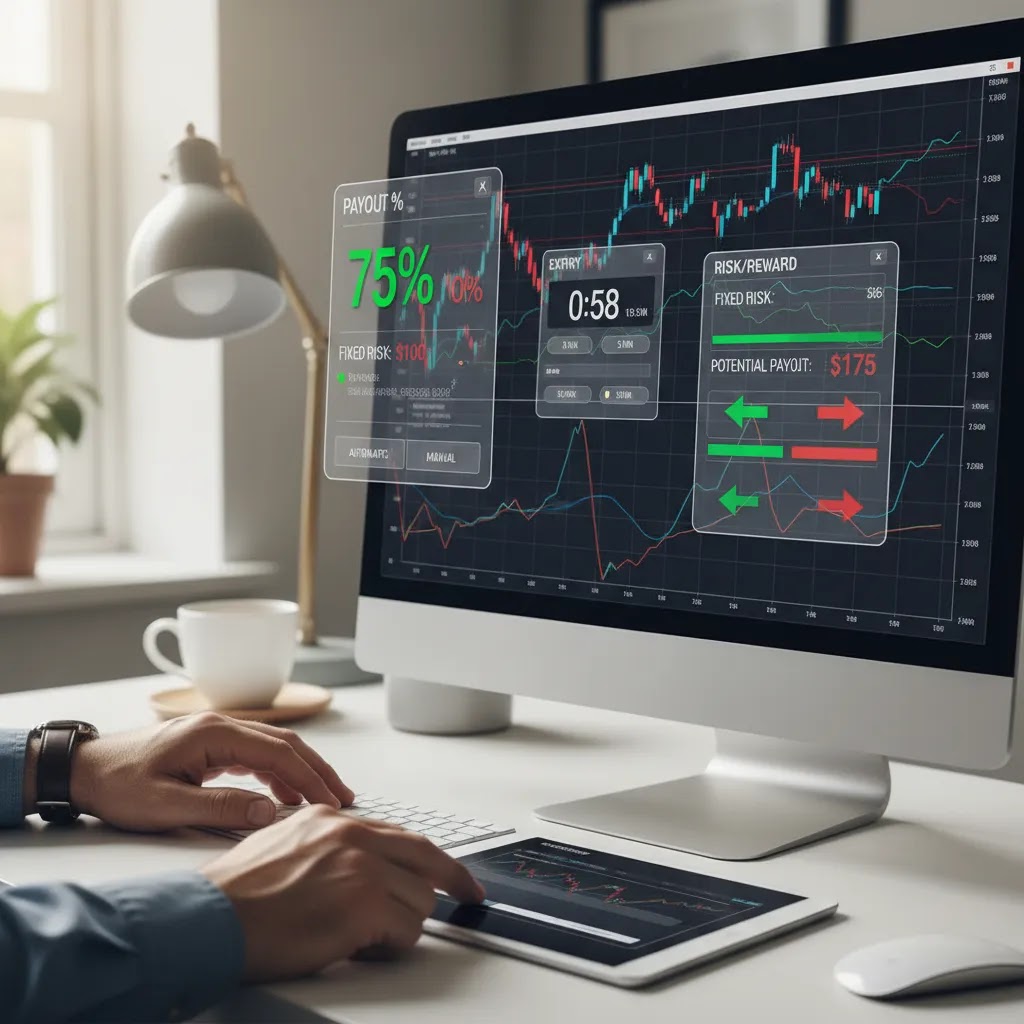
Most platforms display the potential profit as a payout percentage, for example 70%, 80%, or 90%. The important part is what that number implies about the win rate you would need just to break even over time. Since binary options are fixed payout contracts, you can estimate break-even with simple math.
Think of it this way. If a contract pays 80% profit when you win, you gain $0.80 for every $1 staked, and you typically lose the full $1 when you lose. In that common setup, your break-even win rate is usually 1 / (1 + 0.80) = 55.6%. If the payout drops to 70%, the break-even win rate rises to about 58.8%. This is before any platform frictions like execution delays, rule disputes, or settlement edge cases. It is a useful reminder that payout percentages are not just marketing numbers, they directly affect the difficulty of staying above water.
What many traders overlook is that different contract types often bundle different difficulty levels. A High/Low trade might require price to finish just one tick above a strike at expiry, while a One-Touch trade may require price to reach a distant level at any point during the contract. A Ladder level may ask for a larger move than a simple direction trade. Higher displayed payouts commonly reflect that difference in probability. A higher payout is not automatically a better deal if the required market move is less likely in the time available.
For UAE traders specifically, the practical comparison step is to check payouts on the same asset and the same expiry window when you are evaluating platforms or switching contract types. Payouts can change by instrument, by time of day, and by expiry length. Two platforms might both advertise strong headline payouts, yet show very different terms for the exact contract you actually trade. Small payout differences can materially change your break-even win rate, which matters in a product where losses can accumulate quickly.
Binary options trading carries significant risk of capital loss. Break-even math does not make a contract safe, but it does help you read the payout screen with the right level of skepticism.
High/Low binary options
High/Low binary options are the format most beginners encounter first. They are sometimes labeled Up/Down or Call/Put. You predict whether the asset price will finish above or below the strike price, which is the reference price set when the trade opens.
If the platform uses call and put language, a call usually means you expect the price to end higher at expiry, while a put means you expect it to end lower. If that terminology still feels abstract, read call vs put options before risking real funds.
From a practical standpoint, High/Low contracts are often the easiest to understand because the question is direct. Did price finish above or below the starting point? That makes them a common training ground on demo accounts. BinaryOptionsAE often emphasizes demo use for exactly this reason, because contract mechanics are easier to observe without the pressure of immediate capital loss.
Even so, simple does not mean safe. A short-expiry High/Low trade can be heavily influenced by spread changes, brief price spikes, or fast volatility around news events. Many UAE traders first discover this after placing several quick trades on major currency pairs or commodities and seeing outcomes swing on very small price moves.
Why traders use them
What to watch out for
One-Touch and No-Touch options
One touch binary options work differently from High/Low contracts. Instead of asking where price finishes, they ask whether price touches a pre-set target level before expiry. If the level is touched even once, the contract may settle as a win, depending on platform rules. That means timing and volatility matter a lot.
No-Touch options reverse that logic. You are taking the view that price will not hit a specific level before the contract expires. Think of it this way, these contracts are less about the final destination and more about whether the market visits a certain point along the way.
These structures can appear attractive because platforms may offer higher payouts on targets that are harder to reach. Still, higher quoted returns usually reflect higher difficulty. A distant target may look appealing on screen, but if price rarely reaches it within the chosen expiry window, the probability may be lower than many beginners realize.
One-Touch options may suit conditions where markets are moving strongly and price is already showing momentum. No-Touch contracts may be more relevant in quieter periods where price tends to remain within a narrower band. Neither is inherently better. What matters is whether the contract condition matches the market behavior actually taking place.
What many traders overlook is that broker rule clarity matters here. You should verify how the platform defines a touch, how price is sourced, and whether early settlement rules apply. On binaryoptions.ae, the educational focus is not only on payouts or interface design, but also on these contract details that can affect outcomes materially.
Range, Ladder, and exotic contracts
Range options, sometimes called Boundary or In/Out options, are built around a price zone rather than a single direction or target. The platform sets an upper and lower boundary. You then speculate on whether price will stay inside that range or move outside it before expiry.
Range contracts can be useful for understanding how platforms package volatility. If the market is quiet, staying in range may look more plausible. If volatility is rising, a break outside the band could become more likely. The challenge is that many traders choose these contracts without first considering whether current market conditions support that view.
Ladder options are more complex. They use several strike levels above or below the current market price. Each level may offer a different payout depending on how ambitious the target is. A closer level may pay less because it may be easier to reach, while a farther level may pay more because the event could be less likely.
This is where the term exotic option often appears. In binary options, exotic usually refers to structures that are less standard than High/Low, such as Ladder, Range, or custom target contracts. Exotic does not mean better. It usually means more conditions, more variables, and more room for misunderstanding.
When complexity becomes a problem
A contract with more moving parts can make it harder to judge risk. That matters if you are still learning expiry times, strike levels, and payout trade-offs. Many first-time traders in the UAE are drawn to these options because the potential payout can look higher, but that can distract from the actual probability of the event taking place.
If you are comparing brokers that offer advanced contract menus, focus on transparency first. Based on available site data, IQ Option is currently featured and is noted for advanced charting tools, educational resources, a demo account, and high-speed execution. Those features may help you study contract behavior more carefully, but they do not remove the underlying risk of speculative trading.

Turbo, 30 second, and 60 second binary options
Turbo contracts are simply binary options with very short expiry times. This category often includes 30 second binary options, 60 second binary options, and other short-duration trades lasting a few minutes or less. They are heavily marketed because they look fast, convenient, and exciting.
The reality is that short speed often means higher noise. A 30 second contract may be decided by tiny price fluctuations, execution timing, or a brief burst of volatility that has little to do with a stable market trend. That makes these products especially difficult for new traders, even if the interface makes them seem straightforward.
Very short-expiry contracts can accelerate losses just as quickly as they settle. If you place repeated trades in a short session, your total exposure may rise before you fully process the results of previous positions. That pattern is common in accounts where emotion starts to drive decision-making.
Consider this scenario. A trader in Dubai sees several rapid wins on a demo and assumes live trading will behave the same way. Once real money is involved, the trader begins increasing stake size after losses, trying to recover quickly. Within a short period, the issue is no longer trade direction, it is pace, discipline, and risk control. That is why many educational resources classify turbo contracts as advanced-risk products rather than beginner tools.
If you want to understand risk in this area better, the Risk section is a more useful starting point than chasing short-term excitement.
Digital options vs vanilla options
Digital options are often discussed alongside binary options because they share a conditional payout structure. In many cases, a digital option pays based on whether a specific market condition is met at expiry or during the contract life. Depending on the platform, the label may be used broadly or in a more technical way.
Vanilla options are different. A vanilla option is a more traditional options contract, usually involving the right, but not the obligation, to buy or sell an asset at a strike price before or at expiry. Its value can change continuously, rather than settling into the simple all-or-nothing outcome common in binary products.
That distinction matters because traders sometimes use the terms loosely. A platform may market digital options in a way that sounds close to standard binaries, while vanilla options belong to a wider options market with different pricing models, risk behavior, and trade management rules. If you are researching contract basics more broadly, the Fundamentals hub is a useful next step.
For beginners, the practical takeaway is simple. Do not assume every option product works like a binary. If the payout is fixed and the outcome is all or nothing, you are likely dealing with a binary-style or digital-style contract. If the value fluctuates with time and price movement in a more continuous way, it may be something else entirely.
Cash-or-nothing vs asset-or-nothing, and what “digital options” mean in practice
Some educational sources describe two common payoff styles for digital or binary structures: cash-or-nothing and asset-or-nothing. This is useful terminology because it clarifies what you actually receive when the condition is met.
A cash-or-nothing contract pays a fixed cash amount if the condition is met, otherwise it pays nothing. Most retail platforms that market “binary options” work this way in practice, you stake a set amount and the platform offers a fixed profit amount if you win. An asset-or-nothing contract is different. If the condition is met, it pays the value of the underlying asset (or an equivalent exposure), which makes it behave more like a structure tied to the instrument itself rather than a simple fixed payout ticket.
Now, when it comes to the phrase “digital options,” naming can create confusion. On many retail platforms, “digital” is simply a label used for binary-style contracts, meaning an all-or-nothing outcome with a fixed return. In more technical or institutional settings, a digital option can refer to an over-the-counter structure that may be priced and hedged differently, even if the payoff is still binary at expiry. That is why it is smarter to rely on the contract specification rather than the label on the menu.
From a practical standpoint, you can reduce surprises by doing a quick spec check before you trade any binary or digital contract with real money, especially because binary options trading carries significant risk of capital loss:
Those details sound small, but they often explain why two platforms can show similar products while producing different real outcomes in edge cases.

How to choose a contract type more carefully
Choosing among the different types of binary options should start with caution, not enthusiasm. The contract that looks most exciting on a platform is not automatically the one you understand best. In many cases, the safer learning path is the less complex one.
A practical checklist before using any binary option type
Now, when it comes to platforms, education and transparency matter. Based on available product data, IQ Option is listed with a $10,000 demo account, educational materials, webinars, and advanced charting tools. Those features may help you test different contract types before funding a live account. They should still be treated as learning tools, not as a promise of better trading results.
You should also separate contract choice from broker trust. A platform can offer a wide range of binaries and still be a poor choice if withdrawal terms, account policies, or regulatory disclosures are unclear. For UAE traders, that means checking whether the broker explains its status clearly and whether claims align with recognized authorities such as the Securities and Commodities Authority (SCA) in the local regulatory context, or international regulators where applicable.
BinaryOptionsAE approaches broker research using a weighted review methodology that considers platform experience, payout structure, regulation, deposits and withdrawals, asset availability, account types, and customer support. If you later move from theory to broker selection, reviewing the Brokers section may help you compare platforms more carefully, rather than relying on social media ads or payout headlines alone.
Scam and manipulation red flags tied to settlement and withdrawals
Contract types are not only about strategy, they can also expose where a platform is vague on rules. The reality is that many trader complaints about binary options do not start with the trade idea. They start after settlement, or when a trader tries to withdraw. This is why scam prevention is part of understanding contract types, not a separate topic.
Consider this from a contract-specific angle. One-Touch and Ladder products rely heavily on exact definitions. If the platform does not clearly explain what counts as a “touch,” which price feed is used, or whether brief spikes count, you are exposed to disputes you cannot easily argue later. Range or Boundary contracts can have similar problems if the broker does not clearly define whether the boundary is inclusive, and what happens when price hits the line at expiry.
There are also platform behavior red flags that tend to show up during volatility:
What many traders overlook is how these issues can combine. A trade may show as “won” in the interface, then later be disputed or adjusted based on a different price reference. If the platform does not provide transparent logs, timestamps, and price source details, you are left with limited recourse.
Withdrawal behavior is another area where problems may only appear after you request a payout. Some platforms process small withdrawals smoothly, then create friction for larger ones, or request repeated documentation without a clear timeline. For UAE traders specifically, it helps to confirm supported UAE payment methods, stated processing times, and all withdrawal conditions in the broker’s terms before you deposit. You should also be careful with unrealistic marketing, especially very high payouts with no explanation of trade conditions, settlement rules, or pricing source. That combination is a serious red flag in a market where unregulated operators often target new traders.
None of these checks remove the core reality that binary options trading carries significant risk of capital loss. They simply help you avoid adding platform risk on top of product risk.
Key Takeaways
Frequently Asked Questions
What are the main types of binary options?
The main types of binary options usually include High/Low, One-Touch, No-Touch, Range or Boundary, Ladder, and short-expiry Turbo contracts. Some platforms also use the term digital options for contracts with fixed-condition outcomes. The key difference is the event that must occur for the trade to settle successfully. In one case, price must finish above or below a level. In another, it must touch a target or stay inside a range. Understanding that contract condition is more important than focusing only on the payout shown on screen.
Are High/Low binary options the easiest for beginners?
In many cases, yes. High/Low binary options are often the easiest format for beginners because the question is straightforward, price ends above or below the opening level at expiry. That simplicity makes them easier to test on a demo account. Still, they are not low-risk. A short expiry can make outcomes highly sensitive to brief market moves, and frequent trading may lead to rapid losses. Beginner-friendly should be understood as easier to grasp mechanically, not safer financially.
How do one touch binary options differ from regular binary options?
One touch binary options focus on whether price reaches a pre-set target before expiry, not simply where it finishes. A regular High/Low trade only cares about the closing position at the end of the contract. A One-Touch trade may win even if price later reverses, as long as the target was touched according to the platform's rules. That structure makes volatility and target distance very important. It also means you should verify how the broker defines a touch and what price feed is used for settlement.
Are 30 second binary options and 60 second binary options suitable for beginners?
They are widely marketed to beginners, but that does not mean they are suitable for them. Very short-expiry contracts can be difficult because outcomes may depend on small price fluctuations, rapid execution, and short bursts of volatility. Those conditions can feel random, especially to traders who are still learning basic market behavior. They may also encourage impulsive trading and loss-chasing. If you are new, a demo account and longer observation period are usually more sensible than jumping straight into 30 second or 60 second trades.
What is the difference between digital options and vanilla options?
Digital options and binary options are often grouped together because both can use condition-based payouts. Vanilla options are a broader traditional options product with more complex pricing and value movement over time. A binary-style or digital-style contract often settles in a fixed, all-or-nothing way. A vanilla option can gain or lose value continuously before expiry. If a platform uses these labels loosely, read the contract specifications carefully. You should not assume every product called an option behaves like a standard binary contract.
What are the different types of binary options in forex?
On retail platforms, “forex binary options” usually refers to binary contracts where the underlying asset is a currency pair. The main contract types are typically the same ones you see on other assets, including High/Low (Up/Down), One-Touch and No-Touch, Range or Boundary, Ladder, and short-expiry Turbo contracts. The main difference is how currency pairs behave in short time windows. They can react quickly to economic releases and liquidity changes, which may make very short expiries harder to manage. Binary options trading remains highly speculative, regardless of whether the underlying market is forex, commodities, or indices.
Is binary trading really profitable?
It can be profitable for some traders over certain periods, but there is no built-in guarantee of profitability, and many traders lose money. The fixed payout structure means you often need a win rate above 50% to break even, and the exact break-even level depends on the payout percentage. From a practical standpoint, execution quality, settlement rules, and trading frequency can also affect outcomes. The key point is that binary options trading carries significant risk of capital loss, so it should not be treated as a reliable income plan or a low-risk activity.
What is the most successful binary options strategy?
There is no single “most successful” strategy that works for everyone or in all market conditions. Strategies that appear to work in a demo or during a specific volatility regime may fail when conditions change. A more useful approach is to focus on understanding the contract type, expiry timing, and how payout percentages affect the break-even win rate, then testing ideas on demo before risking real funds. Risk control matters at least as much as entry logic, especially with short-expiry products where overtrading and emotional decisions can lead to fast losses.
Are binary options legal in the USA?
In the United States, binary options are tightly restricted and heavily regulated. In most cases, legal binary options trading is limited to regulated exchanges and properly authorized entities, not offshore retail platforms. Many offshore brokers do not accept U.S. clients due to these rules. If you are based in the UAE, U.S. legality does not determine whether a broker is appropriate for you, but it is a useful reminder that regulation and enforcement vary by country and that you should verify claims carefully before depositing funds.
Do more complex binary option types offer better returns?
Not necessarily. A more complex contract may show a higher payout, but that often means the required event is harder to achieve. For example, a distant Ladder level or One-Touch target may pay more because price may be less likely to reach it within the time allowed. That is why payout percentage alone can be misleading. You need to consider the probability of the event, the time to expiry, and market conditions. A higher return on paper does not automatically mean a better or more favorable setup.
Are binary options legal for traders in the UAE?
The legal and regulatory position depends on the platform, how it operates, and which authority supervises it, if any. UAE traders should be cautious and verify broker claims carefully. If a platform markets aggressively in the UAE but provides vague or inconsistent regulatory information, that is a warning sign. The Securities and Commodities Authority (SCA) is the key local reference point in the UAE context, while some brokers also cite international regulators. Legal availability should never be confused with platform quality or trader protection.
How can I tell if a broker is offering these contract types transparently?
Look for clear contract specifications, expiry definitions, payout disclosure, and settlement rules. A transparent broker should explain whether a contract depends on final price, touching a level, or staying within a range. It should also explain how prices are sourced and what happens if a market is volatile or temporarily unavailable. If those details are hard to find, or if promotional language dominates the page, treat that as a concern. Good interface design does not compensate for weak disclosure or unclear withdrawal terms.
Should I start with a demo account before trying different binary option types?
Yes, in many cases that is the most sensible approach. A demo account lets you observe how High/Low, One-Touch, Range, and Turbo contracts behave without putting capital at risk immediately. It can help you understand expiry timing, strike levels, and how small price moves affect outcomes. That said, demo trading still has limits. It may not reproduce the emotional pressure of live trading. Use it as a learning tool, not proof that you are ready to scale up with real money.
What should I focus on before choosing a broker for binary options in the UAE?
Focus on transparency before features. Check regulation claims, account terms, deposit and withdrawal methods, demo availability, customer support quality, and how clearly the broker explains contract rules. UAE traders may also care about language support, payment convenience, and whether the platform addresses Islamic account requests with care. If you are comparing platforms, use independent review criteria rather than social media ads or payout banners. A broker offering many contract types is not automatically a trustworthy choice.
Conclusion
The most important thing to understand about the types of binary options is that each contract asks a different question of the market. High/Low contracts focus on direction at expiry. One-Touch contracts focus on whether price reaches a level. Range and Ladder structures add more conditions, and turbo formats compress risk into a very short time. If you treat them all as the same product, you may underestimate how quickly losses can happen.
For most new UAE traders, the smarter path is to learn the mechanics before thinking about live results. That means understanding expiry, payout logic, and settlement rules, then testing contract types on demo where possible. If you want to continue your research, review the educational material in the fundamentals hub, compare broker criteria carefully, and read full platform reviews before opening a live account. BinaryOptionsAE is one resource built around that cautious process, with a focus on helping traders assess platforms more critically rather than relying on marketing claims.
Risk Disclaimer: Binary options trading carries significant risk of capital loss and is not suitable for all traders. This content is for informational purposes only and does not constitute investment advice. BinaryOptionsAE may earn commission from broker referrals, but this does not influence editorial ratings or rankings. Always verify a broker's regulatory status and terms before depositing funds.
About the Author
Braden Chase is an investor, trading specialist, and former research specialist for Forex.com who helps aspiring investors develop the confidence and habits they need to make an income from the market. Braden has served as a registered commodity futures representative for domestic and internationally-regulated brokerages and has also spoken & moderated numerous forex and finance industry panels across the globe.