
Binary Options Copy Trading: Mechanics, Risks, and Verification (2026)


Capital is at risk. Binary options copy trading replicates another trader's positions into the follower's account. The feature does not change the structural mathematics of binary options, the documented retail-loss rates, or the counterparty risk of the underlying broker. This article documents how copy trading works mechanically, where outcomes diverge from the copied trader's results, and what UAE residents should verify before allocating capital to copy features.
Risk warning
The UAE Capital Market Authority (CMA, successor to the SCA from 1 January 2026 under Federal Decree-Laws 32 and 33 of 2025), the Dubai Financial Services Authority (DFSA), and the Financial Services Regulatory Authority (FSRA) of ADGM have not authorised any binary options broker for retail clients. Copy trading is a feature of offshore binary options platforms; it operates within the same regulatory framework as the underlying broker. Performance statistics displayed on broker leaderboards are typically self-reported and have not been audited by any tier-one regulator.
What binary options copy trading is
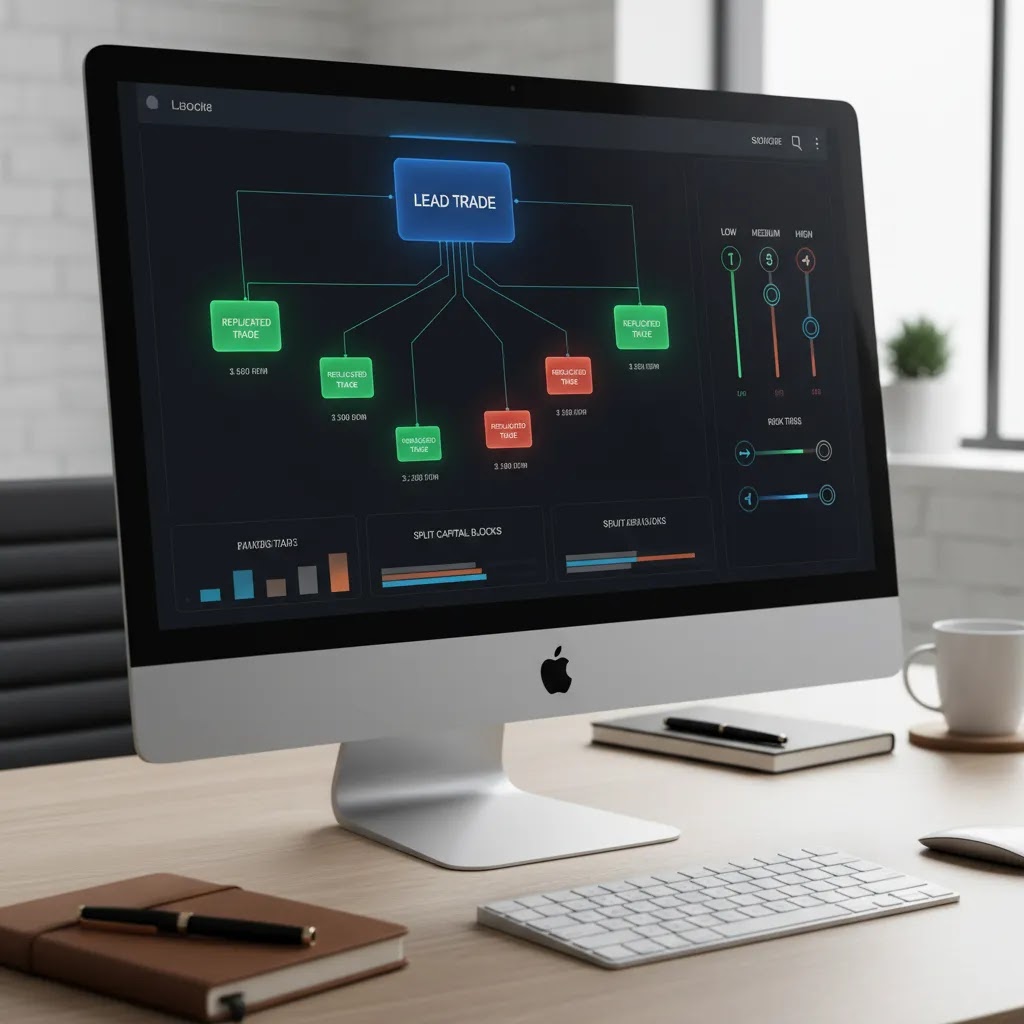
Binary options copy trading is a feature on some offshore binary options platforms that allows a follower's account to automatically mirror trades placed by a designated trader (the "leader," "master," or "signal provider"). When the leader places a trade, the broker's system attempts to place an equivalent trade in each follower's account.
Common variants of the same basic concept appear under different marketing labels:
- Copy trading — automatic replication of selected trader's positions
- Social trading — broader concept including trader feeds, performance leaderboards, and community features
- Mirror trading — typically a similar mechanism, sometimes with different account-level controls
- Follow traders — the same mechanism with a less specific label
The feature is offered by some offshore binary options brokers, with its commercial logic clear: copy trading increases trading frequency in follower accounts (driving the broker's revenue under the principal counterparty model), while also providing a marketing instrument that suggests a path to profitability for users who lack confidence in independent trading. Detailed treatment of the broker revenue structure at How Binary Options Brokers Make Money.
For UAE residents, the practical question is whether copy trading provides genuine analytical value or whether it primarily produces additional trading volume in accounts that would otherwise trade less frequently. The honest answer, supported by regulator findings on copy trading across various derivatives markets, is that copy trading typically produces outcomes consistent with the underlying retail-loss distribution rather than meaningfully improving it.

How the mechanics actually work
- Trader selection. The follower browses a leaderboard or feed showing self-reported performance metrics (total return, win rate, total trades, current followers, sometimes maximum drawdown).
- Allocation settings. The follower selects allocation parameters: fixed amount per trade, proportional sizing, percentage of balance, or multiplier (0.5×, 1×, 2× of leader's stake).
- Risk controls (where available). Maximum stake per copied trade, maximum number of open copied positions, daily loss limit, asset filters, auto-stop conditions.
- Execution. When the leader places a trade, the platform attempts to replicate it in each follower's account.
- Monitor and record. The follower receives confirmation of the trade and its outcome at expiry.
Why copy trading outcomes diverge from leader outcomes
A common assumption: if I copy a trader who earned 30% last month, I will earn approximately 30% this month. The assumption is broadly incorrect for several reasons.
- Self-reported leader performance is selection-biased. Leaderboards display traders who are currently performing well, by construction. The same leaderboard a month later will show different traders. Survivor bias and recency bias dominate.
- Past performance is not predictive at retail timeframes. Individual performance is dominated by variance over short timeframes. A 30% return over a month is statistically consistent with a wide range of underlying skill levels — including no skill plus favourable variance.
- Execution timing differences. Copy trades are placed slightly after leader trades. Even fractional-second timing differences can change the strike at order entry, especially on turbo expiries.
- Allocation model effects. Different allocation models produce different risk profiles than the leader's. Fixed amount per trade can be much more concentrated; multiplier above 1× amplifies losses proportionally.
- Payout differences across accounts. Some brokers offer different payout percentages to different account tiers. A leader's results at 88% payouts may not replicate at the follower's 80% payouts.
- Trade-skipping conditions. Trades may be skipped due to insufficient balance, asset unavailability, daily loss limit hits, or maximum position counts. Skipped trades are not random — they often correlate with periods of elevated market activity.
- Leader behaviour changes after gaining followers. Some leaders adjust trading after acquiring followers — increasing position sizes, taking more aggressive setups, or modifying style for visibility.
Across these divergence sources, the typical follower's realised returns are materially different from — and typically worse than — the leader's displayed returns. Regulator analyses of copy trading in regulated derivatives markets have generally found that follower outcomes track aggregate retail-loss patterns more closely than they track leader-specific outcomes.
Risk controls and what they actually achieve
- Maximum stake per copied trade. Useful if the leader uses variable position sizing. Caps individual trade losses but does not address aggregate frequency risk.
- Maximum number of open copied positions. Useful for limiting total exposure when the leader places many concurrent trades.
- Daily loss limit. Useful for capping cumulative losses. Effectiveness depends on whether the limit is set at a meaningful level (5–10% of account).
- Auto-stop after consecutive losses. Useful for breaking the cycle during prolonged drawdowns.
- Asset filters. Useful for excluding asset classes you do not understand.
- Pause and stop functions. Essential. Should be available immediately at any moment with no continued trades placed after pause is initiated.
The presence of risk controls is necessary but not sufficient. The substantive question is whether the follower will use the controls actively. A follower who sets initial controls and then leaves the account on autopilot through a leader's drawdown period typically experiences losses that the controls would have addressed if applied actively.
Counterparty considerations
Copy trading does not change the underlying counterparty structure. The follower is contracting with the broker for each copied trade, not with the leader.
- The leader is not financially responsible for follower outcomes. Leaders earn from broker affiliate-style arrangements (a portion of broker revenue from follower trades), not from follower outcomes. A leader whose followers lose substantially still earns from the broker's structural margin on those losses.
- Broker-level disputes still operate at the broker level. Withdrawal disputes, account suspensions, and platform issues are not affected by copy trading status.
- Leader identity is typically not verified. Most platforms display leader profile names and self-reported metrics without independent verification.
- Affiliate-style leader arrangements create alignment with brokers, not followers. The compound interest alignment — broker, leader, against follower — is the structural concern with copy trading at offshore binary options brokers.
For UAE residents: the leader providing the trades is not on your side of the financial relationship. Your interest in profitability is opposed by the structural interest of both broker and leader in trading volume.

Break-even mathematics still apply
The structural mathematics of binary options applies to copy trading identically. Even copying a trader with a strong win rate, the follower's profitability depends on whether the realised payouts produce a break-even threshold below the realised win rate.
Break-even win rate by realised payout
| Realised average payout on copied trades | Break-even win rate required |
|---|---|
| 70% | 58.8% |
| 75% | 57.1% |
| 80% | 55.6% |
| 85% | 54.1% |
| 90% | 52.6% |
A leader with a displayed 60% win rate at 85% payouts is profitable on those displayed conditions. A follower receiving 75% realised payouts on the same trades needs the leader's 60% win rate to translate intact. If execution timing differences reduce the follower's realised win rate to 55%, the follower is loss-making at 75% payouts even though the leader is profitable.
Track realised win rate and realised payout on copied trades from day one, not just account P&L. The data after 100–200 copied trades is sufficient to evaluate whether the copy approach is profitable at your specific realised conditions.
Pre-deposit verification framework for copy trading
- Verify the broker first. Copy trading at a broker with weak regulatory standing or documented withdrawal-refusal patterns is materially worse than independent trading at a stronger broker.
- Read the copy trading terms specifically. How are leader metrics calculated? Over what period? How is trade copy executed? What conditions cause copied trades to be skipped? What are the broker's discretion clauses?
- Check leader profile transparency. Is the leader identified beyond a profile name? Is the track record auditable? Is the trade history downloadable for independent analysis?
- Test in demo first. Verify mechanics work as advertised, test allocation settings, observe how delays affect outcomes, identify execution differences between leader and follower.
- Set strict initial parameters. Minimum allocation, tightest available risk controls, auto-stop conditions activated, maximum number of open positions limited.
- Track realised performance separately. Per-trade log including leader's stated trade, time of leader's vs. follower's trade, strikes, payouts, outcomes.
- Apply break-even discipline. If realised win rate at realised payouts produces a negative-expected-value position, the copy approach is loss-making regardless of leader's displayed performance.
Frequently asked questions
Is binary options copy trading appropriate for UAE residents new to the product? The empirical evidence does not support copy trading as a path to profitability for typical retail users. Across regulator analyses, follower outcomes typically track aggregate retail-loss distributions (74–80% loss rates per ASIC binary options data) rather than individual leader outcomes.
Does copy trading reduce risk compared to independent trading? No. The risk profile is determined by the same structural factors as independent trading, plus additional risks specific to copy trading (execution timing, leader behaviour changes, trade-skipping selection effects).
Can leaders be trusted based on their displayed performance? Displayed performance is self-reported by the platform and typically reflects current leaderboard ranking rather than long-term sustainable performance. Survivor bias and recency bias mean leaderboard contents shift materially month over month.
What is the difference between copy trading and signals? Copy trading is automated — the broker's platform places trades when the leader places trades. Signals are advisory — a service notifies you of suggested trades and you decide whether to act. See Binary Options Signals.
Should I select a broker based on copy trading features? No. Broker quality factors that matter more for outcomes — regulatory standing, withdrawal reliability, payout consistency, customer support — should drive selection.
Is copy trading the same as having a money manager? No. A money manager operates under fiduciary obligations, regulatory oversight, and contractual responsibility for client outcomes. A binary options copy trading leader has none of these.
What should I do if my copy trading account is losing money? Pause copying immediately. Do not deposit additional capital to "catch up." Document the divergence between displayed leader performance and follower outcomes. Compute realised win rate against the break-even threshold.
Will the new UAE CMA framework affect copy trading? The CMA framework does not authorise binary options brokers for UAE retail clients, including those offering copy trading features. As of April 2026, copy trading remains accessible at offshore brokers but without UAE regulatory protections.
Final risk warning
Binary options copy trading replicates trades from selected leader accounts into follower accounts at the same broker, operating within the same offshore broker structure as independent binary options trading. Documented retail-loss rates of 74–80% across regulator-reviewed populations apply to copy trading and independent trading similarly. UAE residents trading binary options through offshore platforms are not protected by any UAE-authorised investor compensation scheme. Capital is at risk and total loss of deposit is a frequent outcome.
Related reading
About the Author
Braden Chase is a trading specialist and former research specialist at Forex.com. He writes about market mechanics, trading instruments, and the regulatory landscape to help readers research financial markets with a clearer understanding of risk. Braden has previously served as a registered commodity futures representative for domestic and internationally-regulated brokerages. Articles are educational analysis and do not constitute investment advice. Binary options are high-risk speculative instruments and are not regulated in the UAE.