
Binary Options Deposit Methods: Cards, E-Wallets, and Cryptocurrency Compared (2026)


Capital is at risk. Deposit method selection materially affects what recovery options are available if disputes arise. This article documents the practical differences between deposit methods relevant to UAE residents, with focus on chargeback mechanisms, recovery viability, and verification implications.
Affiliate disclosure
BinaryOptionsAE may receive affiliate commissions when readers click outbound broker links and open accounts. Compensation does not influence the operational facts, payment-processor references, or recovery-mechanism analysis cited below. All references to specific payment methods are sourced from the relevant operator's published terms.
Risk warning
The UAE Capital Market Authority (CMA, successor to the SCA from 1 January 2026 under Federal Decree-Laws 32 and 33 of 2025), the Dubai Financial Services Authority (DFSA), and the Financial Services Regulatory Authority (FSRA) of ADGM have not authorised any binary options broker for retail clients. Deposit method selection does not change the underlying broker risk; it changes only the recovery options available if disputes occur. UAE residents should approach all offshore binary options deposits as potentially non-recoverable.
Why deposit method selection matters
Most UAE residents researching binary options brokers focus on payout percentages, platform features, and broker reputation. Deposit method selection is typically treated as a convenience question: which option is fastest, which is most familiar, which is supported. This is incomplete.
The substantive consideration is what happens if the deposit produces a loss requiring recovery. Different payment methods have substantially different recovery profiles:
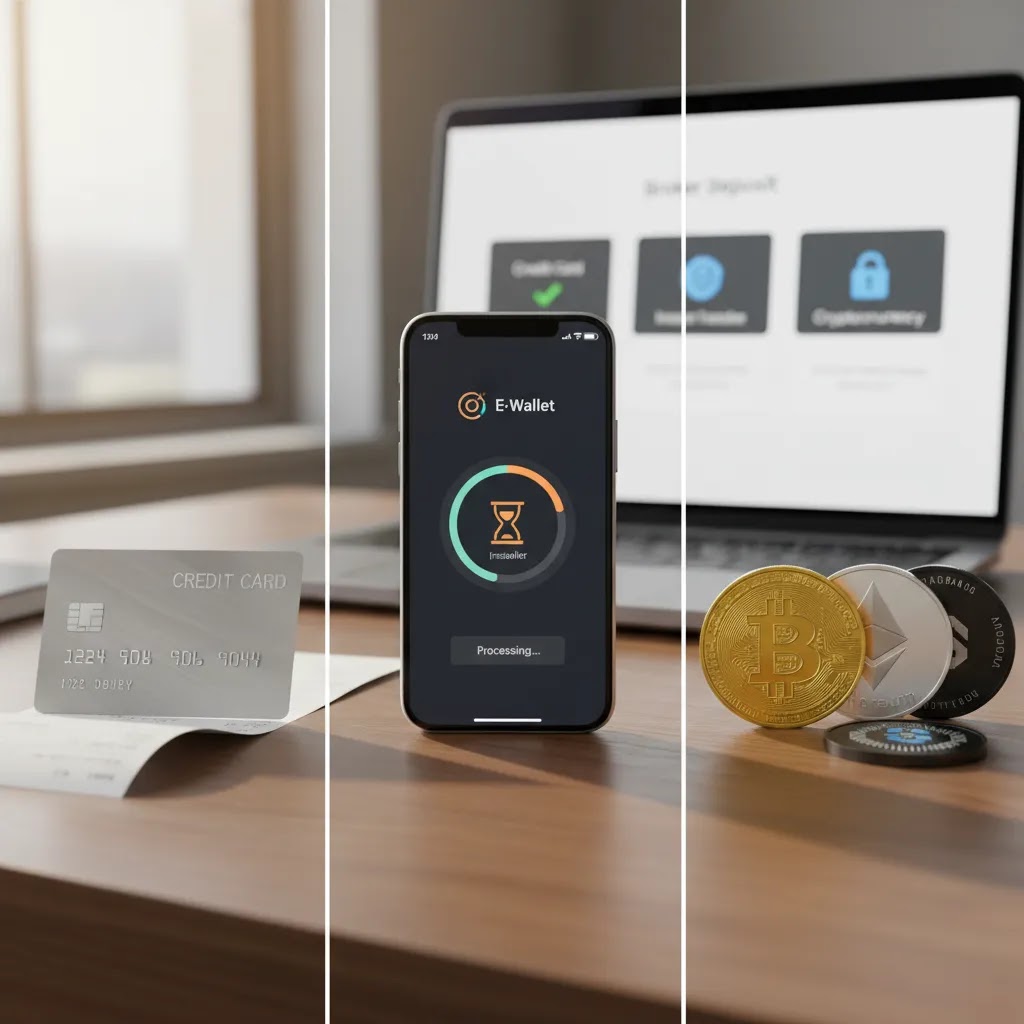
- Card deposits (Visa, Mastercard, Amex) offer chargeback rights through the issuing bank, typically within 120 days of transaction. The chargeback process produces actual recovery in a meaningful fraction of broker-fraud cases.
- E-wallet deposits (Skrill, Neteller, PayPal) offer dispute mechanisms through the wallet operator, with varying effectiveness depending on the operator and case specifics.
- Bank transfer deposits generally have no chargeback mechanism after a brief processing window. Recovery typically requires legal action.
- Cryptocurrency deposits have no recovery mechanism after blockchain confirmation. Funds are effectively final.
The asymmetry is material. A UAE resident depositing $5,000 via card to a broker that subsequently refuses withdrawal has a chargeback claim that may recover the funds. The same resident depositing $5,000 via cryptocurrency to the same broker has no equivalent route. The deposit method selection at the front end determines the recovery options at the back end.
This matters because withdrawal disputes are common in the offshore binary options sector. The expected case for a UAE resident depositing with an offshore binary options broker is not that disputes will not occur, but that disputes may occur and the deposit method determines what response is available.
Card deposits (Visa, Mastercard, American Express)
Card deposits remain the most common funding method for offshore binary options brokers and offer the strongest recovery profile.
Mechanics. The broker accepts the card, charges the deposit, and credits the trader's account. The card transaction appears on the issuing bank's statement, typically as a generic merchant code that does not always identify the broker by recognisable name.
Chargeback rights. Visa and Mastercard chargeback rules permit cardholders to dispute transactions for specified reasons within specified timeframes. The most relevant reason codes for binary options disputes are typically "services not rendered" or "merchandise not received". The chargeback window for most Visa/Mastercard claims is 120 days from transaction or expected service delivery, with extensions available in specific circumstances.
The chargeback process:
- Cardholder contacts issuing bank to dispute the transaction
- Issuing bank requests evidence (transaction records, communication with merchant, evidence of services not rendered)
- Bank initiates chargeback through Visa/Mastercard infrastructure
- Merchant has opportunity to respond with evidence of legitimate transaction
- Card scheme rules on disputes
Practical effectiveness for UAE residents. Chargeback effectiveness depends on:
- The cardholder's documentation of the dispute basis
- The merchant's response (offshore brokers often do not contest chargebacks effectively, particularly when the underlying transaction terms were ambiguous)
- The issuing bank's willingness to process chargebacks in the binary options category (some UAE banks may decline to process chargebacks for trading-related disputes)
Limitations. Chargebacks are not a guaranteed recovery mechanism. The 120-day window is strict. Cardholders should not rely on chargeback as a substitute for due diligence; rather, chargeback is a fallback for cases where due diligence proves inadequate.
For UAE residents: Visa and Mastercard deposits remain the single most defensible deposit method for offshore binary options brokers. Where alternatives exist, cards generally provide the best recovery profile.
E-wallet deposits (Skrill, Neteller, PayPal)
E-wallets — primarily Skrill, Neteller, and PayPal — provide an intermediate position between cards and crypto on the recovery profile.
Mechanics. The trader funds the e-wallet (typically with a card or bank transfer), then pays the broker from the e-wallet. The transaction appears in the e-wallet's transaction history, often with the broker identified by name.
Dispute mechanisms. Each e-wallet operates its own dispute process:
- PayPal Buyer Protection covers eligible transactions, with an extended dispute window and a structured resolution process. PayPal's coverage of binary options transactions varies; the trading category is not always within standard buyer protection scope.
- Skrill offers limited dispute mechanisms, primarily focused on fraud and unauthorised transactions rather than service-quality disputes.
- Neteller similarly offers limited dispute mechanisms focused on unauthorised use rather than merchant disputes.
Verification implications. E-wallets require their own KYC verification, separate from the broker's KYC. Some brokers also require verification that the e-wallet account name matches the broker account name. UAE residents should expect to provide:
- Photo ID for the e-wallet
- Proof of address for the e-wallet
- (For deposits to brokers) Screenshots showing the e-wallet account name matching the broker account
Practical effectiveness. E-wallet disputes are typically less effective than card chargebacks for binary options disputes. The wallet operator has limited insight into whether services were rendered, and the trading category does not fit comfortably within consumer-protection frameworks designed for retail goods.
For UAE residents: E-wallets are convenient but offer materially weaker recovery than cards. Where the choice is between an e-wallet and a card, cards are generally preferable for recovery purposes. E-wallets are appropriate where they are the only supported method or where their convenience outweighs the recovery differential.
Bank transfer deposits
Bank transfer (wire transfer) deposits offer reliability and typically high transaction limits but limited recovery options.
Mechanics. The trader initiates a wire transfer from their UAE bank to the broker's nominated bank account. The transfer typically takes 1-3 business days to complete and may incur fees from both the sending bank and intermediary banks in the routing path (typically $15-30 per transfer).
Recovery options. Bank transfers have no chargeback mechanism analogous to card payments. Recovery options are limited to:
- Recall of the transfer during the brief processing window before the receiving bank releases funds, typically within hours of initiation. Once the receiving bank credits the funds, recall is generally not possible.
- Legal action in the broker's jurisdiction. This requires UAE-licensed legal counsel coordinating with counsel in the broker's jurisdiction, and is typically expensive and uncertain.
- Bank-side fraud reporting in cases of fraudulent transfer instructions (e.g., compromised account credentials), which is a different category from broker-fraud cases.
Practical effectiveness. Bank transfers to offshore broker accounts are essentially final upon receipt by the broker's bank. The transfer becomes a debt of the broker to the trader, recoverable only through the broker's voluntary action or legal process.
For UAE residents: Bank transfers are appropriate for traders depositing larger amounts with brokers they have already verified through smaller test deposits via card. Bank transfer should not be the first deposit method to a new broker; the absence of meaningful recovery options makes the upfront due diligence requirement substantially higher.
Practical note on intermediary fees. International bank transfers from UAE banks to offshore broker accounts often incur intermediary bank fees that are not visible on the deposit confirmation. The broker may credit the trader's account with the amount they actually receive, which can be $20-50 less than the amount sent. This shrinkage is normal but should be expected; UAE residents should not assume the full amount sent will be credited.
Cryptocurrency deposits
Cryptocurrency deposits — primarily Bitcoin, Ethereum, and stablecoins (USDT, USDC) — have become common in the offshore binary options sector, particularly with brokers that have lost access to card processing or e-wallet support.
Mechanics. The trader sends cryptocurrency from their wallet (exchange-hosted or self-custodied) to the broker's deposit address. The transaction is confirmed on the relevant blockchain, typically within 10-30 minutes for Bitcoin, 1-5 minutes for Ethereum, and seconds to minutes for stablecoin chains.
Recovery options. Cryptocurrency deposits have no recovery mechanism after blockchain confirmation. Once a transaction is confirmed on the blockchain, it is final. There is no chargeback, no dispute mechanism, no operator able to reverse the transaction. The recipient's wallet now controls the cryptocurrency.
Practical implications. A UAE resident sending cryptocurrency to an offshore broker has, in functional terms, transferred ownership of the cryptocurrency to the broker. Any subsequent recovery depends entirely on the broker's voluntary cooperation. Where the broker cooperates, withdrawals process normally. Where the broker does not — for any reason, including the broker disappearing, refusing withdrawals, or invoking spurious account-freeze provisions — the cryptocurrency is effectively lost.
Why brokers prefer cryptocurrency. From the broker's perspective, cryptocurrency deposits eliminate chargeback risk, are not subject to the AML/KYC oversight of card processors and bank rails, and provide irreversible settlement. Brokers that have been delisted by card processors due to high chargeback rates often migrate to cryptocurrency-only or cryptocurrency-preferred deposits.
The pattern indicator. Brokers that strongly prefer cryptocurrency deposits — for example, by offering large crypto-deposit bonuses, charging extra fees on card deposits, or restricting payment methods to crypto entirely — are signalling the type of operator they are. The signal is not that crypto-accepting brokers are necessarily fraudulent, but that brokers preferentially favouring crypto over card deposits are typically operating in a regulatory and risk environment where chargeback liability is material to their business.
For UAE residents: Cryptocurrency deposits to offshore binary options brokers should be treated as essentially non-recoverable in the event of disputes. The amounts deposited via cryptocurrency should be amounts the resident is prepared to lose entirely. Where alternatives exist (card, e-wallet), they are generally preferable for the recovery profile alone.
What about PayPal specifically?
PayPal is widely searched in connection with binary options deposits because of its retail familiarity and Buyer Protection framework. The reality is that PayPal support for binary options brokers is limited:
Limited acceptance. Most major offshore binary options brokers do not accept PayPal deposits. PayPal's terms of service include restrictions on certain trading categories, and PayPal has historically declined to process payments for many binary options operators.
Where accepted, dispute coverage is uncertain. Even where a broker accepts PayPal, PayPal Buyer Protection coverage of binary options transactions is not guaranteed. Trading-related disputes do not fit comfortably within Buyer Protection's framework, which is designed primarily for retail goods.
Practical implication for UAE residents. Marketing claims of PayPal acceptance should be verified directly in the broker's cashier before depositing. UAE residents should not deposit with the assumption that PayPal Buyer Protection provides the same coverage for binary options trades that it provides for retail purchases.
Method-specific minimums and limits
Most brokers impose payment-method-specific minimum and maximum deposit limits. Typical structures:
Method-specific limits
| Method | Typical minimum | Typical maximum (per transaction) |
|---|---|---|
| Card (Visa/Mastercard) | $10-50 | $5,000-10,000 |
| Skrill / Neteller | $10-50 | $10,000+ |
| Bank transfer | $50-100 | No effective cap (subject to bank limits) |
| Cryptocurrency | $10-50 | Effectively unlimited |
These figures are illustrative; the actual figures should be verified in the broker's cashier. UAE residents should also check:
- Currency conversion implications. Most offshore brokers operate in USD; UAE-residents depositing in AED via UAE banks will encounter conversion fees (typically 1-3% above mid-market) at the bank's rate.
- Daily and monthly limits. Some brokers cap aggregate deposits per day or per month, which may matter for traders intending larger initial funding.
- First-deposit minimums. Some brokers require larger first deposits than subsequent deposits, often as part of a bonus-eligibility structure.
Verification implications
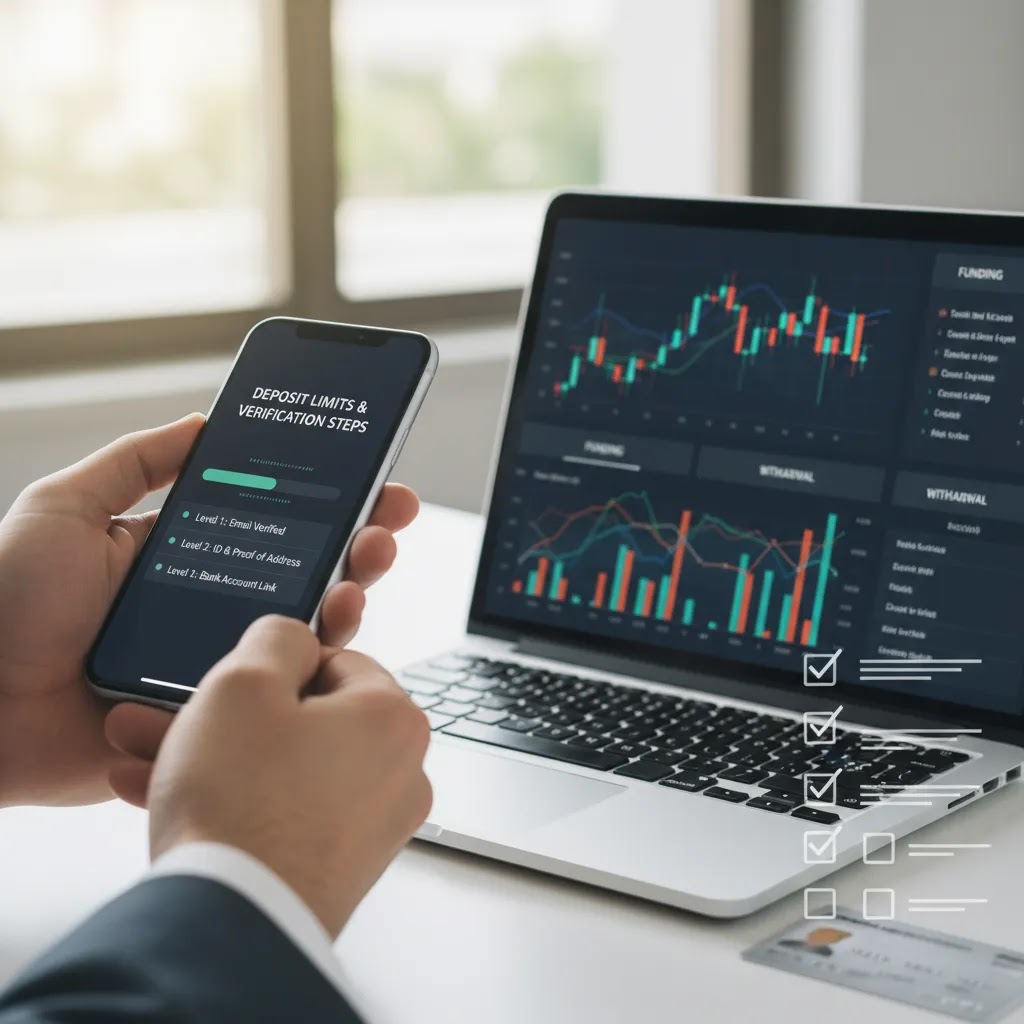
KYC verification typically applies at withdrawal rather than at deposit, but deposit method selection has verification implications:
Card deposits typically require verification of the card on first withdrawal — usually photos of front and back of the card with middle digits hidden. Some brokers require the card name to match the broker account name.
E-wallet deposits typically require verification of the e-wallet account, including matching the wallet account name to the broker account name. Some brokers require screenshots of the wallet's transaction history showing the deposit.
Bank transfer deposits typically require verification that the bank account name matches the broker account name. Some brokers require recent bank statements.
Cryptocurrency deposits typically have lighter verification at deposit time but may require source-of-funds documentation at withdrawal time, particularly for larger amounts. The "lighter at deposit, heavier at withdrawal" asymmetry is a documented withdrawal-friction pattern.
UAE residents should ensure the deposit method is registered in the same name as the broker account. Mismatches (e.g., depositing from a spouse's card, using a workplace e-wallet) are common sources of withdrawal disputes.
A practical framework for UAE residents
For UAE residents weighing deposit method selection:
For first deposits to a new broker:
- Use a card if available. The chargeback profile is the strongest recovery mechanism.
- Keep the first deposit modest (e.g., $200-500). The first deposit is effectively a test of the broker.
- Avoid cryptocurrency for the first deposit. The non-recoverability of crypto compounds the risk of an unverified broker.
- Avoid bank transfer for the first deposit. The absence of chargeback rights compounds the risk before the broker has been validated.
For subsequent deposits after the broker is validated:
- Card remains the preferred method for recovery profile.
- E-wallets are acceptable where convenient and cards are unavailable.
- Bank transfers are appropriate for larger amounts where the broker has been validated through prior withdrawal experience.
- Cryptocurrency is acceptable where the trader is comfortable with the non-recoverability profile and the broker is well-validated.
For brokers that strongly prefer or require cryptocurrency:
- The deposit-method preference is itself a signal. Brokers that have lost card processing access typically have lost it for reasons (chargeback rates, regulatory action, operator profile).
- UAE residents should weight the cryptocurrency preference as a negative factor in broker evaluation.
For all deposit decisions:
- Validate the broker before depositing. Detailed framework at Regulated Brokers and Binary Options Blacklist.
- Test withdrawal before scaling. A small test withdrawal validates the entire process.
- Document everything. Screenshots of deposit confirmations, account states, and communication form the evidentiary basis for any subsequent dispute.
Frequently asked questions
What is the safest deposit method for binary options?
Card deposits (Visa, Mastercard) provide the strongest recovery profile through chargeback rights, typically within a 120-day window. They are not "safe" in the sense of guaranteeing recovery, but they offer materially better recovery options than alternatives. UAE residents prioritising downside protection should generally prefer cards.
Can I get my money back from a binary options broker through chargeback?
Possibly. Chargeback effectiveness depends on the dispute basis (services not rendered is the typical applicable reason code for binary options), the trader's documentation, the issuing bank's willingness to process the chargeback in this category, and the broker's response. Chargebacks within the 120-day window are recoverable in a meaningful fraction of broker-fraud cases. Detailed treatment at Recover Money From Binary Options.
Why do some brokers prefer cryptocurrency deposits?
From the broker's perspective, cryptocurrency eliminates chargeback liability, is not subject to the same AML/KYC oversight as card processors and banks, and provides irreversible settlement. Brokers that have lost access to card processing — typically due to high chargeback rates — often migrate to cryptocurrency. The broker's preference for crypto is informative about the broker's regulatory and operational profile.
Is PayPal accepted for binary options deposits?
Most major offshore binary options brokers do not accept PayPal. PayPal's terms restrict certain trading categories, and PayPal has historically declined to process payments for many binary options operators. Where accepted, PayPal Buyer Protection coverage of binary options transactions is uncertain — the trading category does not fit comfortably within consumer-protection frameworks designed for retail goods.
Can I withdraw to a different method than I deposited with?
Many brokers require withdrawals to return to the original deposit method up to the deposited amount, with profits available via alternative methods. This is a standard AML-compliance practice. UAE residents should confirm the broker's specific policy in the cashier section before depositing.
What about depositing in AED versus USD?
Most offshore brokers operate in USD. UAE residents depositing in AED encounter currency conversion at their bank's or processor's rate, typically 1-3% above mid-market. Some UAE banks may charge additional fees on USD-denominated transactions. The aggregate currency-conversion cost over multiple deposits and withdrawals can be material; UAE residents should factor this into their decision.
Is cryptocurrency really non-recoverable?
Yes. Once a cryptocurrency transaction is confirmed on the blockchain, it is final. There is no chargeback mechanism, no dispute resolution process, no central operator able to reverse the transaction. The recipient's wallet has functional control of the cryptocurrency. Recovery depends entirely on the recipient's voluntary cooperation, which a fraudulent or non-cooperative broker will not provide.
What about depositing through a friend's or family member's payment method?
Most brokers require the deposit method to be registered in the same name as the broker account. Mismatches are a documented source of withdrawal disputes — the broker may freeze the account at withdrawal time citing identity-verification issues, even where the original deposit was processed without question. UAE residents should deposit only with payment methods registered in their own name.
My broker only accepts cryptocurrency. Should I deposit?
The exclusive cryptocurrency preference is a signal about the broker's profile. UAE residents should treat it as a negative factor in broker evaluation, particularly for first deposits. Where the broker is otherwise well-validated through other indicators (regulator standing, complaint patterns, withdrawal track record observable through other traders' experiences), cryptocurrency may be acceptable for amounts the resident is prepared to lose entirely.
How much should I deposit on first try?
Sufficient to test the broker's process, modest enough that loss is acceptable. Typical first deposits in the $200-500 range allow meaningful platform testing while limiting exposure to validation risk. UAE residents should not scale deposits until the broker has been validated through actual withdrawal experience.
What about brokers that offer deposit bonuses?
Bonus terms commonly impose turnover requirements that affect withdrawability of the deposit, the bonus, and trading profits. Detailed treatment at No-Deposit Bonuses. For first deposits, declining bonuses entirely is often the cleaner choice — an unencumbered balance is more flexible than a bonused balance with restrictions.
Are deposit fees ever legitimate?
Some are: payment processor fees passed through by the broker, currency conversion spreads, intermediary bank fees on international transfers. These should be disclosed in the broker's fee schedule. Fees that are not legitimate include "verification fees" charged to release withdrawals, "tax payments" demanded outside the platform's normal payment flow, and "release fees" required to unlock bonus profits — these are scam patterns regardless of the framing.
Will the new UAE CMA framework change deposit-method protections?
The CMA framework (effective 1 January 2026 under FDL 32 and 33) does not directly address payment-method protections for retail consumers using offshore brokers. The framework's expanded scope under FDL 33 Article 2 over persons targeting UAE clients may eventually produce CMA-led enforcement actions, but this is regulatory development that will become clearer over time. The deposit-method analysis above remains applicable in the meantime.
Final risk warning
Binary options are speculative products with a high probability of loss. Deposit method selection does not change this underlying risk; it changes only the recovery options available if disputes occur. UAE residents trading binary options through offshore platforms are not protected by any UAE-authorised investor compensation scheme. The Capital Market Authority (effective 1 January 2026), the Dubai Financial Services Authority, and the Financial Services Regulatory Authority have not authorised any binary options broker for UAE retail clients. UAE residents should approach all offshore binary options deposits as potentially non-recoverable, with deposit method selection providing only marginal mitigation. Capital is at risk and total loss of deposit is a frequent outcome.
This article is informational only and does not constitute legal advice or financial advice.
Related reading
About the Author
Braden Chase is a trading specialist and former research specialist at Forex.com. He writes about market mechanics, trading instruments, and the regulatory landscape to help readers research financial markets with a clearer understanding of risk. Braden has previously served as a registered commodity futures representative for domestic and internationally-regulated brokerages. Articles are educational analysis and do not constitute investment advice. Binary options are high-risk speculative instruments and are not regulated in the UAE.