
Binary Options in the United States: CFTC Framework, Nadex Wind-Down, and Retail Position (2026)


Capital is at risk. This article documents the binary options regulatory framework in the United States as of April 2026, including the December 2025 retirement of the Nadex binary options product. UAE residents are advised that the US regulatory framework is restrictive and most US-domiciled venues do not accept UAE retail clients.
Affiliate disclosure
BinaryOptionsAE may receive affiliate commissions when readers click outbound broker links and open accounts. Compensation does not influence the regulatory facts, enforcement records, or legislative references cited below. All references are sourced from the named US regulators' public records or the relevant legislation.
Risk warning
The UAE Capital Market Authority (CMA, successor to the SCA from 1 January 2026 under Federal Decree-Laws 32 and 33 of 2025), the Dubai Financial Services Authority (DFSA), and the Financial Services Regulatory Authority (FSRA) of ADGM have not authorised any binary options broker for retail clients. The United States operates a restrictive framework in which binary options can lawfully be offered to retail clients only through CFTC-regulated Designated Contract Markets (DCMs); most offshore binary options brokers do not accept US retail clients.
Why this page exists for UAE residents
UAE residents typically search "binary options USA" for one of three reasons:
- Identifying which brokers serve US clients — usually because the user has heard a US-regulated broker would be safer than an offshore alternative
- Understanding US restrictions — usually because the user is trying to understand why a particular broker excludes US residents
- Cross-border situations — US persons resident in the UAE, or UAE residents with US connections, who need to understand how US rules might apply to them
This article addresses all three, with the principal substantive answer being that the US framework is among the most restrictive globally; that UAE residents typically cannot access US-domiciled venues; and that the US framework's restrictiveness reflects regulatory analysis of the same retail-harm patterns that drove the EEA, UK, and Australian retail prohibitions.
The US regulatory framework
US retail access to binary options is governed by the Commodity Futures Trading Commission (CFTC), which has jurisdiction over derivatives markets, and to a lesser extent by the Securities and Exchange Commission (SEC) for binary options on securities. The framework's principal features:
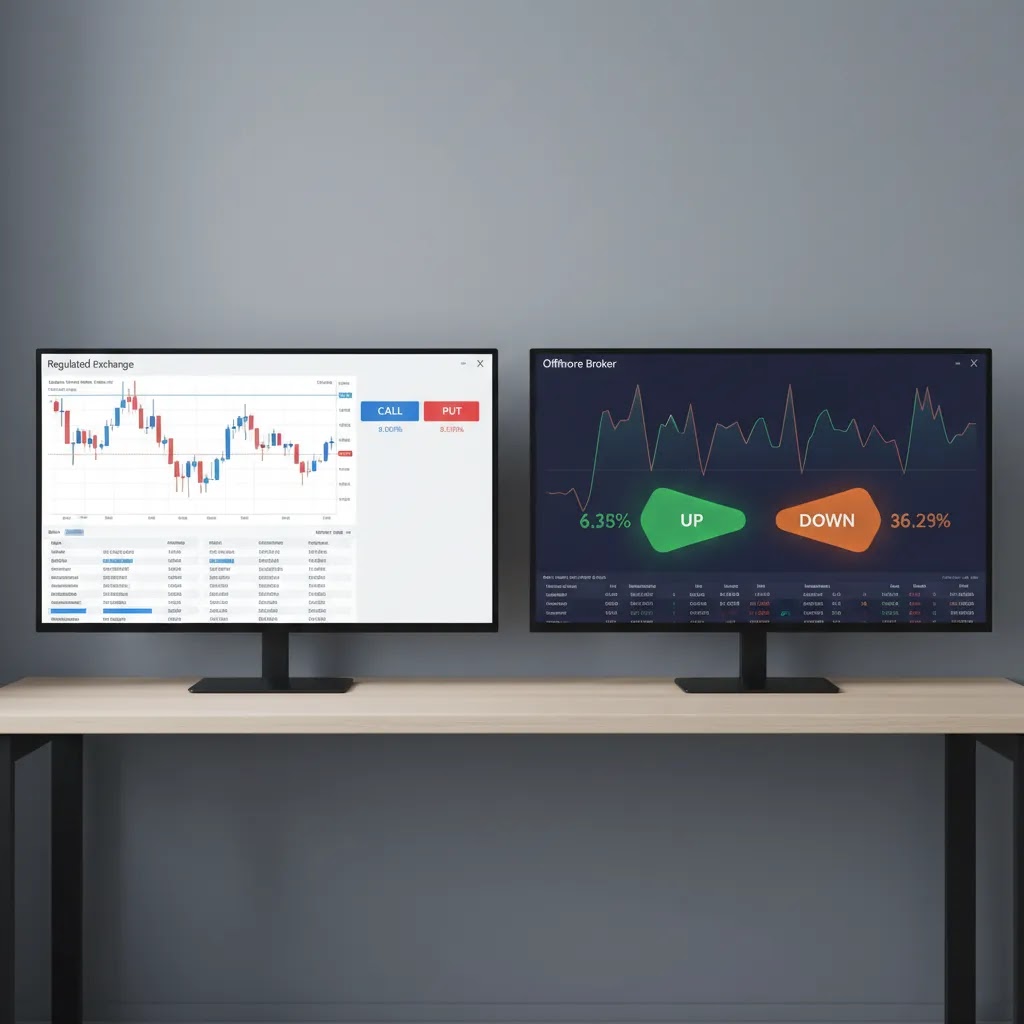
Binary options can lawfully be offered to US retail clients only through CFTC-regulated Designated Contract Markets (DCMs). A DCM is an exchange that has been registered with the CFTC and meets specific operational, compliance, and supervisory requirements. The DCM model differs from the OTC broker model used by most offshore binary options operators in several material ways:
- The exchange operates a transparent order book with multiple market participants
- Pricing is determined by market supply and demand, not by the broker as counterparty
- The exchange is supervised by the CFTC, with enforcement powers
- Members of the exchange are subject to clearing and capital requirements
- Disputes are resolved through formal exchange and CFTC processes rather than the broker's internal procedures
This is a fundamentally different market structure from the offshore retail binary options brokers serving UAE residents.
Offshore binary options brokers cannot lawfully solicit US retail clients without proper registration. The CFTC has pursued enforcement actions against offshore operators marketing to US retail clients without DCM registration. Most offshore binary options brokers respond to this enforcement environment by excluding US clients entirely, blocking US-IP registrations, and rejecting US identity documents during KYC.
The CFTC and SEC have published multiple investor alerts about binary options fraud. The agencies' alerts cover withdrawal refusal, manipulated trading software, and identity-theft patterns commonly associated with the offshore binary options sector.
The FBI's 2017 binary options fraud advisory estimated annual global losses at approximately $10 billion. This advisory, while not a regulatory action, reflects US law enforcement's assessment of the sector and is consistent with the CFTC and SEC enforcement focus.
The Nadex transition
For most of the past two decades, the principal US-domiciled binary options venue was Nadex (the North American Derivatives Exchange), a CFTC-regulated DCM (registration 34536). Nadex offered exchange-traded binary options on US and international markets to US retail clients within the CFTC framework.
On 20 December 2025, Nadex retired its binary options product in connection with its transition to Crypto.com. The wind-down of the Nadex binary options offering means there is no longer an active US-domiciled binary options venue accepting retail clients. The implications:
For US retail clients: US retail traders who were active on Nadex must either transition to alternative products (CFTC-regulated futures, conventional options) or to non-US venues. The latter is generally not lawfully available to US retail clients given the CFTC framework.
For UAE residents: Nadex did not generally accept UAE retail clients during its operating period. Its closure does not change the practical position for UAE residents, who never had meaningful access. The closure does, however, eliminate the principal example of "regulated US binary options" that UAE residents might cite when comparing US to offshore alternatives.
For the global market: The closure removes one of the few venues globally that operated retail binary options under tier-one regulatory supervision. The remaining global retail binary options market is now almost entirely offshore-domiciled, OTC-broker-operated, and outside tier-one supervision.
Why the US framework is so restrictive
The US framework's restrictiveness reflects regulatory analysis of patterns that have produced retail harm globally:
The product structure issues. Binary options have an all-or-nothing fixed payoff with a structure that produces negative expected returns for retail clients at typical retail payout levels, as documented in detail at Can You Make Money From Binary Options?.
The marketing pattern. The retail binary options sector has been characterised by misleading representations, fake regulatory claims, and aggressive sales practices on a scale that has prompted product-level prohibitions in the EEA, UK, and Australia.
The fraud incidence. The FBI's 2017 advisory estimating $10 billion in annual global losses to binary options fraud reflects the volume of fraud activity tracked by US law enforcement.
The cross-border enforcement difficulty. Offshore operators targeting US retail clients are difficult to pursue across borders. The US response — restricting lawful retail access to CFTC-supervised DCMs — was a structural response to this enforcement reality.
The US position is therefore not idiosyncratic. It is one of several major-jurisdiction responses to the same set of underlying patterns.
Implications for UAE residents
UAE residents generally cannot access US-domiciled binary options venues. Nadex did not historically accept UAE retail clients, and with its binary options product retired on 20 December 2025, there is no active US-domiciled retail binary options venue to access regardless. UAE residents searching "best US binary options brokers" will not find a viable US retail venue.
Offshore brokers that exclude US clients are not necessarily safer than brokers that exclude no one. Some UAE residents reason that "if a broker excludes US clients, it must be cautious about regulation, which is reassuring." This reasoning is misleading. Offshore brokers excluding US clients typically do so to avoid CFTC enforcement risk, not because of broader regulatory caution. The same operators may freely accept clients from jurisdictions with less aggressive cross-border enforcement (including the UAE).
The US framework's existence is informative for UAE-resident decisions. The fact that the US — a jurisdiction with substantial retail trading volume in many financial products — has restricted retail binary options to a narrowly-defined exchange-traded venue, and that the principal such venue has now retired its binary options product, reflects regulatory judgment about retail outcomes in this product. UAE residents should factor this into their assessment alongside the EEA, UK, and Australian regulatory positions.
US-person UAE residents should consult US tax and compliance counsel. US persons (citizens or green-card holders) resident in the UAE are subject to US extraterritorial jurisdiction in some respects, including tax filing obligations and potentially OFAC compliance. Binary options trading by US persons may have additional regulatory implications beyond what applies to non-US UAE residents. US-licensed legal counsel is appropriate for individual situations.
What "regulated by US authorities" actually requires
Some offshore binary options brokers cite "international" or "global" regulatory affiliations that include US-sounding names or claim "compliance with US standards". UAE residents should distinguish:
CFTC registration. A genuine CFTC-regulated entity appears on the CFTC's public register. The principal categories relevant to binary options include Designated Contract Markets (DCMs), Swap Execution Facilities (SEFs), and Futures Commission Merchants (FCMs). A broker claiming CFTC regulation should be verifiable by name on cftc.gov.
SEC registration. A genuine SEC-regulated entity (broker-dealer, investment adviser, exchange) appears on the SEC's public register. Verification is at sec.gov.
FINRA membership. FINRA is a self-regulatory organisation (SRO) for broker-dealers. FINRA membership for a broker-dealer is verifiable on FINRA's public BrokerCheck.
State-level securities regulators. US states have their own securities regulators with jurisdiction over certain activities. These do not generally regulate binary options activity, which is a federal CFTC matter for retail derivatives.
Generic claims. Phrases such as "regulated internationally", "globally compliant", "approved by US standards", and similar are not specific regulatory references and should not be treated as evidence of US regulatory oversight. UAE residents should ask for the specific US regulator and verifiable registration number.
A broker that cannot provide verifiable CFTC, SEC, or FINRA registration is not subject to US regulatory oversight regardless of its marketing language.
Frequently asked questions
Are binary options legal in the United States?
Binary options can lawfully be offered to US retail clients through CFTC-regulated Designated Contract Markets (DCMs). The principal US-domiciled binary options venue, Nadex, retired its binary options product on 20 December 2025. As of April 2026, there is no active US-domiciled binary options venue accepting retail clients. Offshore binary options brokers cannot lawfully solicit US retail clients without proper registration.
Why did Nadex retire its binary options product?
Nadex retired its binary options product on 20 December 2025 in connection with its transition to Crypto.com. The wind-down was a corporate decision rather than a regulatory action.
Can UAE residents access US binary options venues?
Generally no. Nadex did not historically accept UAE retail clients, and its binary options product is no longer offered. The remaining CFTC-regulated US derivatives venues do not generally offer retail binary options to international clients.
Can US persons resident in the UAE trade binary options through offshore brokers?
Most offshore brokers exclude US persons (citizens and green-card holders) regardless of country of residence. A US person resident in the UAE registering with an offshore broker would typically be blocked at KYC if US documentation is provided, or would be in breach of broker terms if non-US documentation is provided. US-licensed counsel is appropriate for individual situations.
Is the CFTC the only US regulator of binary options?
The CFTC has primary jurisdiction over binary options as derivatives. The SEC has jurisdiction over binary options on securities. The FBI conducts criminal investigations of binary options fraud. State-level regulators have limited involvement. For practical purposes, "US regulation of binary options" generally refers to the CFTC framework.
What does it mean if a broker says it follows "US standards"?
The phrase is generally marketing language without specific regulatory meaning. UAE residents should ask for the specific US regulator, verifiable registration number, and the activities authorised. Generic compliance claims should not be treated as evidence of US regulatory oversight.
Is offshore binary options trading by US persons illegal?
Use of unregistered offshore binary options brokers by US retail clients raises CFTC enforcement issues for the broker (which is operating without registration) and potentially compliance issues for the client. The specific legal exposure for individual US-person clients is fact-dependent and requires US-licensed counsel for individual situations.
Was the FBI 2017 advisory actually about US victims, or global?
The FBI's March 2017 advisory addressed binary options fraud as a global phenomenon, with the $10 billion estimate reflecting estimated annual worldwide losses. The advisory specifically called for victims worldwide to contact FBI field offices or the Internet Crime Complaint Center, indicating the FBI was investigating beyond just US-victim cases. The advisory's frame — that binary options operators "are only interested in one thing — taking your money" — reflects US law enforcement's assessment of the sector globally.
What happened to Nadex's clients when binary options were retired?
Nadex clients were transitioned to alternative products. The specific arrangements for client funds and existing positions at the time of the wind-down were handled under the CFTC's exchange supervision. Detailed information is available from Nadex (now operating as part of Crypto.com) and from CFTC public records.
Will binary options return to the US retail market?
This is a matter of regulatory policy that the article cannot predict. The CFTC framework permits binary options on properly registered DCMs; whether new venues will register specifically for binary options retail offerings depends on commercial decisions by potential operators and on the CFTC's evolving position on retail product oversight.
What are the alternatives to binary options for retail directional speculation?
CFTC-regulated retail futures, conventional exchange-traded options, and (for traders meeting suitability requirements) more complex derivatives are available through CFTC-regulated brokers. These products are not directly comparable to binary options but cover similar use cases (directional speculation on price movements) under stronger regulatory frameworks.
Are CFTC-regulated venues completely safe?
No. CFTC-regulated venues operate under stronger oversight than offshore alternatives, but trading any speculative product carries risk of capital loss. The CFTC framework reduces certain platform risks (manipulated software, fraud, withdrawal refusal) but does not change the underlying market risk of directional speculation.
Final risk warning
Binary options are speculative products with a high probability of loss. UAE residents trading binary options through offshore platforms are not protected by any UAE-authorised investor compensation scheme. The Capital Market Authority (effective 1 January 2026), the Dubai Financial Services Authority, and the Financial Services Regulatory Authority have not authorised any binary options broker for UAE retail clients. The United States operates a restrictive framework that effectively bars retail access to binary options outside CFTC-regulated venues, and the principal such venue (Nadex) retired its binary options product on 20 December 2025. The US regulatory framework is informative for UAE-resident decisions even where direct US access is not available. Capital is at risk and total loss of deposit is a frequent outcome.
This article is informational only and does not constitute legal advice or financial advice.
Related reading
About the Author
Braden Chase is a trading specialist and former research specialist at Forex.com. He writes about market mechanics, trading instruments, and the regulatory landscape to help readers research financial markets with a clearer understanding of risk. Braden has previously served as a registered commodity futures representative for domestic and internationally-regulated brokerages. Articles are educational analysis and do not constitute investment advice. Binary options are high-risk speculative instruments and are not regulated in the UAE.