
Binary Options After Hours (2026 Guide)


A common situation for UAE traders looks like this: you finish work in Dubai or Abu Dhabi, open a trading app late in the evening, and notice that some binary options are still available even though major exchanges appear to be closed. That often leads to the same questions. Is this real market access, is it OTC pricing, and can you trust the conditions being shown on screen? Binary options after hours can seem convenient, especially if you are trading outside standard U.S. or European sessions, but convenience does not remove risk.
This guide explains what after-hours trading means in a binary options context, when markets are actually open, how weekend binary options trading usually works, and why payout conditions may differ from regular sessions. You will also see how UAE traders can evaluate whether an after-hours offering is worth considering at all, and when it may be smarter to wait for more active conditions. If you are still building your timing framework, this guide on market hours and sessions can help you place after-hours activity in the broader trading day.
Table of Contents
What after-hours means in binary options
In binary options, after-hours trading usually refers to trade availability outside the main session of the underlying market. During normal market hours, prices may track active exchange or interbank conditions more closely. After hours, the platform may either offer limited access to still-open global assets or switch to an over-the-counter model.
That distinction matters. Not every after-hours price comes from the same market structure. In many cases, you are not trading the underlying asset directly. You are taking a fixed-outcome position based on a price feed and expiry time offered by the platform.
Think of it this way: if a stock exchange is closed, but a broker still offers a short-expiry binary contract on a related instrument, the pricing process may be less transparent than during core exchange hours. This does not automatically mean the platform is acting improperly, but it does mean you should understand what is driving the quoted price before risking real funds.
For many beginners, the confusion starts with terminology. “After hours” sounds similar to extended-hours trading in other markets, but in binary options it can cover several situations, including low-liquidity periods, alternative pricing feeds, and OTC binary options.
What many traders overlook is that binary options are not the same product as traditional exchange-traded options. With a binary contract, you are typically choosing between two outcomes at expiry: finishes above or below a set level, often called the strike. If your stake is $100 and the payout is 80%, a win usually returns your $100 plus $80 profit, and a loss usually means losing the $100 stake. That fixed structure can make risk easier to define per trade, but it also means tiny price differences at expiry can decide the result, and that becomes more noticeable in after-hours conditions.
Here’s the thing: “after hours” can also change what you are really trading. Some platforms keep a familiar asset name on screen, but the pricing may be based on a broker feed, an OTC reference, or a synthetic quote. Before you place any late-session trade with real money, you want clarity on what reference price is used at expiry, because that is what determines your outcome.
Regular market hours vs OTC trading
The cleanest way to understand binary options market hours is to separate regular-session trading from OTC trading.
Regular-session binary options
These contracts are generally linked to assets that are active during known market sessions, such as forex pairs during major overlap periods or indices during their home-market hours. Price movement may be more responsive, and technical levels may behave more consistently because more participants are active.
That still does not make outcomes predictable. Binary options remain high risk because your result depends on price direction at expiry, and short expiries can magnify noise.
OTC binary options
OTC stands for over the counter. In this setting, the broker or platform may provide pricing outside the normal exchange session. This is often where weekend binary options trading appears. The asset name may look familiar, but the market mechanics are different from a live exchange session.
From a practical standpoint, this means spreads, price behavior, and payout conditions may not feel the same. If you want a focused explanation of how these contracts work, read BinaryOptionsAE’s page on OTC binary options before treating weekend or late-night availability as equal to regular-session trading.
Why the difference matters
The reality is that many traders focus only on whether a trade is available. A better question is whether the conditions behind that trade are clear enough for you to evaluate the risk properly.
When is “after hours” in UAE time
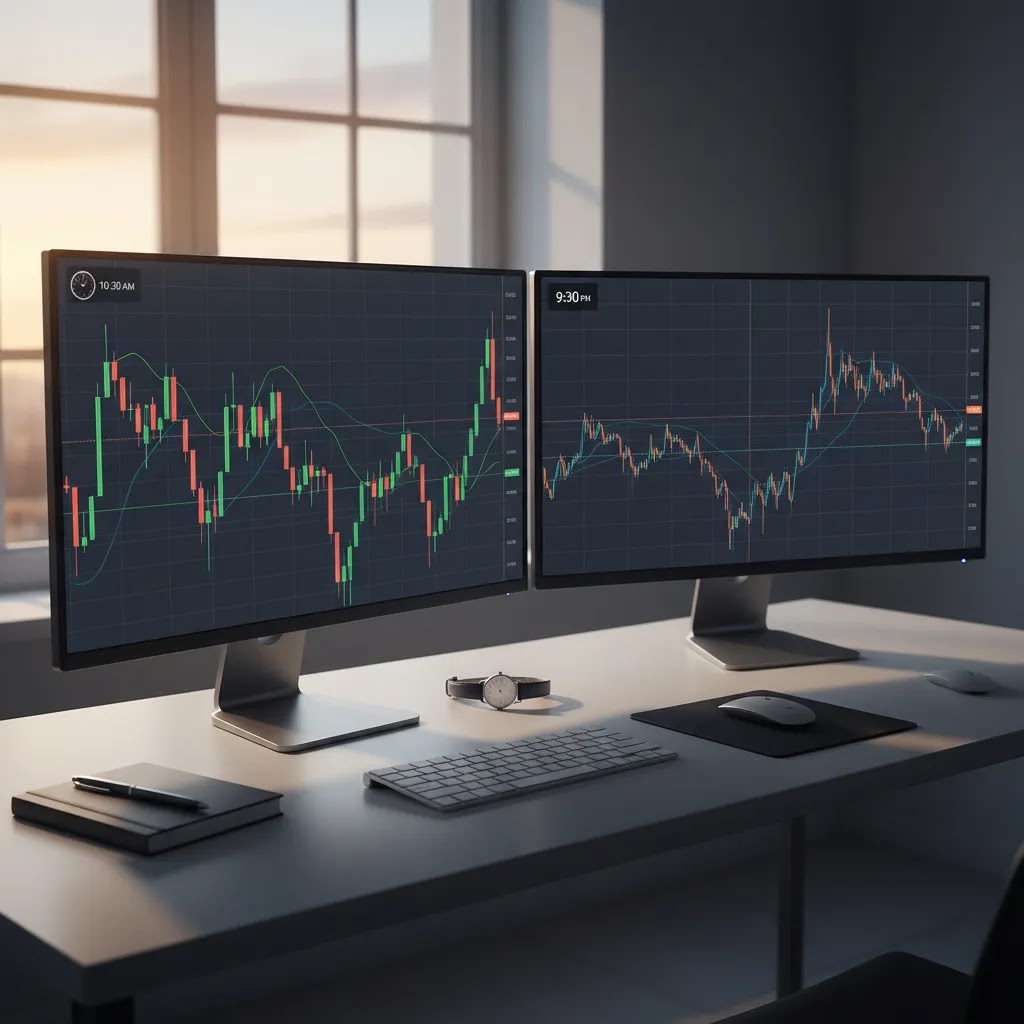
For UAE traders, “after hours” is less about a single clock time and more about which global session you are actually overlapping. Dubai time (GST, UTC+4) sits between Europe and Asia, which is why you can still see active markets in the evening even when some exchanges are closed.
Here is a simple way to map it in UAE terms. Asia session activity is typically strongest in the UAE morning to early afternoon. Europe becomes more active from UAE afternoon into early evening. U.S. activity usually overlaps with the UAE evening and late night. This is why a UAE trader might call 9:00 pm or 11:00 pm “after hours” in everyday life, even though it may still be a busy window for U.S.-linked instruments.
Now, when it comes to what “after hours” means by asset type, it changes:
Instead of relying on marketing labels like “after-hours access,” look for signs of thin conditions on the platform itself. You may notice a reduced asset list, fewer expiry choices, more frequent pricing jumps, or choppier candles that do not respect the levels you normally watch. Those are practical signals that you are not in an active, well-participated window, even if the app is still allowing trades.
Consider this: holiday schedules and daylight savings changes can shift your usual UAE trading window. The UAE does not use daylight savings, but the U.S. and much of Europe typically do, and those changes can move session overlap by about an hour for a period. That is why a time slot that used to be your “normal” evening window can feel different seasonally, even if your routine in Dubai stays the same.
Can you trade binary options 24/7
The short answer is no, not in the sense that every underlying market is naturally active all day, every day. If you ask, can you trade binary options 24/7, the more accurate answer is that some platforms may offer trading access across most of the week, and some may also list weekend OTC contracts, but that is not the same as continuous access to fully active underlying markets.
Forex-related instruments may be available across much of the business week because the global currency market moves through Asia, Europe, and North America in sequence. Indices and stocks are more session-bound. Commodities vary by market. Weekend availability usually points to OTC conditions rather than standard exchange trading.
Here is the practical framework:
If your goal is simply to find a time that matches your schedule, that is understandable. But availability should not be mistaken for quality trading conditions. A market being open on your screen does not mean it is active, efficient, or suitable for your risk tolerance.
Why after-hours trading feels different
Many UAE traders notice that late-session or weekend trades feel harder to read. That is not just a matter of experience. Market structure may genuinely be different.
Lower participation can distort movement
When fewer participants are active, price movement may become less orderly. A small move close to expiry can decide the whole contract. In a fixed-return product, that can turn a trade from in the money, meaning it expires in your favor, to out of the money, meaning it expires against you, very quickly.
Payouts may look tempting, but context matters
Some traders are drawn to after-hours contracts because the payout may appear attractive. Here’s the thing: payout percentage alone does not tell you whether the setup is sensible. A higher quoted return may simply reflect greater uncertainty or weaker underlying conditions. Any discussion of payouts should be read with caution because returns are never guaranteed, and a single loss still means losing the staked amount under most binary structures.
Technical analysis may become less reliable
Indicators and support-resistance levels can still be used, but they may carry less weight in quieter or synthetic conditions. If you use short expiries, false moves can become more damaging.
That is one reason some traders prefer structured timing methods such as an end-of-day strategy, where the logic of timing and market context is clearer than simply opening trades because a platform is still live at midnight.
After-hours pricing can be harder to verify
After hours, a key issue is the pricing reference and how settlement works at expiry. In many online binary options setups, you are not receiving an exchange fill. You are entering a fixed-outcome contract where the broker’s platform decides whether your contract expires in or out of the money based on a specific reference price at a specific timestamp.
That reference can vary by platform and by product. It may be based on an internal broker feed, an OTC reference, or a synthetic quote designed to keep a market open when the underlying exchange is closed. This is not automatically a problem, but you should be able to find a clear explanation of what price is used at expiry, how the expiry time is defined, and what happens if there is a price spike or a quote pause.
Think of it this way: in a fixed payout structure, the only thing that matters at expiry is whether you are on the right side of the strike by even a small amount. In thin conditions, that small amount can be decided by a quick jump or a noisy candle. That can feel harsher after hours because you may see more irregular movement, and you may have less confidence that the price on screen matches a widely observed market level.
From a scam-prevention standpoint, this is where due diligence matters most. If a platform cannot explain its pricing source, expiry rules, or dispute process in plain language, that is higher risk in late-session and weekend conditions. Transparency does not remove the risk of capital loss, but it gives you a way to judge whether the game rules are clear enough to participate knowingly.
Payout math for after-hours trades
After-hours payout offers often trigger a simple question: if the payout is higher, does that make the trade better? The reality is that payout percentage controls the break-even win rate you need over time, and after-hours conditions can make hitting that win rate harder, not easier. Binary options are high risk, and even with a fixed maximum loss per trade, the math can work against you quickly if you keep taking low-quality entries.
Here is the basic logic. If the payout is 80%, you risk $100 to potentially gain $80 profit if you win. To break even over many trades, you typically need to win more than about 55.6% of your trades, because each loss costs $100 and each win only earns $80 profit. If the payout is 60%, the break-even win rate rises to about 62.5%. That is a big difference, and it is one reason payout should never be treated as a cosmetic number.
Now connect that to after-hours reality. If the session is thin, your ability to read the move, manage timing, and avoid random spikes may get worse. Even if the platform offers a slightly higher payout after hours, the conditions may still reduce your probability of expiring in the money. A payout improvement does not help if the quality of the pricing environment drops more than the payout rises.
Consider this: many traders focus on the fact that “the most I can lose is the stake.” That is true in a narrow sense, but repeated losses compound fast. A few late-night trades placed because the platform is open, not because the conditions are strong, can drain an account quickly. That is why BinaryOptionsAE puts so much emphasis on session awareness and disciplined selectivity, especially outside normal market hours.
How UAE traders should evaluate after-hours trading
If you are trading in the UAE, after-hours access may fit your schedule. Many people check the markets after work, especially when European and U.S. sessions overlap with evening hours locally. The key is not whether the timing is convenient. The key is whether the conditions are understandable and manageable.
Start with the asset, not the platform banner
If a broker advertises “24/7 trading,” ask what instruments are actually available at each time. Are they forex pairs during active sessions, or are they OTC contracts on weekends? The label matters because it shapes the behavior of the price feed and your expectations around analysis.
Check whether the market session matches your method
Consider this: if your approach relies on momentum from economic data, after-hours OTC conditions may not fit it well. If your approach depends on reaction to session opens or closes, timing is everything. Building awareness of market hours and sessions usually helps more than forcing trades into quiet periods.
Use a demo first if available
Tool data shows IQ Option offers a $10000 preloaded demo account with unlimited balance refills. That can be useful for observing how late-session contracts behave without immediate capital risk. BinaryOptionsAE often emphasizes demo testing in its educational material for exactly this reason: you can study platform behavior, expiry handling, and quote movement before depositing real money.
Treat weekend activity as a separate environment
Weekend binary options trading should be evaluated on its own terms. Do not assume that a pattern you observed during an active weekday session will behave the same way on a Sunday OTC chart.
Platform and broker checks before you trade late
After-hours trading increases the need for broker due diligence. If conditions are less transparent, platform quality matters even more.
Based on available product data, IQ Option is currently featured on BinaryOptionsAE and includes tools such as advanced charting, customizable indicators, a demo account, and fast deposits and withdrawals. Those features may improve the user experience, but they do not remove trading risk. They also should not be treated as proof that every after-hours contract is equally suitable.
Now, when it comes to choosing any platform for late-session trading, use a simple checklist:
For UAE readers, regulation should always be part of the process. The Securities and Commodities Authority (SCA) is relevant in the local financial context, while many offshore brokers rely on international registrations or licenses in other jurisdictions. That does not automatically make a platform unsuitable, but it does mean you should verify what supervision actually applies and what protections may exist if a dispute arises.
BinaryOptionsAE’s broker research framework looks at platform experience, payout structure, regulation, deposits and withdrawals, asset availability, account types, and customer support. If you want to continue your own screening process, the site’s Brokers section and broader Strategies library are useful next steps.
When waiting may be the better decision
One of the most underrated skills in binary options is deciding not to trade. That matters even more after hours.
What many traders overlook is that a contract being visible on a screen can create pressure to act. In practice, this means you may enter trades because the platform is available, not because the conditions are compelling. That is a risky habit, especially with turbo contracts or very short expiries.
You may want to wait instead if:
Preserving capital is often more important than finding constant trade frequency. Binary options are fixed-risk trades, but repeated poor entries can still drain an account quickly. A patient trader may skip many after-hours setups and still be making the more disciplined decision.
If you are still building your foundation, the educational content in the Fundamentals section may help you understand the product mechanics before you focus on late-session timing.
Key Takeaways
Frequently Asked Questions
What does binary options after hours actually mean?
It usually means you are trading binary contracts outside the main session of the underlying asset. In some cases, that may still involve active global markets, such as forex during another regional session. In other cases, especially on weekends, it may refer to OTC pricing provided by the platform. The important point is that after-hours availability does not always reflect the same market conditions you would see during regular trading hours. Before placing a trade, you should check what asset type is being offered and how the price feed may differ from standard session activity.
Can you trade binary options 24/7?
Not in the strict sense of every real market being fully active around the clock. Some platforms may offer trading opportunities for much of the week, and some may also list weekend OTC contracts. That creates the impression of continuous access, but the market structure can vary a lot. Forex-related products may be available more often than stocks or indices. Weekend trading typically involves OTC conditions rather than standard exchange sessions. So yes, trading may be offered at many times, but no, you should not assume that all those hours provide the same depth, transparency, or quality.
Is weekend binary options trading the same as weekday trading?
No, in many cases it is not. Weekend trading often takes place through OTC contracts rather than regular-session pricing from active exchanges. That means the behavior of the chart may differ, and your usual timing assumptions may not hold up. Some traders wrongly treat weekend contracts as just another extension of Friday trading. A better approach is to view weekend conditions as a separate environment with its own risks. If a platform does not explain clearly whether the product is OTC, that lack of transparency is a warning sign and should make you more cautious.
Why do after-hours payouts sometimes look higher?
A quoted payout may rise because the platform is pricing in greater uncertainty, lower activity, or different market conditions. It should not be read as a sign that the trade is safer or more favorable. In binary options, a higher potential return often comes with a harder-to-evaluate setup. Since outcomes are fixed at expiry, even a small late move can flip the result. That is why payout percentage should never be viewed alone. You need to consider market conditions, the type of asset, expiry length, and whether the session is regular or OTC before treating an after-hours contract seriously.
Can you do options trading after hours?
It depends on what you mean by “options.” Traditional exchange-traded stock options follow the rules and trading hours of the exchange and the options venue, and after-hours access can be limited. Binary options are different. Many online platforms may still list binary contracts after the underlying exchange is closed, often via an OTC or alternative pricing model. That means you may be able to place a trade, but the pricing reference, liquidity conditions, and settlement rules may not match what people expect from exchange-traded options. Because binary options are high risk, after-hours trading should only be approached after you understand exactly how the platform sets the expiry price.
What is the 3 5 7 rule in trading?
The “3 5 7 rule” is not a single universal rule with one accepted definition, and it is often used differently across trading communities. In binary options spaces, you may see similar labels attached to timing habits, trade frequency limits, or personal discipline rules. The practical point for UAE traders is this: be cautious of viral rules that are not backed by clear logic, risk controls, and testing. Because binary options outcomes are fixed at expiry and losses can add up quickly, any rule you follow should be connected to session conditions, payout math, and your ability to stay consistent, not just a catchy number sequence.
How much money do day traders with $10,000 accounts make per day on average?
There is no reliable, consistent “average” that applies to most traders, and online numbers are often selective or promotional. Outcomes vary widely based on strategy, risk per trade, payout structure, fees, and market conditions, and many traders lose money over time. With binary options specifically, the fixed payout structure means you need a sufficiently high win rate just to break even, and after-hours conditions can make that harder. If you are evaluating trading realistically, focus less on daily income targets and more on whether you understand the product rules, the risks, and the conditions you are trading in.
Is it true that 97% of day traders lose money?
You will see this number quoted often, but it is not a universal statistic that can be applied cleanly to every market, time period, and trading product. What is fair to say is that a large proportion of short-term traders do lose money, especially when they use high-risk products, overtrade, or rely on low-quality signals. Binary options carry significant risk of capital loss, and the payout math means the bar for break-even can be high. Rather than focusing on a single headline percentage, focus on whether you can verify broker terms, understand pricing and settlement, and control position sizing and frequency.
Are binary options legal in the UAE?
The legal and regulatory picture can be complex, and availability to UAE residents does not automatically mean local endorsement. The Securities and Commodities Authority (SCA) is the key regulatory body in the UAE context, and you should always check whether a platform has any relevant authorization, restrictions, or cross-border marketing implications. Many binary options platforms serving global users operate from offshore jurisdictions. That may affect complaint handling and investor protections. Because rules can change, the safest approach is to verify the broker’s current regulatory status directly and avoid relying on social media ads or vague licensing claims.
How can I tell if an after-hours broker offer is suspicious?
Watch for vague claims such as “guaranteed payouts,” “always-open institutional pricing,” or pressure to deposit quickly for late-night opportunities. A trustworthy platform should explain what products are being offered, whether trading is OTC, and what terms apply to deposits and withdrawals. You should also be wary if the broker hides company details, gives unclear answers about regulation, or makes it difficult to test the platform with a demo. After hours, transparency matters more because market conditions are already less familiar. If the broker adds confusion on top of that, stepping away may be the smartest move.
Should beginners trade after hours or stick to normal sessions?
Most beginners may find normal sessions easier to understand because price behavior is often more consistent when more participants are active. That does not make regular hours safe, but it may reduce some of the confusion that comes with thin or OTC conditions. If you are new, a sensible approach is to first learn how binary options market hours affect asset behavior, then observe after-hours conditions on a demo. Many first-time traders lose money by combining short expiries with unfamiliar time windows. Building experience during clearer sessions may help you make better decisions later.
What role does a demo account play in after-hours trading?
A demo account gives you a way to observe late-session pricing, expiry handling, and trade flow without immediate financial loss. This is especially useful when you want to compare weekday evening trading with weekend OTC conditions. Tool data indicates that IQ Option offers a $10000 demo balance with refill access, which can help you test how the platform behaves at the exact hours you are considering. A demo does not remove the need for caution, and live psychology can still be very different, but it is a practical first step before risking real capital.
Do market hours matter more than strategy?
They work together. Even a sound method can struggle in poor market conditions, while a weak method is unlikely to improve just because you trade at a “good” time. Market hours matter because they shape volatility, participation, and the reliability of the price action you are reading. If you use a setup designed for active sessions and then apply it to quiet after-hours OTC conditions, the edge may disappear. That is why understanding timing is part of strategy, not something separate from it. Many avoidable losses come from ignoring that connection.
What is the safest next step if I am curious about after-hours trading?
The safest next step is education and observation, not immediate live trading. Start by learning the difference between regular-session and OTC contracts, then test the same time window on a demo account if the broker offers one. Review the broker’s withdrawal terms, customer support quality, and regulatory disclosures before depositing anything. You can also compare platforms using independent review criteria such as payout structure, account types, and funding methods. BinaryOptionsAE is one resource that organizes those factors for UAE traders, but you should still verify all key details yourself before opening a live account.
Conclusion
Binary options after hours can look attractive because they fit real life. Many UAE traders are free in the evening, not during the middle of the trading day. But timing convenience and trading quality are not the same thing. Once you understand the difference between active market sessions and OTC availability, after-hours contracts become easier to judge more realistically.
The central question is not whether you can trade late. It is whether the product, pricing conditions, and broker transparency give you enough clarity to take that risk knowingly. In many cases, the better choice may be to wait for a stronger session, use a demo account first, or focus on learning how market hours affect trade behavior. If you want to continue your research, explore the broker comparison resources and educational guides on binaryoptions.ae, and read full reviews before funding any account with real money.
Risk Disclaimer: Binary options trading carries significant risk of capital loss and is not suitable for all traders. This content is for informational purposes only and does not constitute investment advice. BinaryOptionsAE may earn commission from broker referrals, but this does not influence editorial ratings or rankings. Always verify a broker’s regulatory status, product terms, and withdrawal conditions before depositing funds.
About the Author
Braden Chase is an investor, trading specialist, and former research specialist for Forex.com who helps aspiring investors develop the confidence and habits they need to make an income from the market. Braden has served as a registered commodity futures representative for domestic and internationally-regulated brokerages and has also spoken & moderated numerous forex and finance industry panels across the globe.