
AI Binary Options Trading: Hype vs Reality (2026)


AI binary options trading is now heavily promoted across social media, Telegram groups, and broker communities, often with claims that software can predict short-term price direction with unusual accuracy. For UAE traders, that raises an important question: is artificial intelligence actually useful in binary options, or is most of the marketing just recycled hype? The answer usually sits somewhere in the middle. Some tools may help with chart review, data organization, and trade journaling, but none remove the core risk of binary options trading, and losses can happen quickly. If you are still learning how signal services fit into decision-making, it helps to start with our guide to binary options signals before relying on any automated tool or paid prompt-based service.
Disclosure: BinaryOptionsAE earns affiliate commissions when readers register with brokers via links on this site. This does not influence our broker rankings or editorial evaluations. Our methodology is applied independently.
Contents
What AI tools really do in binary options
Most binary options AI products fall into one of four categories: signal generation, chart interpretation, trade journaling, or strategy testing. In practical use, these tools usually analyze price patterns, indicators, volatility, or historical candle behavior and then produce an output such as a directional bias, confidence score, or suggested expiry window.
That may sound useful, but binary options are structurally difficult. A trade is often decided by very small short-term price moves around a fixed expiry. Even a tool that identifies a broader trend may still fail on a 30-second or 5-minute contract because timing is everything. This is where many exaggerated sales claims break down.
For UAE traders, the real value of a tool is not whether it claims to be intelligent. It is whether it improves your process in a measurable, limited, and realistic way. A tool may help you review charts faster or filter out impulsive trades. It usually cannot produce reliable profits on demand. That distinction matters because many traders confuse analysis assistance with predictive certainty.
If you want context on other forms of automation, our article on binary options trading bots is a useful companion read, especially before paying for a subscription service that promises fully automated entries.
Common types of binary options AI tools
ChatGPT binary options assistants
ChatGPT-style tools are often used to summarize market conditions, explain indicators, build journaling templates, or convert a rules-based strategy into a checklist. They may help with education and structure. They do not have direct predictive power unless they are connected to live, high-quality market data and a defined trading framework. Even then, outputs may be inconsistent or overly general.
AI binary options signals
These tools usually scan price behavior and then issue CALL or PUT suggestions with an expiry period. The risk is that traders may treat those signals as instructions rather than one input among many. Signal quality can vary widely depending on data source, latency, and whether the model adapts to changing volatility regimes.
Binary options analysis software
This category may include indicator dashboards, pattern scanners, heat maps, or probability overlays. These can be more practical than pure signal tools because they support decision-making rather than pretending to replace it. Used carefully, analysis software may help a trader organize information faster, though it still cannot eliminate false signals.
Binary options AI trade journals
Some of the most useful AI applications are not entry tools at all. Journaling software can classify mistakes, track recurring setups, and highlight whether certain expiry lengths or assets are consistently underperforming. That kind of review process may be more valuable than buying another signal subscription.
What “AI bot” claims usually hide: data quality, latency, and backtest traps
Here’s the thing: many products branded as a binary options ai “robot” are not truly operating on reliable, real-time data. Some are effectively static rule sets wrapped in modern language. Others depend on delayed feeds, screenshots, or manual copy-paste prompts that can never match live conditions. In binary options trading, especially with 30-second to 5-minute expiries, the difference between live data and stale data is not a minor detail, it can change the entire outcome of a contract.
Data source and freshness is the first checkpoint. A ChatGPT-style tool may generate a confident narrative about trend direction, but unless it is connected to a high-quality live feed, it is not “seeing” the current market. Even signal groups that claim “AI scanning” may be pulling prices from a different source than your broker chart. That mismatch can matter when prices move quickly or when the platform’s quoted price differs slightly at the moment you place the trade.
Latency and execution is the second checkpoint. A signal created at 10:00:00 and delivered to you via Telegram at 10:00:15 might already be outdated for a 30-second expiry. Then there is the extra delay from you opening the app, selecting the asset, choosing the expiry, and confirming the order. What many traders overlook is that short-expiry binary options are not just about direction, they are about being right at a specific moment. Even small delivery delays can turn an apparent “correct call” into a loss.
Backtest vs live reality is the third checkpoint. Many vendors advertise backtested accuracy while hiding the parts that make results look better than they are. Common issues include curve fitting to a specific market window, cherry-picking only the most favorable session hours, ignoring payout variability by asset, and assuming perfect entries without delays. A more transparent provider should be able to explain what data was used, what period was tested, how many trades were included, whether results include losing streaks, and how the model behaved when volatility changed. Without that, a backtest can be more marketing than evidence, and binary options trading involves significant risk of capital loss regardless of how strong a chart looks in hindsight.
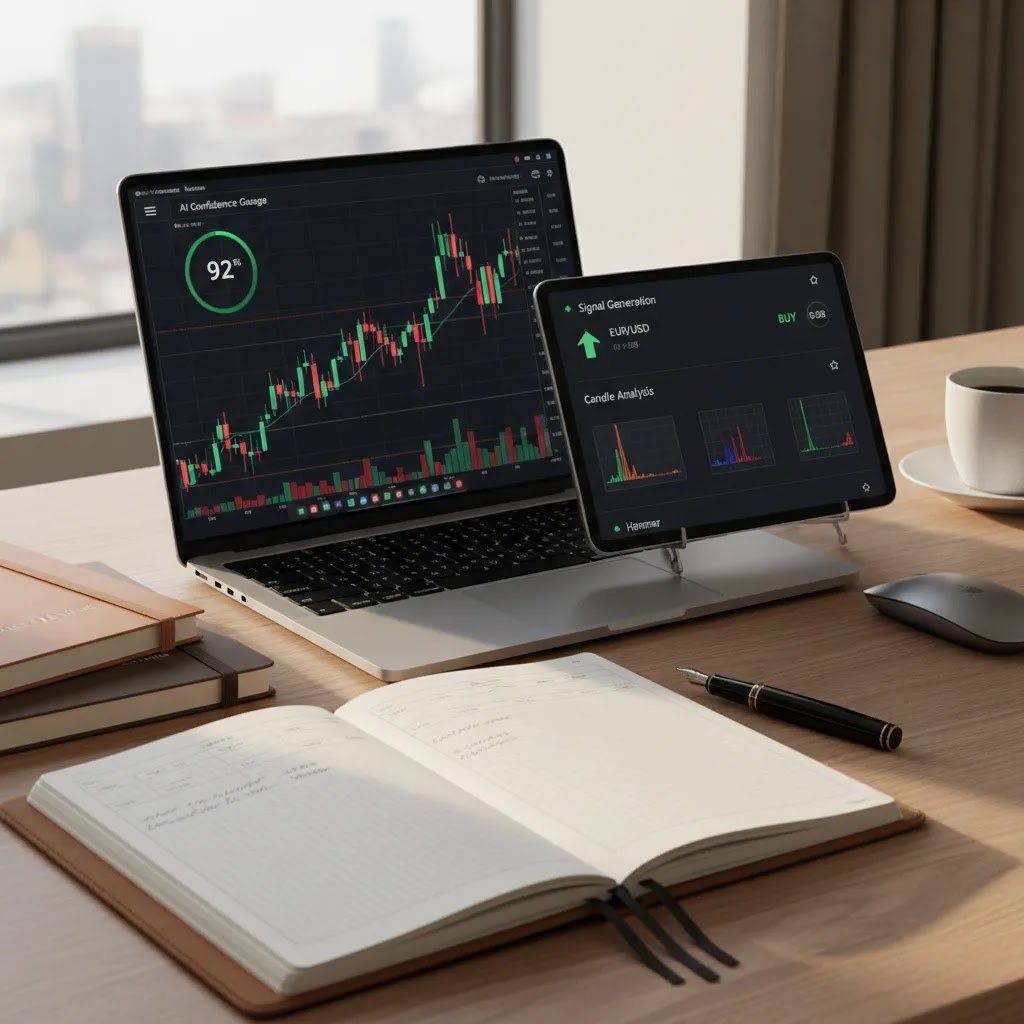
AI binary options trading: hype vs reality
What the hype usually sounds like
What reality usually looks like
A useful way to judge any binary options ai product is to ask whether it solves a narrow problem. For example, does it improve chart scanning speed, identify repeated candle structures, or flag when market conditions no longer fit your rules? Those are plausible benefits. Claims that it can consistently forecast ultra-short-term outcomes with minimal drawdown should be treated with caution.
This is also where many traders blur the line between AI and standard technical methods. A system may simply repackage common indicators under a more modern label. Before paying for access, compare the output with what you can already build using standard binary options indicators.
How AI changes the math: payouts, break-even win rate, and why “high accuracy” claims mislead
Consider this: binary options are not scored like normal forecasting. You are not rewarded for being “mostly right.” You either finish in the money at expiry and receive a fixed payout, or you lose the stake. This is why accuracy claims from AI signal sellers can be misleading, even before you factor in execution issues and broker conditions. Binary options trading involves significant risk of capital loss, and the payout math is one reason losses can accumulate quickly.
The key concept is the break-even win rate. If a contract pays 80% on a win, you risk $10 to make $8, and you lose $10 on a loss. To break even over time, you typically need to win more than half your trades because your average win is smaller than your average loss. In simplified terms, the break-even win rate is approximately 1 divided by (1 + payout). With an 80% payout, that is about 55.6%. With a 70% payout, it is about 58.8%. With a 95% payout, it is about 51.3%.
This is why a claim like “70% win rate” is not meaningful by itself. You need to know the payout levels on the specific assets and expiries traded, and you need to know how results were tracked. A 70% win rate on a few high-payout assets can look very different from a 70% win rate on lower-payout contracts. Then there are other practical frictions: late entries, signal delivery delay, and whether the broker payout drops during volatile moments.
Now, when it comes to AI, another detail matters. Even if a model’s directional bias stays the same, payout shifts by asset and expiry can change outcomes. A tool might be “right” on direction but trained or optimized on a different set of instruments than the ones you trade. If the AI is sending signals on a pair or time window where the platform payout is routinely lower, the break-even point rises, and the same accuracy no longer supports the same expectation.
From a practical standpoint, AI tools can also look right on direction and still fail on short expiries because timing noise is high. A signal that correctly identifies a short-term upward bias can still lose if the entry arrives late, if the market spikes against the position seconds before expiry, or if the platform price at execution differs from the chart feed used by the tool. This is one reason you should judge tools on live, timestamped behavior in demo conditions, not on screenshots or hindsight explanations.
Platform context and broker reality
An AI tool is only one part of the trading process. Your broker platform still affects execution, chart usability, payout consistency, and whether a signal can even be placed at the quoted time. Based on current product data available to BinaryOptionsAE, IQ Option is one of the active platforms relevant to this discussion, with a minimum deposit of $10 and payout rates that may reach up to 95% on selected assets. It also offers a demo account and advanced charting tools, which may matter more to serious testing than any marketing around artificial intelligence.
Those platform features can be useful if you want to compare AI-assisted analysis with manual chart reading. IQ Option also lists a $10,000 demo balance, customizable charts, and broad educational material. Still, no platform feature changes the underlying risk of binary options, and payout rates can vary by asset, expiry, and market conditions.
For UAE readers, this is where BinaryOptionsAE can help. Rather than chasing AI claims in isolation, use our site to review broker conditions, demo availability, payment support, and withdrawal considerations together. You can also browse the broader Strategies hub for educational context or read more about capital protection principles in our Risk section before testing any tool with real funds.

Safety and legitimacy checks for UAE traders using AI signal groups and apps
What many traders overlook is that the biggest risk with AI-promoted binary tools is not only whether the signal is “smart.” It is whether the surrounding ecosystem is trustworthy. Binary options are restricted or banned in multiple jurisdictions globally, and that reality has created a market where aggressive marketing and weak consumer protection can overlap. For UAE traders specifically, it makes sense to be stricter than average about verification before sending money to a broker, a signal group, or an app that claims automated profitability.
Think of it this way: scam patterns in this space tend to repeat. One common pattern is heavy emphasis on performance screenshots with no independent tracking, no full trade log, and no timestamps that allow verification. Another is pressure to deposit quickly, often paired with “limited spots” messaging or claims that you must use a specific broker link to access the AI. You should treat any guaranteed-style language as a major warning sign. Binary options trading involves significant risk of capital loss, and no system can remove that risk.
Before you deposit, focus on practical checks that protect you from the most common failure modes, including non-payment disputes. Review the broker’s withdrawal terms and conditions, including processing times, verification requirements, and any clauses that allow delays. Test support responsiveness with specific questions, for example how payout levels are determined and whether payouts can change by expiry. If a platform offers a demo account, use it to test the full workflow, including how quickly you can place the trade after receiving a signal and whether the quoted price matches what the signal appears to reference.
Regulation is also part of the picture, but it needs to be understood in a realistic way. Seeing a regulatory logo is not the same as having meaningful protections in practice, and many AI signal sellers are not regulated entities at all. In the UAE, the Securities and Commodities Authority (SCA) is the relevant local authority for securities and related financial services, but many offshore binary options offerings fall outside UAE supervision. Your goal is not to find a perfect guarantee, it is to reduce avoidable risks by choosing platforms and services that are transparent about terms, responsive to questions, and consistent about withdrawals.
Pros and Cons
Strengths
Considerations
Who this topic is most relevant for
This guide is most useful for UAE traders who are considering paid signal groups, prompt-based market assistants, or binary options analysis software and want a more realistic framework before subscribing. It is especially relevant for beginners who may be vulnerable to exaggerated win-rate claims, and for intermediate traders who are trying to improve process discipline rather than search for a shortcut. If you are comparing tools, it is sensible to test them in a demo account first, compare outputs with your own chart work, and review whether the tool genuinely improves consistency or simply adds noise.

How BinaryOptionsAE suggests evaluating these tools
BinaryOptionsAE is built for UAE traders who need broker research and trading education that is specific to binary options, not generic multi-asset commentary. Our broker assessments use a weighted methodology covering platform experience and usability, payout structure and return rates, regulation and safety, deposits and withdrawals, asset availability and trade types, account types including Islamic accounts, and customer support. If an AI tool interests you, the next step should be practical due diligence: explore our broker comparison resources, check the full broker review before registering, and start with a demo account before risking live capital. Affiliate compensation may apply when readers register through site links, but it does not determine rankings or editorial judgments.
Selection guide for UAE traders
1. Separate analysis support from signal selling
A tool that helps you review setups is different from a service that pushes constant entries. The first may support discipline. The second may encourage overtrading. If the product focuses mainly on frequent alerts, ask how performance is tracked, what assets are covered, and whether live timing delays are disclosed.
2. Check demo compatibility first
Any binary options ai workflow should be tested in demo conditions before it is trusted with real funds. A demo environment lets you compare signal timing, expiry suitability, and chart logic without immediate financial damage. If a seller discourages testing and insists on direct live trading, that is a warning sign.
3. Review the broker, not just the software
Even a reasonable tool can become ineffective on a poor platform. Execution speed, chart clarity, available expiry types, and payout variation all affect real use. UAE traders should also check deposit methods, withdrawal handling, and whether the broker offers account features aligned with their needs.
4. Be skeptical of win-rate marketing
Binary options outcomes are binary by structure, so headline win rates can be presented in a misleading way. You need more than a percentage. Ask how many trades were tracked, over what period, on which assets, and under what market conditions. A short run of favorable results could say very little about long-term performance.
5. Use AI for review before using it for execution
In many cases, the safer use of AI is post-trade analysis. Let it summarize your journal, classify errors, or compare setup quality. That can build skill without creating the false impression that software can reliably predict every short-term move. For most traders, this may be a more realistic use case than blindly following ai binary options signals.
Frequently Asked Questions
Can AI predict binary options trades accurately?
AI may help analyze patterns or organize chart data, but it usually cannot predict short-term binary options outcomes with consistent certainty. These markets are highly sensitive to timing, volatility, and payout conditions. Traders should treat AI output as one input, not a guarantee, and should test any method in demo conditions before risking funds.
Is ChatGPT useful for binary options trading?
ChatGPT binary options use cases are usually educational rather than predictive. It may help explain indicators, create journals, summarize trading rules, or structure a checklist. Its usefulness depends on the quality of the prompt and underlying data. It should not be treated as a live trading authority or a substitute for broker and risk due diligence.
Are AI binary options signals trustworthy?
Some may be useful in limited conditions, but trust should be earned through transparent tracking, clear methodology, and realistic claims. If a service advertises extreme win rates without explaining timing, assets, or sample size, caution is appropriate. Traders should compare signals against manual chart review and use a demo account first.
Do I still need technical indicators if I use AI?
Usually yes. Many AI tools are built on top of common technical concepts such as momentum, support and resistance, candle behavior, or volatility filters. Understanding those foundations helps you judge whether the tool is adding value or simply repackaging familiar logic. That is why core knowledge still matters, even when software appears sophisticated.
Can AI replace binary options trading bots?
Not necessarily. Some tools overlap with automation, but AI and bots solve different problems. Bots may automate execution, while AI may focus on pattern recognition or analysis support. Both carry risk, and neither removes the need for supervision. If automation interests you, compare this topic with our guide to binary options trading bots.
What is the biggest risk when using binary options AI tools?
The biggest risk is false confidence. Traders may assume that advanced language or algorithm claims mean reliable predictive power. That can lead to larger position sizing, more frequent trades, or weaker discipline. In practice, poor broker conditions, changing volatility, and timing errors may still produce losses quickly.
Should beginners in the UAE use AI tools?
Beginners may use them for learning, journaling, and chart review, but they should be careful about paid signals and auto-entry promises. It is usually better to build a basic understanding of signal logic first through educational content such as our page on binary options signals, then test ideas in demo mode.
How do I know if an AI tool is mostly marketing?
Warning signs include guaranteed-style language, hidden track records, no explanation of data source, pressure to trade live immediately, and vague references to machine learning without practical detail. If the seller cannot explain how the tool behaves in different market conditions, the product may be more promotional than analytical.
Does the broker matter if I already have a good AI tool?
Yes. Broker conditions still shape live results. Chart responsiveness, expiry options, payout variation, and withdrawal handling all matter. A useful signal on paper may become less effective if execution is delayed or the platform is difficult to use. That is why broker evaluation should sit alongside software evaluation, not behind it.
Which AI is best for binary options trading?
There is no single “best” AI for binary options trading because usefulness depends on what the tool actually does and what you can verify in practice. For many UAE traders, the most credible uses are narrow ones: journaling assistance, rule checklists, and chart review support that can be tested in a demo environment. Any tool claiming it can consistently predict outcomes on short expiries should be evaluated with extra caution, because payout math, timing delays, and volatility shifts can break even a good-looking model.
Can I use AI to trade options?
AI can be used to support decision-making in options-style products, including binary options, but it does not remove risk or turn trading into a guaranteed process. In binary options specifically, AI is often used for alerts, pattern scanning, or post-trade review. If you use an AI tool for signals, it is usually safer to treat it as one input, verify it in demo conditions, and check whether the broker platform execution and payout conditions match what the tool assumes.
Can AI predict binary trading?
AI may detect patterns and produce probabilities, but binary options outcomes can still be heavily influenced by short-term noise, sudden volatility, and timing. A model can appear accurate on a backtest and still fail live if signals arrive late, if prices differ between data sources, or if payout percentages vary by asset and expiry. The reality is that prediction quality has to be judged under real conditions, with realistic assumptions, and with an understanding that binary options trading can lead to rapid losses.
Do AI trading bots actually work?
Some AI trading bots may function as designed in the sense that they generate signals or automate actions, but “work” is often used to imply reliable profitability, and that is where marketing can become misleading. In binary options, even small issues like latency, payout shifts, and overfitting to past data can cause live results to differ sharply from advertised performance. If you test any bot, do it first in demo mode, compare the entries against your broker’s live chart, and focus on transparency rather than claims.
Key Takeaways
Conclusion
AI tools in binary options are neither magic nor meaningless. Used carefully, they may support chart review, process discipline, and post-trade analysis. Used carelessly, they can create unrealistic expectations and encourage overconfidence in a high-risk product. The practical question is not whether a tool sounds advanced. It is whether it improves your decisions in a way you can actually verify. Before subscribing to any AI-based signal or analysis service, compare broker conditions, test everything in demo mode, and review platform safety, payouts, and withdrawal factors together. BinaryOptionsAE is designed to help UAE traders make that comparison more carefully through broker research, educational guides, and methodology-based reviews rather than marketing claims alone.
Binary options trading involves a high level of risk and may not be suitable for all investors. You may lose some or all of your invested capital. Past performance does not guarantee future results. This content is for informational purposes only and does not constitute investment advice. BinaryOptionsAE may receive compensation when you register with a broker through links on this site. This does not influence our editorial rankings or assessments. Binary options trading involves significant risk and is not suitable for all investors. You may lose some or all of your invested capital. Past performance is not indicative of future results. This content is provided for informational and educational purposes only and does not constitute investment advice. BinaryOptionsAE does not recommend placing any specific trades. Always trade responsibly and only with funds you can afford to lose.
About the Author
Braden Chase is an investor, trading specialist, and former research specialist for Forex.com who helps aspiring investors develop the confidence and habits they need to make an income from the market. Braden has served as a registered commodity futures representative for domestic and internationally-regulated brokerages and has also spoken & moderated numerous forex and finance industry panels across the globe.