
Trendlines Binary Options (2026 Guide)


Trendlines binary options analysis can help UAE traders read market direction more clearly, especially when deciding whether price is continuing, slowing, or testing a reversal zone. Used carefully, trendlines and channels are not prediction tools — they are chart structures that may improve timing and trade selection.
Risk warning
Binary options remain high risk. Losses can happen quickly, particularly on short expiry trades. Not authorised by the CMA, DFSA, or FSRA for UAE retail clients.
Why trendlines and channels matter
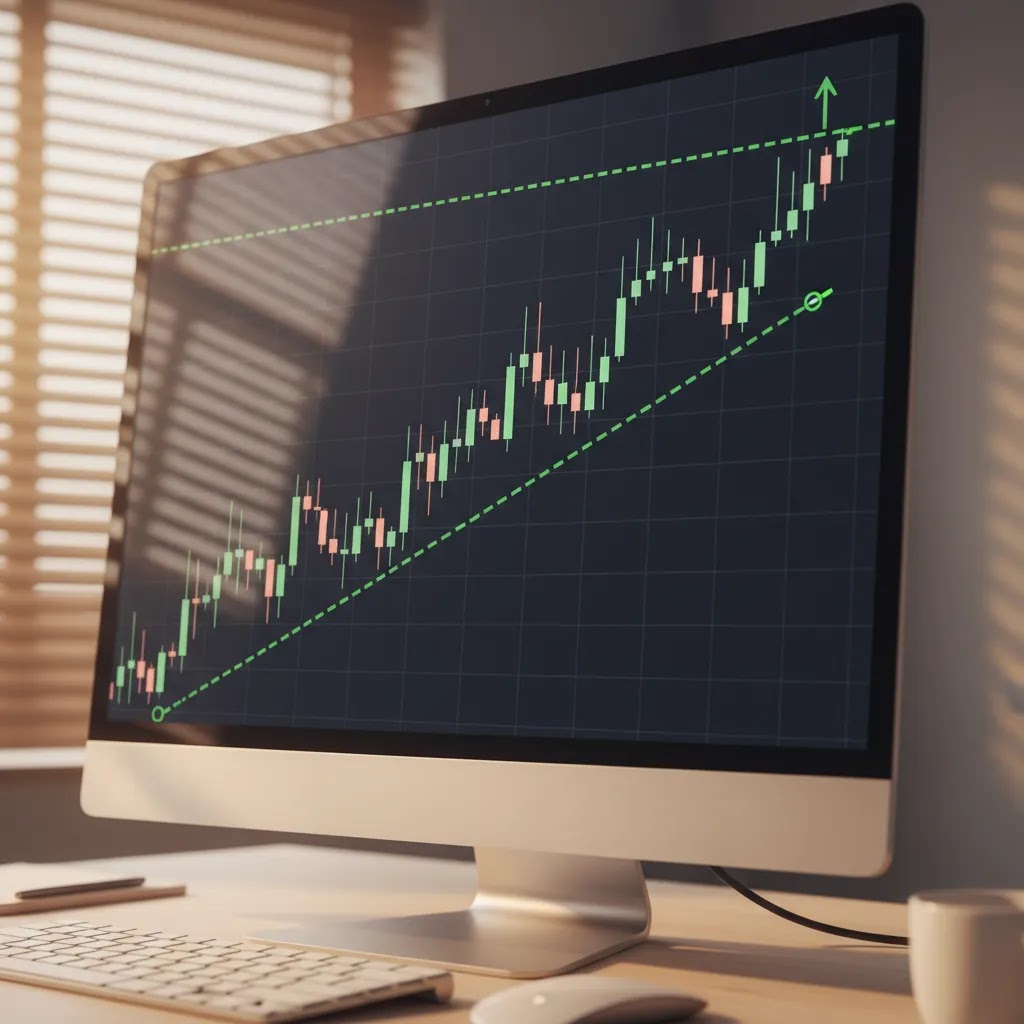
A trendline is a line drawn along rising lows in an uptrend or falling highs in a downtrend. A channel adds a parallel boundary on the opposite side of price movement. These structures may help judge whether momentum is still intact or whether price is reaching an area where it could hesitate.
Trendlines, binary options, digital options, and traditional options
Binary options and digital options are often used interchangeably — both describe a fixed-outcome setup where the trader chooses a direction and expiry. Traditional vanilla options are different — they represent a right, not an obligation, and pricing changes with volatility and time decay.
Binary options are not authorised by the CMA, DFSA, or FSRA for UAE retail clients, and many online platforms operate under non-UAE jurisdictions.
How trendlines work in binary options
In an uptrend, price forms higher lows. In a downtrend, price forms lower highs. Channels show price moving between two parallel boundaries.
A binary options trend approach often uses trendlines in three ways:
- Buying into trend continuation after a pullback to the line
- Avoiding trades when price is stretched far from the line
- Watching for trendline breaks that may signal weakening momentum
Break-even win rate, payout math, and why it matters
Break-even win rate by payout
| Payout | Break-even win rate |
|---|---|
| 70% | 58.8% |
| 80% | 55.6% |
| 90% | 52.6% |
A 55% win rate in demo on a specific asset and expiry may still produce losses live even though direction is correct more often than not. On short expiries, a small timing difference can flip a win to a loss.
How to draw trendlines and channels properly
Basic drawing rules:
- Use at least two clear swing points; three touches usually give more confidence.
- Connect candle wicks or bodies consistently.
- Use the timeframe planned for trading.
- Avoid drawing on choppy markets with no clean swing structure.
- Treat lines as zones, not perfect entry prices.
For channels, place a parallel line on the opposite side of price after drawing the main trendline. When price respects both edges reasonably well, there may be a usable channel.

Trendline rules: touches, the 3-5-7 idea, and confirmation
A "3-5-7 rule" is sometimes referenced — implying a trendline becomes more valid after 3 touches, stronger after 5, very strong after 7. Touch counts are a secondary filter; whether the market is forming clear higher lows or lower highs matters more.
In most cases, a touch is price trading into the trendline zone and showing a response. Wick overshoots are common. A wick through the line does not automatically invalidate it. Consistency matters — when drawing using wicks, keep using wicks.
Confirmation framework:
- Visible rejection candle at the zone
- Confluence with a clearer horizontal level
- A calmer market environment where price is moving in an orderly way
Trend setups for binary options
- Trendline pullback continuation. In an uptrend, price pulls back toward a rising trendline and shows a bullish rejection candle.
- Channel boundary rejection. When price reaches the lower side of a rising channel, it may react back toward the midpoint.
- Trendline plus horizontal confluence. When a trendline touch lines up with prior support or resistance.
- Avoiding late entries. When price has already bounced strongly away, the setup may be gone.
Expiry should fit the timeframe and pace of the trend. A trendline on a 15-minute chart may not support a 30-second option well.

Strengths and considerations
Strengths:
- Make market direction easier to visualise.
- Channels improve entry discipline by showing when price is extended.
- Combine well with support, resistance, and candlestick rejection.
- Work across multiple timeframes.
Considerations:
- Trendlines are partly subjective.
- Lower timeframes can produce many false breaks.
- Binary options require precise timing.
- Choppy or news-driven conditions may invalidate setups.
What to look for in a broker for chart-based trading
- Demo account access. Trendline trading requires screen time.
- Charting usability. Clear zoom controls, drawing tools, timeframe flexibility.
- Payout structure with caution. Higher payouts are not the whole story.
- Withdrawal transparency. Verification, processing expectations.
- Regulation and account suitability. Regulation status may affect dispute handling.
Frequently asked questions
Are trendlines reliable for binary options? May be useful, but not reliable in every condition.
What is the difference between trendline and channel? A trendline tracks one side; a channel adds a parallel line.
Which timeframe is better? Slightly higher timeframes produce cleaner trendlines than very short charts.
Should trendlines be used alone? Usually not. Stronger when combined with candlestick rejection or horizontal levels.
Can a trendline break be traded? It can, but false breaks are common.
How can bad trendlines be avoided? Use obvious swing points, keep the method consistent, avoid forcing lines.
What are the 4 types of trends? Uptrend, downtrend, sideways/ranging, and transition phases.
What is the 3-5-7 rule? A heuristic suggesting a trendline becomes more credible after 3, 5, or 7 touches.
Key takeaways
- Trendlines may help identify direction and pullback zones.
- Channels add context by showing whether price is near a boundary or stretched.
- A trend approach works better with support, resistance, and visible price rejection.
- Expiry selection is critical.
Related reading
About the Author
Braden Chase is a trading specialist and former research specialist at Forex.com. He writes about market mechanics, trading instruments, and the regulatory landscape to help readers research financial markets with a clearer understanding of risk. Braden has previously served as a registered commodity futures representative for domestic and internationally-regulated brokerages. Articles are educational analysis and do not constitute investment advice. Binary options are high-risk speculative instruments and are not regulated in the UAE.