
Binary Options Assets in 2026: Forex, Commodities, Indices, and Crypto Compared


Every binary options contract you place sits on top of an underlying asset — a forex pair, a commodity like gold, a stock index, or a cryptocurrency. The contract itself is identical across asset classes (predict direction, get a fixed payout if right), but how each asset behaves, when it trades, what payout it offers, and how forgiving it is to a beginner are very different things. This guide explains the four asset classes available on the platforms UAE traders can actually use in 2026, the structural differences between them, and how to think about choosing one to specialise in. For the trader-facing shortlist of which specific symbols to trade, see the best binary options assets guide — this page focuses on the asset classes themselves.
The four asset classes in binary options
On the major offshore platforms — IQ Option, Quotex, Pocket Option — the asset universe sorts cleanly into four buckets. The mix on each platform varies by 50–100 individual symbols, but the structure of each class, the trading session, and the payout band are roughly the same.
- Forex. Currency pairs. Largest by symbol count and by retail trading volume. Includes "majors" (EUR/USD, GBP/USD, USD/JPY, AUD/USD, USD/CHF, USD/CAD, NZD/USD), "minors" (cross pairs without USD), and "exotics" (USD/TRY, USD/ZAR, USD/MXN). Quotes 24/5, closed weekends.
- Commodities. Gold (XAU/USD), silver (XAG/USD), oil (WTI, Brent), and a handful of agricultural products on some platforms. Gold is by far the most traded; oil is heavily news-driven; silver and softs are illiquid. Quotes typically 24/5 with brief overnight halts.
- Indices. Stock market indices: US 500 (S&P 500), US 100 (Nasdaq), Germany 40 (DAX), UK 100 (FTSE), Japan 225 (Nikkei). Only quoted during the underlying market's cash hours, with extended futures hours on some platforms.
- Cryptocurrencies. BTC/USDT, ETH/USDT, and a handful of large-cap altcoins. The only category that quotes continuously, 24/7. Volatility highest during US hours; quote quality varies by platform on weekends.
How asset classes differ structurally
The choice between asset classes is not aesthetic. Each class has a different volatility profile, a different relationship to news flow, a different set of dominant participants, and a different payout band on retail platforms. The differences below matter because a strategy that works on EUR/USD can fail outright on BTC, even though both are "predict direction over 5 minutes" contracts.
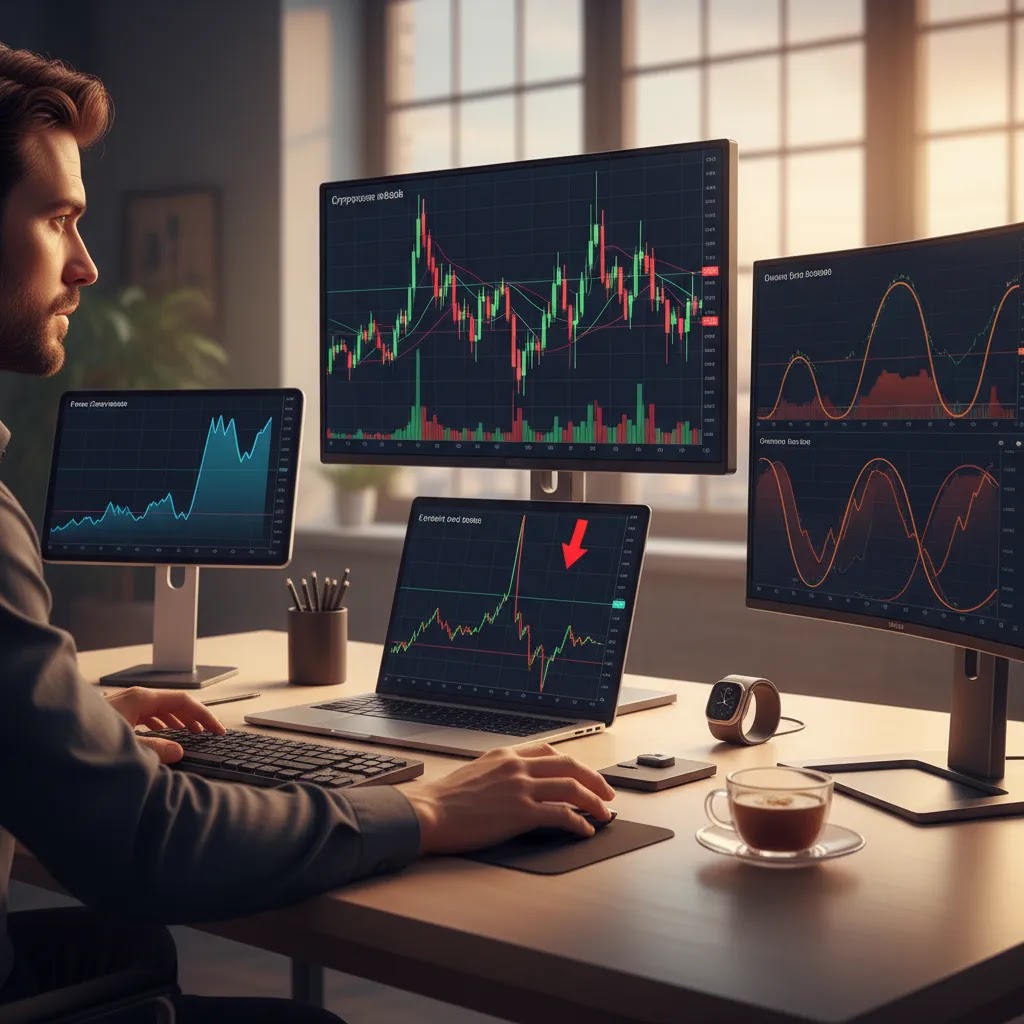
Asset class characteristics
| Class | Trading hours | Volatility | News sensitivity | Typical payout (majors) |
|---|---|---|---|---|
| Forex | 24/5 (Sun 23:00 UAE — Fri 24:00 UAE) | Low to moderate, session-dependent | High around scheduled releases (NFP, CPI, FOMC, ECB) | 80–92% |
| Commodities | 24/5 with brief halts | Moderate; spikes around inventory reports and geopolitics | Very high (oil) to high (gold) | 78–88% |
| Indices | Cash session of underlying market | Moderate; predictable open/close volatility | High during cash session, around earnings and Fed | 76–85% |
| Cryptocurrencies | 24/7 | High; long-tailed | Moderate; less calendar-driven, more event-driven | 80–92% |
What "session-dependent" means in practice
Forex pairs trade 24/5 but each pair has 4–6 hours of meaningful liquidity per day. EUR/USD is essentially asleep during Asian session — quotes are wide, broker payouts drop, price barely moves, and any setup is more likely to be a fakeout than a trend. The same pair from London open through New York close is the most heavily traded asset on Earth, with tight quotes and clean technical behaviour. The clock matters more than the chart for forex.
Commodities and indices have similar session structure. Indices are explicitly tied to cash hours — US 500 binaries are not quoted between 24:00 UAE and 17:30 UAE on most platforms — so the question of "when to trade" is partly answered for you. Crypto is the exception: it quotes continuously, but volume and volatility still cluster around US trading hours and major news events.
Payout differences and why they exist
Payout percentages are higher on more liquid, more easily hedged assets. Brokers offset binary positions in spot markets, futures, or against opposing client flow; the cheaper that offset is to execute, the higher the payout they can offer while still earning their structural edge. EUR/USD is the cheapest asset in the world to hedge — instant liquidity, microscopic spreads — so it consistently shows the highest payouts. Exotic forex pairs and illiquid commodities are expensive to hedge, so their payouts run 5–10 percentage points lower despite using identical contract mechanics.
Crypto is an interesting case: payouts are competitive (80–92%) because retail flow is heavily two-sided, which means brokers can often net opposing client positions internally without needing to hedge externally. The broker business model deep dive explains how this internal netting works and why some assets are more profitable for the platform than others.
Which asset class suits which trader
- New traders: forex majors. Cleanest charts, best documentation, most predictable session structure, highest payouts. EUR/USD on the 5-minute or 15-minute timeframe during London session is the textbook starting point. Almost every working beginner strategy was developed on majors.
- Traders with a job ending around 17:00 UAE: forex majors plus gold. The London/NY overlap (16:00–20:00 UAE) is the highest-quality trading window in the day for both, and the news-driven volatility on gold provides setups that are genuinely different in character from forex pure technicals.
- Traders only available evenings (after 21:00 UAE): crypto plus US indices. These are the assets actually quoted and active during your hours. Trying to trade EUR/USD at midnight UAE is a recipe for slow losses.
- Traders with weekend availability: crypto only. Forex, indices, and commodities are closed on weekends. The OTC versions some brokers offer should be approached with caution — they are platform-priced and do not reflect external markets.
- Active news traders: commodities and indices. Calendar-driven volatility is most pronounced on these classes. Skill set is harder to develop and news trading is a specialised approach that takes longer to learn than pure technical trading.

How asset selection differs across brokers
All three major offshore platforms list each of the four asset classes, but the depth differs. The shortlist below is based on what each broker actually quotes consistently with usable payouts in normal market hours — not the full marketing list of "200+ assets" that includes pairs nobody trades.
Asset depth by platform
| Platform | Forex (consistent) | Commodities | Indices | Crypto |
|---|---|---|---|---|
| IQ Option | ~25 pairs (all majors, most minors, selected exotics) | Gold, silver, oil | US 500, US 100, Germany 40, UK 100, Japan 225 | BTC, ETH, plus 8–10 large-caps |
| Quotex | ~20 pairs (majors + popular minors, fewer exotics) | Gold, silver | US 500, US 100, Germany 40 | BTC, ETH, plus 12–15 large-caps |
| Pocket Option | ~30 pairs (broadest exotic coverage) | Gold, silver, oil, gas | US 500, US 100, Germany 40, UK 100, Hong Kong 50 | BTC, ETH, plus 15+ altcoins |
Pocket Option lists the broadest universe but payouts on its exotic pairs and altcoins drop noticeably below its majors-and-mainstream-crypto offering. IQ Option has the cleanest charts and the most reliable index quoting around cash session opens. Quotex consistently shows the highest peak payouts on majors but with a narrower asset list. Pick the platform on the basis of the asset class you actually plan to trade, not the headline asset count. The full broker comparison has the side-by-side detail.
OTC and weekend asset classes
When forex, commodity, and index markets close on weekends, brokers offer "OTC" versions of selected pairs based on their own internally generated price feeds. These are not the underlying markets — they are simulated quotes constructed by the broker to keep the platform tradable when real markets are closed. Payouts often look generous (90%+) and contracts are continuous, but quote quality is unverifiable and the broker is the only counterparty. OTC trading is a category to understand and generally avoid unless you are specifically studying platform behaviour rather than market behaviour.
Crypto pairs are the only "real market" continuously available on weekends because the underlying exchanges (Binance, Coinbase, etc.) trade 24/7. Quote quality on crypto pairs over the weekend is materially better than OTC forex, but liquidity still drops and broker quote spreads widen relative to weekday US-session conditions.
Asset class versus contract type
Asset class is independent of contract type. The two main contract types on retail binary platforms are:
- Fixed-time / high-low. The standard binary contract: predict direction over a fixed expiry (60 seconds to several hours). Available on all four asset classes. This is what 95% of retail volume is.
- Touch / no-touch. Predict whether price will reach (or avoid) a specified level before expiry. Available on selected forex pairs and crypto on some platforms. Higher payouts, lower hit rates, more nuanced to trade.
- Range / boundary. Predict whether price will stay within (or break out of) a specified range. Niche, lower volume, payout structure varies significantly between platforms.
The asset class determines the how (volatility profile, session, news sensitivity); the contract type determines the shape of the bet (direction vs. touch vs. range). Most retail traders should begin and end with high-low contracts on forex majors before exploring anything else.
Risk profile by asset class
The contract structure is identical across asset classes — your maximum loss is always your stake — but the rate at which you can lose that stake (variance) differs significantly. Crypto and oil produce more 5-trade losing streaks than EUR/USD, even with identical strategies, because they trend in choppier, more news-sensitive ways. Sizing should reflect this.
- Forex majors: Lowest variance class. 1–2% per contract is a survivable size for a beginner.
- Indices: Slightly higher variance than majors, especially around cash open/close. 1–2% remains appropriate.
- Commodities (gold, silver): Higher news-driven variance. 1% per contract is more honest for new traders.
- Oil and crypto: Highest variance. Same percentage size in dollars feels twice as volatile in P&L. Consider 0.5–1% per contract until you have 100+ trades on the asset.
For position sizing rules and drawdown limits across all asset classes, see the risk management deep dive. The numbers are class-agnostic but the variance multipliers above are why "1% per trade" delivers different real-world experiences depending on what you trade.
Where to go from here
- Best binary options assets — the trader-facing shortlist of which specific symbols to trade, with session-by-session payout data.
- Binary options for beginners — start here if you have not yet placed your first contract.
- Binary options strategies hub — strategy selection by asset class and timeframe.
- How binary options brokers make money — why payouts vary by asset class and what that tells you about broker incentives.
- Best binary options brokers — platform shortlist with full asset depth and payout analysis.
Bottom line
Binary options have four real asset classes — forex, commodities, indices, crypto — and one synthetic one (OTC weekend pairs) that is best avoided. Forex majors are the default starting point for nearly every retail trader because they combine the highest payouts, the cleanest sessions, and the lowest variance. Crypto and indices are valid specialisations if your schedule does not align with London/NY hours. Commodities are a strong addition once you can read calendar-driven volatility. Pick a class, pick two symbols within it, and trade them long enough to actually know how they behave at the times of day you can trade — depth on a narrow asset list will outperform a wide-but-shallow asset rotation in every retail account we have ever looked at.
About the Author
Braden Chase is a trading specialist and former research specialist at Forex.com. He writes about market mechanics, trading instruments, and the regulatory landscape to help readers research financial markets with a clearer understanding of risk. Braden has previously served as a registered commodity futures representative for domestic and internationally-regulated brokerages. Articles are educational analysis and do not constitute investment advice. Binary options are high-risk speculative instruments and are not regulated in the UAE.