
Binary Options Meaning: 50 Terms Explained


If you are new to binary options in the UAE, the first problem is often not strategy. It is language. You see terms like expiry, payout, in the money, one-touch, and regulated broker, then realize you cannot judge risk properly until you understand what those words actually mean. That matters, because binary options are high-risk instruments, and confusion about basic terms may lead you to misunderstand how quickly losses can happen or how a platform really works.
This glossary is built to make the binary options meaning clearer in plain English. You will find 50 essential terms, grouped by topic, with practical explanations that fit how beginners actually research brokers and platforms. If you want a wider foundation first, start with what is binary trading. From there, this page helps you translate trading language into decisions you can assess more carefully before using real money.
Table of Contents
What binary options actually means
Think of binary options this way: you are making a time-based prediction on whether an asset price will meet a specific condition by a set expiry time. The outcome is usually one of two results, a fixed return if the condition is met, or a fixed loss of the stake if it is not. That simple structure is why people ask, “what is binary options” or “what does binary options mean,” but the simple format should not be mistaken for low risk.
In practice, this means a glossary is not just academic. It helps you read platform terms, understand payout claims, and spot where marketing language may hide meaningful risks. If you want the mechanics in more detail, see how binary options work.
1. Binary Option
A financial contract with a yes-or-no style outcome. You either receive the stated payout if the contract finishes under the required condition, or you lose the amount risked. Outcomes are fixed, but losses can still accumulate quickly.
2. Binary Options Definition
A plain definition is a fixed-risk, fixed-return trade on whether an asset will be above, below, or within a defined level at expiry. The “fixed” part refers to the contract structure, not to any guaranteed trading success.
3. Underlying Asset
The market you are trading through the option, such as currency pairs, commodities, indices, or stocks if offered by the platform.
4. Strike Price
The key price level used to judge the trade outcome. On many high/low contracts, the strike is the market price at the moment you open the trade.
5. Expiry Time
The exact time when the contract ends. At that point, the platform checks whether your contract finishes in profit or loss.
6. High/Low Option
The most common binary trade type. You predict whether the price will finish above or below the strike price at expiry.
7. Call Option
On many platforms, this means you expect the price to finish higher than the strike by expiry.
8. Put Option
This usually means you expect the price to finish lower than the strike by expiry.
9. One-Touch Option
A contract that may pay out if the asset touches a specific price level before expiry. These can look attractive, but they are often more sensitive to volatility and timing.
10. Range Option
A binary contract based on whether price stays within or moves outside a set range by expiry.
Binary options vs forex, stocks, and traditional options
Here’s the thing, a lot of confusion around binary options meaning comes from trying to map it onto products people already know, like forex, stocks, or vanilla options. The words can sound similar, but the practical experience is different because binaries typically resolve to a fixed outcome at a fixed time.
In forex or stock investing, your profit or loss usually changes continuously as price moves. You can often exit at many different levels, hold longer if you choose, and manage risk with tools like stop losses (depending on the market and platform). With a standard binary option, your outcome is usually decided by one question at expiry, did the price meet the condition. That means time and expiry rules matter as much as direction.
Traditional (vanilla) options are also derivative contracts, but their payoff is not normally a simple fixed yes-or-no payout. A vanilla option’s value can change before expiration, and the final profit or loss depends on how far price moved relative to the strike, plus the premium paid. With many binary options, the “how far” often does not matter, one tick above or one point above can be treated the same at expiry, and one tick below can mean a full loss of stake.
What many traders overlook is the behavioral side. Short-term binaries resolve quickly, and that fast feedback loop can encourage repeated staking. This is one reason the product is often compared to gambling in casual conversation, even though the contract itself is a derivative instrument. Knowing your maximum loss on one trade can sound safer, but the reality is that frequent losses and the payout math can still create fast drawdowns, especially if you place many short-expiry trades in a session.

Core trade structure terms
Once you understand the binary options definition, the next step is learning how contracts are structured on real platforms. What many traders overlook is that small wording differences can change the risk profile of a trade.
11. Turbo Option
A very short-expiry binary option, often measured in seconds or minutes. These may appeal to beginners because they resolve quickly, but they can also increase the pace of losses.
12. Ladder Option
A trade built around several price levels rather than just one. Different levels may offer different payout terms based on difficulty.
13. Trade Duration
The amount of time between opening the contract and expiry. Shorter durations usually mean less room for market movement to recover from early price swings.
14. Entry Price
The market price recorded when you place the trade. This often becomes the reference point for the contract outcome.
15. Early Closure
A feature some platforms offer that lets you close a trade before expiry. Availability may depend on contract type and market conditions, and it does not remove risk.
16. Touch Level
The target price a one-touch contract must hit before expiry to qualify for payout.
17. Boundary
The upper or lower line used in a range contract. Your trade result depends on whether price stays inside or moves outside those limits.
18. Open Trade
A contract that has been placed and has not yet expired or been closed early.
19. Closed Trade
A contract that has reached expiry or has been exited early, with a final result shown by the platform.
20. Time Frame
The chart period you are viewing, such as 1 minute or 15 minutes. This is different from expiry, though many beginners confuse the two.
Pricing, payout, and results terms
This is where many first-time traders get misled. A payout percentage may look simple, but it does not mean the trade is favorable by default. You still need to consider frequency of losing trades, platform terms, and whether the contract setup matches actual market behavior.
21. Stake
The amount of money you risk on a single binary option trade.
22. Payout
The return offered if the trade finishes in the required condition. This is usually shown as a percentage of your stake. A higher payout does not make a trade safer.
23. Return
The amount received after a winning trade. On some platforms this may include your original stake plus profit, so always check how figures are displayed.
24. In the Money
A trade that finishes with the required condition met, so it qualifies for the stated payout.
25. Out of the Money
A trade that finishes without meeting the condition, meaning the stake is lost in most cases.
26. At the Money
A result where the expiry price is the same as, or extremely close to, the strike price. Platform rules vary on how such outcomes are handled.
27. Breakeven Rate
The win rate needed to offset losses at a given payout percentage. This is one reason payout figures should always be read in context, not as promises.
28. Fixed Return
The predefined profit amount or percentage for a winning contract.
29. Fixed Loss
The known amount risked if the trade loses, typically your full stake.
30. Profitability
A platform term sometimes used to describe the payout level available on a contract. It should not be read as a prediction that your trading will be profitable overall.
31. Slippage
A difference between the expected entry level and the recorded execution level. In very short expiries, even small slippage may affect outcomes.
32. Volatility
The speed and size of price movements. Higher volatility may create opportunities, but it can also make binary outcomes less predictable.
33. Price Feed
The market data source the platform uses to display asset prices. A reliable price feed matters because contract results depend on recorded prices.
34. Candlestick Chart
A chart style showing open, high, low, and close prices for each time period. It is widely used because it gives more context than a simple line chart.
35. Indicator
A chart-based calculation used to analyze price behavior, such as trend or momentum. Indicators may help with structure, but none can guarantee outcomes.
How payout percent translates into the win rate you need
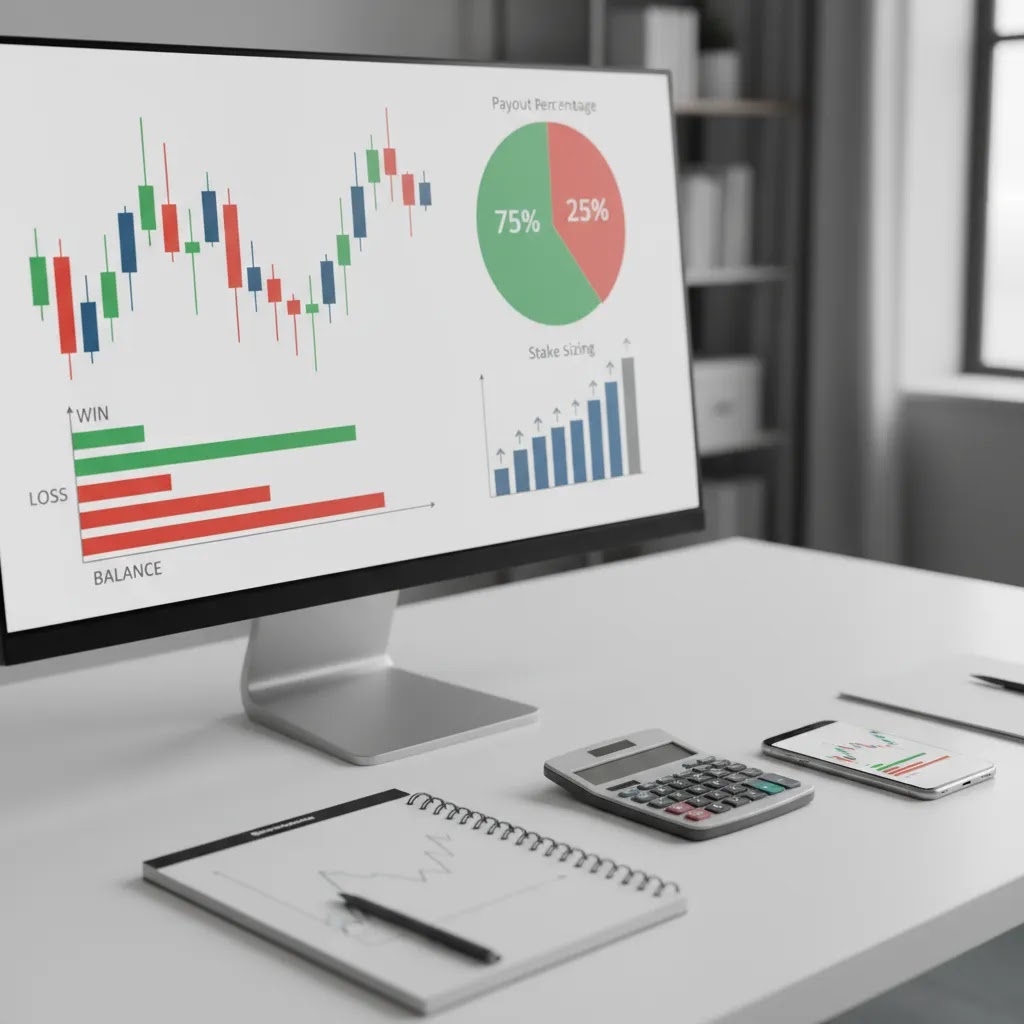
Consider this, the payout percentage is not just a marketing number. It controls the math of what win rate you need just to avoid losing money over time. If the payout is less than 100%, one loss usually wipes out more than one win. That is why traders who focus only on “being right more often than wrong” can still end up down overall.
In simple terms, your break-even win rate can be estimated as: 1 divided by (1 + payout). So if a platform offers an 80% payout, that is 0.80. Your break-even rate is 1 / (1 + 0.80) = 55.56%, ignoring fees, slippage, and any special rules. That means you need to win more than about 55.56% of trades to come out ahead, and real-world factors can push the required win rate higher.
Think of it this way. You place 10 trades at $10 each:
Your net result is +$8 over 10 trades. Now change only one thing, the win count drops from 6 to 5:
You are net -$10, even though you were right half the time. This is the practical reason payout and breakeven rate show up so often in broker reviews and platform comparisons.
The reality is that fixed return and fixed loss can still produce fast drawdowns, particularly on short expiries where traders may place many contracts quickly. Binary options trading involves significant risk of capital loss, and understanding this payout math is part of judging whether your expectations match the product’s structure.
Platform and broker terms
Now, when it comes to choosing where you trade, language matters just as much. A broker may advertise tools, payment options, or account perks, but you should still verify platform quality, withdrawal processes, and regulation claims carefully.
Based on available product data, IQ Option is currently listed on BinaryOptionsAE and is described with features such as a $10,000 demo account, advanced charting tools, and fast deposits and withdrawals. That may make it relevant for beginners researching platforms, but feature lists should never replace due diligence on terms, restrictions, and risk. If you are comparing platforms more broadly, the Fundamentals and Beginners sections on binaryoptions.ae can help you build context before depositing funds.
36. Broker
The company or platform provider that offers access to binary options trading.
37. Platform
The software interface where you analyze charts, place trades, manage funds, and request withdrawals.
38. Demo Account
A practice account using virtual funds. This is one of the safest ways to understand contract behavior before using real money. Some platforms, including IQ Option based on available data, may offer demo access.
39. Live Account
A real-money trading account where profits and losses affect your actual balance.
40. Minimum Deposit
The smallest amount the broker requires to fund a live account. Always verify this directly before registering, because terms may change.
41. Minimum Trade Size
The lowest amount you can risk on one contract. Smaller trade sizes may help with control, though they do not remove the speculative nature of binary options.
42. Withdrawal
The process of moving funds from your trading account back to your payment method or bank account. Delays, verification requests, and fee policies are worth checking early.
43. Verification
The identity checks a broker may require before allowing deposits or withdrawals, often involving ID and proof of address documents.
44. Regulation
Oversight by a financial authority. For UAE traders, you should understand the difference between a broker claiming international registration and one operating under meaningful regulatory supervision. The Securities and Commodities Authority (SCA) is relevant to the UAE financial context, while some international brokers may reference bodies such as CySEC or other offshore regulators. Regulatory status should always be verified independently.
45. Islamic Account
An account type marketed as aligned with Islamic finance principles, often through swap-free terms. In binary options, scholarly opinion may differ on whether the product itself is Shariah compliant, so you should treat broker claims carefully and seek qualified religious guidance if this is important to you.
Risk management and safety terms
The reality is that understanding definitions is only half the job. You also need terms that help you protect yourself from poor broker selection, emotional decision-making, and overtrading.
46. Position Sizing
The amount of your account you risk on one trade. From a practical standpoint, smaller sizing may reduce the damage from a losing streak.
47. Bankroll
The total amount of money set aside for trading. This should be money you can afford to lose, not rent, tuition, or emergency savings.
48. Overtrading
Placing too many trades, often after losses or during emotional stress. This is common with short-expiry contracts because outcomes arrive so quickly.
49. Scam Signal
A warning sign that a platform may be unsafe, such as unrealistic promises, pressure to deposit fast, vague regulation claims, or repeated withdrawal excuses.
50. Risk-Reward Profile
The balance between the amount you can gain and the amount you may lose on a trade. In binary options, this profile is fixed per contract, but it may still be unfavorable depending on payout terms and your actual win rate.
Safety and scam prevention terms many glossaries miss
For UAE traders specifically, safety language matters because not every platform that accepts UAE clients offers the same level of oversight, and “registered” can mean very different things depending on jurisdiction. Scam prevention is not only about spotting obvious promises. It is also about reading withdrawal terms, fee policies, and regulatory disclosures closely before you deposit.
Registered Exchange vs OTC Platform
A registered exchange is typically a formal marketplace with defined listing and oversight rules. Many binary options platforms operate OTC, meaning trades are offered directly by the platform rather than matched on a public exchange. OTC does not automatically mean “scam,” but it does mean the platform controls more parts of pricing, execution, and settlement, so transparency becomes more important.
Segregated Funds
A claim that client money is held separately from the company’s operating funds. In some regulatory frameworks, segregation rules are mandatory and audited. On loosely supervised offshore setups, it may be a marketing statement. If a broker mentions segregated funds, look for clear wording in legal documents, not just a homepage claim.
Chargeback
A process where a cardholder disputes a card payment through their bank or card provider. Chargeback rights depend on the payment method, your bank’s policies, and the reason for the dispute. Traders sometimes mention chargebacks when withdrawals are refused, but it is not a guaranteed solution and it can become difficult if you accepted bonus terms or other conditions.
Jurisdiction
The country or legal region whose laws govern the broker and the client agreement. Jurisdiction affects which regulator, courts, and consumer protections may apply if there is a dispute. A platform can serve UAE traders while being legally based elsewhere, and that difference can matter in practice.
Terms and Conditions
The contract you agree to when you open an account. This usually covers withdrawals, verification, fees, bonuses, account closure, dispute handling, and the platform’s right to change terms. Many withdrawal problems start here, not in the trading interface.
Withdrawal Fee
A cost charged when you take money out of your account. Some platforms charge a fixed fee, others charge a percentage, and some pass through third-party processing costs. Before you deposit, check if fees change by method and whether there is a minimum withdrawal amount.
Dormant Account Fee
A fee charged if your account is inactive for a set period. This can reduce balances over time, particularly if you deposit and then stop trading without withdrawing the remaining funds.
Before you deposit, focus on what you can verify. Can you find clear withdrawal conditions, including processing timelines, verification requirements, and fee wording. Are bonus or promotion terms tied to minimum trading volume before withdrawals are allowed. Is the regulator named in a way you can independently confirm, and is it meaningful oversight or a lighter-touch registration. For UAE traders, keep in mind that the SCA is the relevant local authority, and offshore oversight may not provide UAE-level protections even if a broker is legally operating elsewhere.

How to use this glossary as a beginner
Consider this, a glossary is most useful when you apply it while researching a real platform. If a broker advertises fast execution, high payouts, or a simple account opening process, translate those claims into questions. What is the expiry structure? How are outcomes priced? Is there a demo account? What verification is required for withdrawals? Which regulator is named, and can that claim be checked?
If you are still at the earliest stage, read a beginner trading guide before using real funds. BinaryOptionsAE also organizes educational material by topic, which may help you compare definitions with broker review criteria such as platform experience, payout structure, regulation, deposits and withdrawals, asset availability, account types, and customer support.
Here is a practical sequence you can follow:
Here's the thing, the more clearly you understand the language, the less likely you are to confuse simplicity of format with safety of outcome.
Key Takeaways
Frequently Asked Questions
What is the simplest binary options definition?
A simple binary options definition is a fixed-outcome trade where you predict whether an asset will meet a condition by a set expiry time. If the condition is met, the contract may pay the advertised return. If it is not met, you typically lose the amount staked. The simple structure often attracts beginners, but that should not be confused with low risk. Short expiries, unclear pricing, and poor platform quality can make losses happen faster than many new traders expect.
What does binary options mean for a beginner in the UAE?
For a beginner in the UAE, binary options meaning usually comes down to understanding time, price, and payout. You are not buying the asset itself. You are taking a position on whether price will finish above, below, touch, or remain within a condition by expiry. The key issue is not only how the trade works, but also whether the broker is transparent about withdrawals, regulation, and account terms. In the UAE context, checking the broker's regulatory claims and payment processes is especially important before depositing funds.
How does a binary option work?
A binary option works by setting a condition and an expiry time. You choose a contract type (for example, high/low), a stake amount, and an expiry. At expiry, the platform checks the recorded price against the contract condition. If the condition is met, the trade may pay the stated payout. If it is not met, you typically lose the stake. This fixed outcome can look simple, but binary options trading still involves significant risk of capital loss, especially if you place many short-expiry contracts.
Is binary options the same as forex or stock investing?
No. Binary options are structurally different from traditional investing or spot market trading. In a standard binary contract, your result is fixed by the contract rules at expiry. You usually either receive the stated payout or lose the stake. That is different from owning shares or holding a forex position where profit and loss move continuously with the market. This fixed-outcome design may look easier to understand, but it can also hide how demanding it is to maintain a winning rate high enough to offset repeated losses.
Is binary trading like gambling?
It can feel like gambling for many people, mainly because outcomes resolve quickly and it is easy to place repeated trades in a short period of time. The contract itself is a financial derivative, not a casino game, but the behavioral pattern can be similar if you are staking based on impulse, chasing losses, or relying on luck rather than a tested process. The payout math also matters, because a low payout means you need a higher win rate to break even, which can push people into overtrading. This is why risk controls and careful broker selection matter so much.
How do binary traders make money?
Binary traders make money only when their winning trades, after accounting for the payout rate, outweigh their losing trades over a series of contracts. In most cases, a win does not pay the same amount that a loss costs because many payouts are below 100% of stake. That means your win rate has to be high enough to overcome the payout structure, plus any slippage, fees, or restrictive terms that affect results. There is no guaranteed method, and binary options trading carries significant risk of capital loss.
Why do payout percentages matter so much?
Payout percentages matter because they affect the breakeven rate you need over time. If a broker offers a lower payout, you generally need to win more often just to break even. A higher payout may look attractive, but it still does not guarantee a favorable long-term result. You also need to consider execution quality, expiry rules, slippage, and the actual market setup. This is why payout should be read as one part of the contract, not as proof that the opportunity is good.
What is the difference between expiry time and chart time frame?
Expiry time is when the binary contract ends and the result is decided. Chart time frame is the period used to display price candles, such as 1 minute or 15 minutes. Many beginners mix these up. For example, you might analyze a 5-minute chart but place a trade that expires in 60 seconds. That mismatch can create poor decisions because the chart context and contract duration are not aligned. Understanding this distinction may help you avoid entering trades based on the wrong market view.
Are binary options legal in the UAE?
The legal and regulatory position can be complex, and that is why careful verification matters. UAE traders should pay attention to the role of the Securities and Commodities Authority (SCA) and should not assume that any offshore platform accepting registrations is fully appropriate or protected in the UAE context. A broker may claim international oversight, but that does not automatically mean local protections apply. Before funding an account, review the broker's legal terms, jurisdiction, and regulatory disclosures, then confirm whether those claims can be independently checked.
Are binary options illegal?
Binary options are not universally “illegal,” but the rules vary significantly by country and regulator, and some jurisdictions restrict how binary options can be marketed or offered to retail traders. In the UAE, you should not assume legality or protection just because a website is accessible or accepts registrations. From a practical standpoint, focus on whether the broker provides verifiable regulatory disclosures, clear legal jurisdiction, and transparent withdrawal terms, and consider how much protection you realistically have if a dispute happens.
What is an Islamic or swap-free binary options account?
An Islamic account, often called a swap-free account, is usually marketed as avoiding overnight interest charges to better align with Islamic finance principles. In binary options, the issue is more nuanced because the contract structure itself may raise separate Shariah concerns. So, while a broker may advertise an Islamic account feature, that should not be treated as proof of full religious compliance. If this matters to you, review the product terms carefully and seek guidance from a qualified Islamic finance scholar or advisor you trust.
How can I tell if a binary options platform may be unsafe?
Common warning signs include vague regulation claims, pressure to deposit quickly, unrealistic statements about profits, unclear withdrawal terms, and customer support that avoids direct answers. You should also be cautious if the platform makes it hard to find legal documents or if account managers push you to keep adding funds after losses. In many cases, unsafe operators rely on urgency and confusion. A careful review of regulation, verification steps, and withdrawal policies may reveal problems before you send money.
Should I start with a demo account?
Yes, in many cases a demo account is the safest starting point because it lets you test the platform without risking real funds. You can learn how expiry works, how payouts are displayed, and how quickly contract outcomes change in fast-moving markets. A demo does have limits, because trading with virtual money does not create the same emotional pressure as real losses. Even so, it is usually a better starting point than funding a live account immediately, especially if you are still learning basic terminology.
Does BinaryOptionsAE give investment advice or recommend trades?
No. BinaryOptionsAE positions its content as informational and educational, not as personalized investment advice. The site focuses on helping UAE traders understand broker features, risks, payout mechanics, and platform quality using a structured review approach. That can support better research, but it does not tell you which trade to place or promise profitable outcomes. If you use comparison tools or broker reviews on the site, treat them as one part of your due diligence rather than as a substitute for independent verification.
Conclusion
Most beginners do not run into trouble because they cannot memorize a chart pattern. They run into trouble because they misunderstand the language around the product. If you do not fully grasp terms like payout, expiry, strike price, verification, or regulation, it becomes much harder to judge whether a platform is transparent or whether a contract is exposing you to more risk than you realized.
That is why learning the vocabulary is a practical first step, not a cosmetic one. A solid glossary helps you read broker terms more critically, compare platforms with more confidence, and spot warning signs earlier. If you want to keep building your foundation, explore the educational sections and broker research tools on binaryoptions.ae, then read full reviews and test any available demo account before committing real funds. The goal is not to trade faster. It is to understand enough to make slower, better-informed decisions.
Risk Disclaimer: Binary options trading carries significant risk of capital loss and is not suitable for all traders. This content is for informational purposes only and does not constitute investment advice. BinaryOptionsAE may earn commission from broker referrals, but this does not influence editorial ratings or rankings. Always verify a broker's regulatory status, terms, and withdrawal conditions before depositing funds.
About the Author
Braden Chase is an investor, trading specialist, and former research specialist for Forex.com who helps aspiring investors develop the confidence and habits they need to make an income from the market. Braden has served as a registered commodity futures representative for domestic and internationally-regulated brokerages and has also spoken & moderated numerous forex and finance industry panels across the globe.