
Binary Options vs Stocks: UAE Comparison (2026)


For many readers comparing binary options vs stocks, the real question is not which product is better in general, but which one fits your risk tolerance, time horizon, and trading experience in the UAE. Binary options, Contracts for Difference (CFDs), and stocks all give exposure to market price movement, but they work in very different ways.
Risk warning
Binary options are a high-risk product, and you should understand the mechanics before depositing funds. The CMA, DFSA, and FSRA have not authorised any binary options broker for retail clients.
Overview
With binary options, you are predicting whether the price of an asset will finish above or below a selected level at expiry. The payout is fixed in advance. With CFDs, profit or loss usually depends on how far the market moves from your entry price, and leverage could magnify both gains and losses. With stocks, you are usually buying ownership in a company.
A short-expiry binary trade may be easier to understand than leveraged CFD exposure, but it may also produce losses very quickly if you trade too often.

Break-even math: what payout percentages mean
Because a binary option pays a fixed percentage if you win and loses a fixed amount if you lose, your long-run results depend heavily on whether your win rate is high enough to overcome the payout structure.
Break-even win rate = 1 / (1 + payout). At 70%, break-even is about 58.8%. At 80%, about 55.6%. At 60%, break-even rises to about 62.5%.
Break-even win rate by payout
| Payout | Break-even win rate |
|---|---|
| 60% | 62.5% |
| 70% | 58.8% |
| 80% | 55.6% |
| 90% | 52.6% |
"Knowing your max loss" is not the same as having favorable risk and reward. In a typical stock position, the gain can continue if the price trends over time. In a binary contract, upside is capped, so you may need a higher level of accuracy to offset losing trades.
Binary options vs CFDs vs stocks: core differences
Core differences
| Feature | Binary Options | CFDs | Stocks |
|---|---|---|---|
| Trade outcome | Fixed win or loss at expiry | Variable based on price movement | Variable based on share price |
| Ownership | None | None | Direct ownership of shares |
| Time horizon | Often very short | Short to medium term | Medium to long term |
| Risk profile | High risk, fast outcomes | High risk with leverage | Varies, often lower if unleveraged |
| Best use case | Short-term speculation | Active trading with flexibility | Longer-term investing |
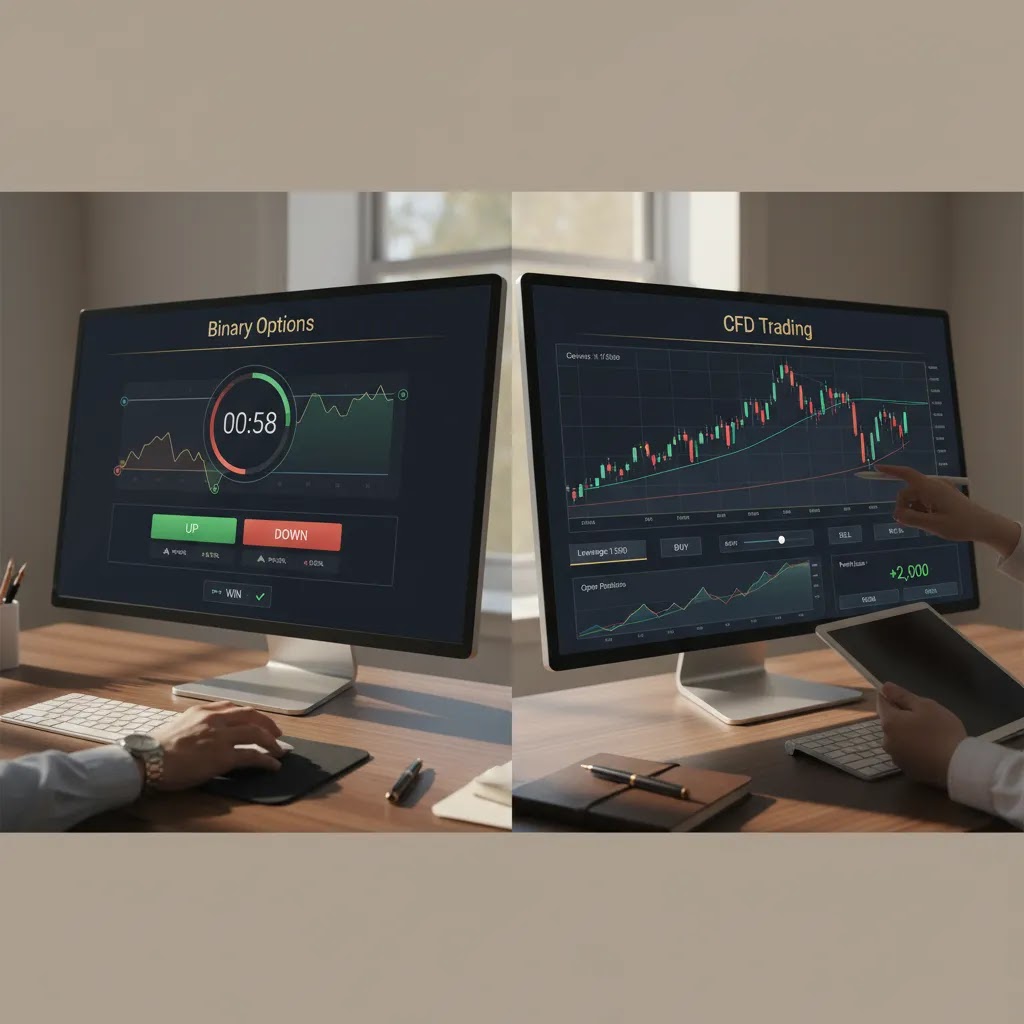
Binary options vs CFD trading
In a binary contract, you typically know the maximum loss before opening the trade. The upside may be fixed too. In CFD trading, the trade is more open-ended. If the market moves in your favor, profit can continue growing. If it moves against you, losses may expand unless you use stop-loss orders.
CFDs require understanding of spread costs, leverage, overnight charges, and position sizing. Binary options remove some of that complexity but replace it with a strict expiry structure where timing becomes critical.
Binary options vs stocks
When you buy a stock, you are purchasing a share in a business. The position does not expire at the end of a five-minute or one-hour window. With stock binary options, you are not buying the share itself. You are predicting whether the stock price will be above or below a set level at expiry.
Stocks may suit readers who want slower decision-making, ownership, and longer holding periods. Binary options may suit traders who specifically want predefined risk and short-term outcomes.
Binary options vs traditional options
A traditional option usually gives the holder the right, but not the obligation, to buy or sell an underlying asset at a strike price. Its value can change continuously before expiration. Traditional options involve strike prices, implied volatility, time decay, and premium pricing. Binary options are simpler on the surface because the outcome is all-or-nothing at expiry.
Trade mechanics that change the comparison
Most High/Low contracts settle based on whether the underlying price is above or below a specific level at the exact expiry time. Settlement is determined at a specific timestamp, not by whether you were correct for most of the trade.
Many binary products are platform-settled rather than exchange-traded. The platform's pricing feed, settlement rules, and dispute handling policies become important. Before you deposit, be comfortable with how the platform defines the strike, what happens around expiry, and what the broker's terms say about pricing interruptions.

Which market may suit you
Binary options may suit you if:
- You prefer a fixed maximum loss known before entry.
- You are focused on short-term trading rather than investing.
- You want a simpler contract structure than leveraged CFD products.
CFDs may suit you if:
- You want more control over entry, exit, and trade duration.
- You understand leverage and position sizing.
- You can manage variable losses with strict discipline.
Stocks may suit you if:
- You are more interested in investing than short-term speculation.
- You want direct ownership exposure.
- You prefer a slower pace and longer holding periods.
Regulation and safety reality check
For UAE traders, "regulated" is not a marketing word. The UAE's relevant regulator is the Securities and Commodities Authority (SCA), now succeeded by the CMA. You should not assume CMA oversight just because a platform accepts UAE clients. The legal entity you sign up with determines which rules and dispute processes may apply.
Confirm the legal entity name in the terms and conditions. Read the withdrawal terms closely. Be cautious of unrealistic marketing claims, especially language that suggests guaranteed outcomes. Warning signs include pressure to deposit urgently, refusal or repeated delays on withdrawals, and requests for excessive personal documents.
Frequently asked questions
Are binary options safer than CFDs? Not necessarily. Binary options may feel simpler because maximum loss is fixed before entry, but they are still high-risk and can lead to rapid losses.
What is the biggest difference between binary options and stocks? Stocks usually represent ownership in a company; binary options are fixed-outcome contracts based on price direction at expiry.
Are stock binary options the same as buying shares? No. Stock binary options do not give you ownership. You are only taking a position on whether the stock price will finish above or below a certain level by expiry.
How do payouts work in binary options? Fixed return if the trade expires in the money, fixed loss if not. Payout rates may vary by broker, asset, and expiry.
Why do 90% of option traders lose money? Many traders do lose money because the learning curve is steep and risk is often underestimated. Overtrading, weak risk controls, and poor platform selection contribute.
Is binary option worth it? Depends on what you are trying to do. The product is highly speculative and timing-sensitive. Using a demo account first is the most responsible approach.
Key takeaways
- Binary options vs stocks is mainly short-term fixed-outcome speculation versus longer-term ownership investing.
- Binary options vs CFD comparisons usually center on fixed risk versus variable exposure and leverage.
- Traditional options are more complex than binary options.
- Platform quality, withdrawals, demo access, and safety checks matter as much as the product itself.
- Binary options remain a high-risk instrument and should be practiced on demo before any live trading.
Related reading
About the Author
Braden Chase is a trading specialist and former research specialist at Forex.com. He writes about market mechanics, trading instruments, and the regulatory landscape to help readers research financial markets with a clearer understanding of risk. Braden has previously served as a registered commodity futures representative for domestic and internationally-regulated brokerages. Articles are educational analysis and do not constitute investment advice. Binary options are high-risk speculative instruments and are not regulated in the UAE.