
Binary Options vs Forex: Which Fits You? (2026)


The binary options vs forex question matters because these two markets may look similar on the surface, but they work very differently in practice. Do you prefer fixed-risk, short-term setups, or open-ended positions that require more active trade management?
Risk warning
Binary options trading carries a high level of risk, and losses can happen quickly, especially on short expiries. The CMA, DFSA, and FSRA have not authorised any binary options broker for retail clients.
Binary options vs forex at a glance
In binary options, you predict whether an asset will finish above or below a strike price at expiry. The result is fixed. In forex, you are trading currency price movement directly. Profit and loss depend on how far price moves, your position size, and how you manage entry and exit.
For many UAE readers, binary options or forex trading is not really about which market is "better." It is about which structure matches your decision-making style, your risk tolerance, and the amount of time you can realistically devote to trading.
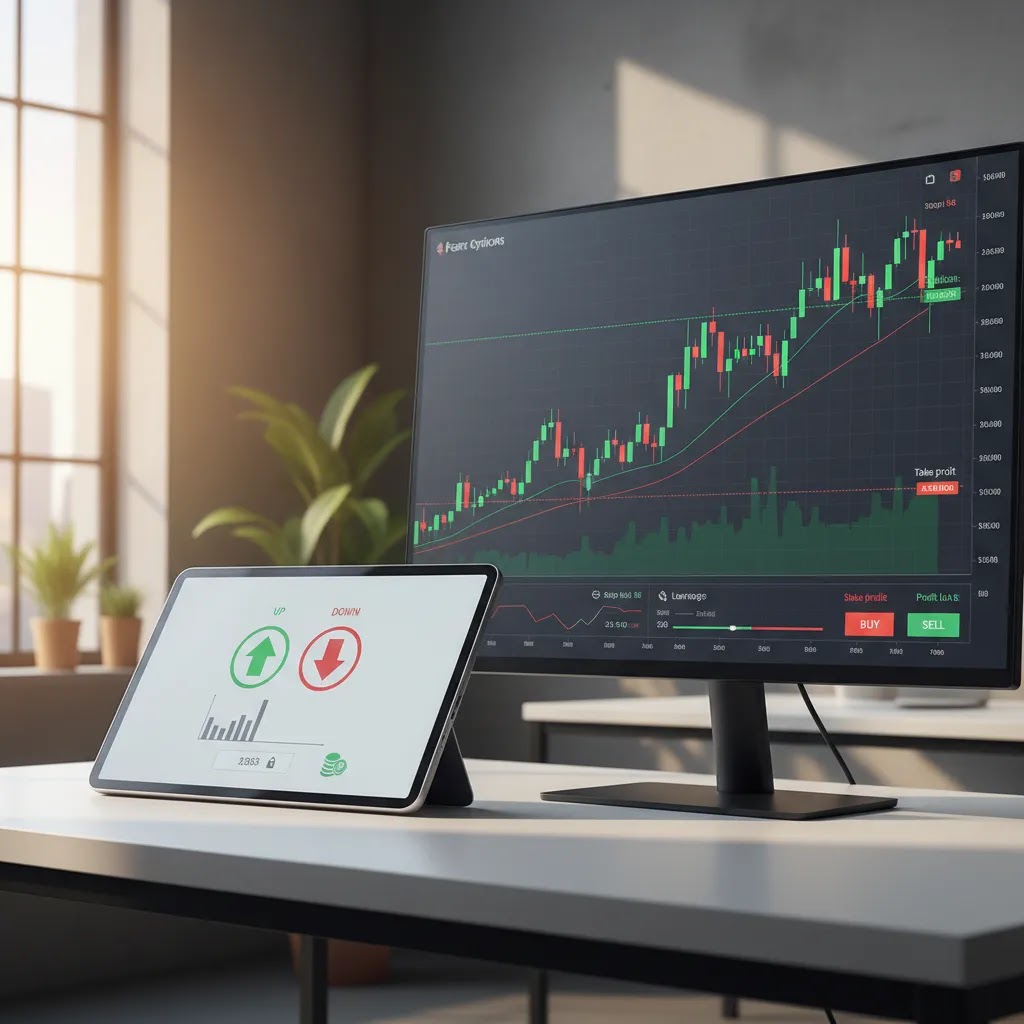
How payouts and break-even win rates differ
In binary options, the payout percentage implies a specific win rate you need just to break even over time. With an 80% payout, you would typically need to win about 56% of trades to break even. If the payout drops to 70%, the break-even rises to about 59%.
Forex break-even works differently because outcomes are variable. You can be right on direction and still lose if your costs, timing, or risk controls work against you. Your break-even is shaped by the spread, any commissions, and (if you hold positions) swap or rollover.
In forex, the size of winners and losers matters as much as how often you win. In binary options, the win amount and loss amount are fixed by the contract, so win rate becomes more central to the math.
How the two markets differ
- Risk structure. Binary options have predefined risk per trade. Forex risk is more variable.
- Complexity. Binary options are easier at the order level. Forex requires more technical understanding.
- Time horizon. Binary options often focus on very short expiries. Forex can support short, medium, or longer-term approaches.
- Cost and return mechanics. Binary options display preset payouts. Forex profit depends on price movement relative to spread costs.
- Emotional pressure. Short expiries create intense decision cycles. Forex losses may expand if risk controls are weak.
Head-to-head comparison
Binary options vs forex
| Criteria | Binary Options | Forex |
|---|---|---|
| Trade outcome | Fixed result at expiry | Open profit or loss based on movement |
| Risk per trade | Usually fixed at entry | Variable, shaped by size and stop-loss |
| Learning curve | Lower at order entry | Higher due to pricing mechanics |
| Time horizon | Often very short-term | Short, medium, or longer-term |
| Return model | Preset payout if correct | No fixed payout cap |
| Loss model | Stake usually lost if wrong | Loss depends on movement and risk controls |
Execution, pricing, and market mechanics
In forex, your trade performance is affected by the price you actually get filled at. Spreads can widen during major news events. Slippage can occur when your stop-loss or entry triggers at a worse price than expected.
Binary options hide some of that complexity but introduce a different timing risk: the result is decided at a specific expiry time. A typical binary contract has a strike price (the level used at the moment you enter) and an expiry price (the level recorded at the exact expiry timestamp). A last-second push can flip a win to a loss.
Binary options make the key number visible upfront: the payout percentage and the stake. Forex costs can be embedded — you pay through entry price disadvantage and the distance price must move before you are net positive.
Legal and regulatory reality check for UAE traders
Availability can vary by jurisdiction, and the rules in places like the United States are not the same as the UAE. The UAE's primary financial regulator is the Securities and Commodities Authority (SCA), now succeeded by the CMA. That does not mean every platform marketing to UAE residents is supervised by the CMA.
Verify the broker's legal entity and licensing claims using official regulator records where possible, not only screenshots on the broker's site. Read the withdrawal terms carefully. Expect identity verification in most cases. If customer support cannot answer basic questions about withdrawals consistently, that is a warning sign.

Which market may suit your style
Binary options may suit you if:
- You prefer knowing your maximum possible loss before placing a trade.
- You want a simpler order structure with fixed expiry.
- You are comfortable with short-term decision-making.
Forex may suit you if:
- You want more control over exits and position management.
- You are willing to learn leverage, spreads, and risk-per-trade calculations.
- You prefer trades that can run longer than a few minutes.
Pros and cons
Binary options strengths:
- Clear fixed-outcome structure.
- Maximum trade risk visible at entry.
- Demo environments often available for practice.
Considerations:
- High risk; short expiries may encourage overtrading.
- Forex leverage and poor stop management could create larger losses.
- Comparing only headline payouts can be misleading.
- Not every platform has reliable regulation or withdrawal handling.
How to choose between binary options or forex trading
- Assess your learning capacity honestly. If unlikely to study position sizing carefully, forex may become dangerous quickly.
- Match the product to your schedule. Binary options may seem more convenient for short windows. Convenience can come with pressure.
- Review your emotional tendencies. If a string of small fixed losses is likely to push you into revenge trading, binary options could be problematic.
- Compare platform quality, not just product type. A weaker platform can undermine any strategy.
- Use demo before live capital. Test whether the product structure feels intuitive or stressful.
Frequently asked questions
What is the main difference between binary options and forex? The payoff structure. Binary options use a fixed outcome at expiry; forex profit or loss changes with market movement.
Which is better for beginners? Binary options may be easier to understand initially because the trade setup is more straightforward. "Easier to understand" does not mean safer.
Is binary options trading riskier than forex? They are risky in different ways. Binary options can produce fast losses because short expiries compress decision time. Forex can expose traders to larger-than-expected losses.
Can you make more money in forex than binary options? Forex does not cap upside with a preset payout. Binary options display the potential return upfront.
Are binary options legal for UAE traders? Availability and oversight depend on the broker. Regulatory status should never be assumed from marketing language alone.
What is the 90% rule in forex? Usually a simplified saying that a large share of retail forex traders lose money. The exact percentage varies by source.
Are binary options banned in the US? Heavily restricted. Many offshore binary options platforms are not allowed to offer services to US residents.
Key takeaways
- Binary options use fixed outcomes at expiry; forex profits and losses remain open and depend on price movement.
- Binary options may be easier to understand at order entry but remain highly speculative.
- Forex offers more flexibility and uncapped upside but requires a stronger grasp of leverage.
- Platform quality, withdrawals, regulation, and account structure matter as much as the market type.
- Demo-first testing and careful research are usually more important than trying to find a universally "better" market.
Related reading
About the Author
Braden Chase is a trading specialist and former research specialist at Forex.com. He writes about market mechanics, trading instruments, and the regulatory landscape to help readers research financial markets with a clearer understanding of risk. Braden has previously served as a registered commodity futures representative for domestic and internationally-regulated brokerages. Articles are educational analysis and do not constitute investment advice. Binary options are high-risk speculative instruments and are not regulated in the UAE.