
Digital Options vs Binary Options (2026 Guide)


Digital options vs binary options is a common point of confusion for new traders in the UAE because many platforms use the terms differently. On some platforms, a digital option is simply a variation of a binary-style contract. On others, it refers to a product with more flexible strike pricing and a payout that changes with market conditions. That difference matters because it may affect how risk, reward, and execution work in practice. Binary options trading carries a high level of risk, and short expiry contracts can increase the chance of fast losses. Before comparing products or platforms, it helps to understand the core mechanics from a broader binary options trading guide and how these instruments are presented to UAE-based users.
Disclosure: BinaryOptionsAE may earn affiliate commissions when readers register with brokers through links on this site. This does not influence our rankings or editorial evaluations. Based on our stated methodology, brokers cannot pay to improve their position.
Contents
What Digital Options and Binary Options Mean
The short answer is no, they are not always the same thing. In everyday broker marketing, the two terms are sometimes used almost interchangeably. In trading mechanics, though, there may be a meaningful difference.
A standard binary option usually has a fixed outcome. You choose whether the price will finish above or below a level at expiry, and if your prediction is correct, the contract pays a pre-defined return. If not, the loss is usually the amount risked on that trade.
A digital option may look similar at first, but the payout structure can be more dynamic. On some platforms, the return changes depending on the strike price selected and how likely that outcome appears in current market conditions. That means two trades on the same asset and expiry could carry different potential returns.
This is one reason education matters more than label recognition. A trader who assumes all short-term fixed-outcome contracts work the same way could misunderstand payout mechanics, break-even expectations, and execution risk. If you are still mapping product types, our guide to types of binary options may help place digital contracts in the wider category.
Digital Options vs Binary Options: Main Differences
When comparing binary options vs digital options, there are five areas worth checking carefully.
Payout structure
Binary options usually offer a fixed return if the position settles in the money. A digital option may offer a payout that moves higher or lower depending on strike selection, asset volatility, and expiry conditions. This may look attractive, but higher quoted returns often come with lower probability outcomes.
Strike price flexibility
Many binary options are built around a simple direction call at the current market level. Digital options may let you select from several strike prices. That creates more choice, but it also increases complexity for beginners who are still learning price behavior.
Pricing logic
A plain binary contract is easier to understand because the payoff is typically set before entry. A digital contract may require you to assess whether the quoted payout is compensating fairly for the probability implied by the chosen strike.
Ease of use
For beginners, standard binary contracts are often simpler. Digital options may be better understood by traders who already know how expiry, entry timing, and strike distance interact.
Risk perception
Both products are high risk. The difference is that digital options can create a false impression of precision because of the extra settings. More flexibility does not reduce the underlying risk of rapid capital loss.
Digital Options vs Binary Options: A Simple Payoff Example
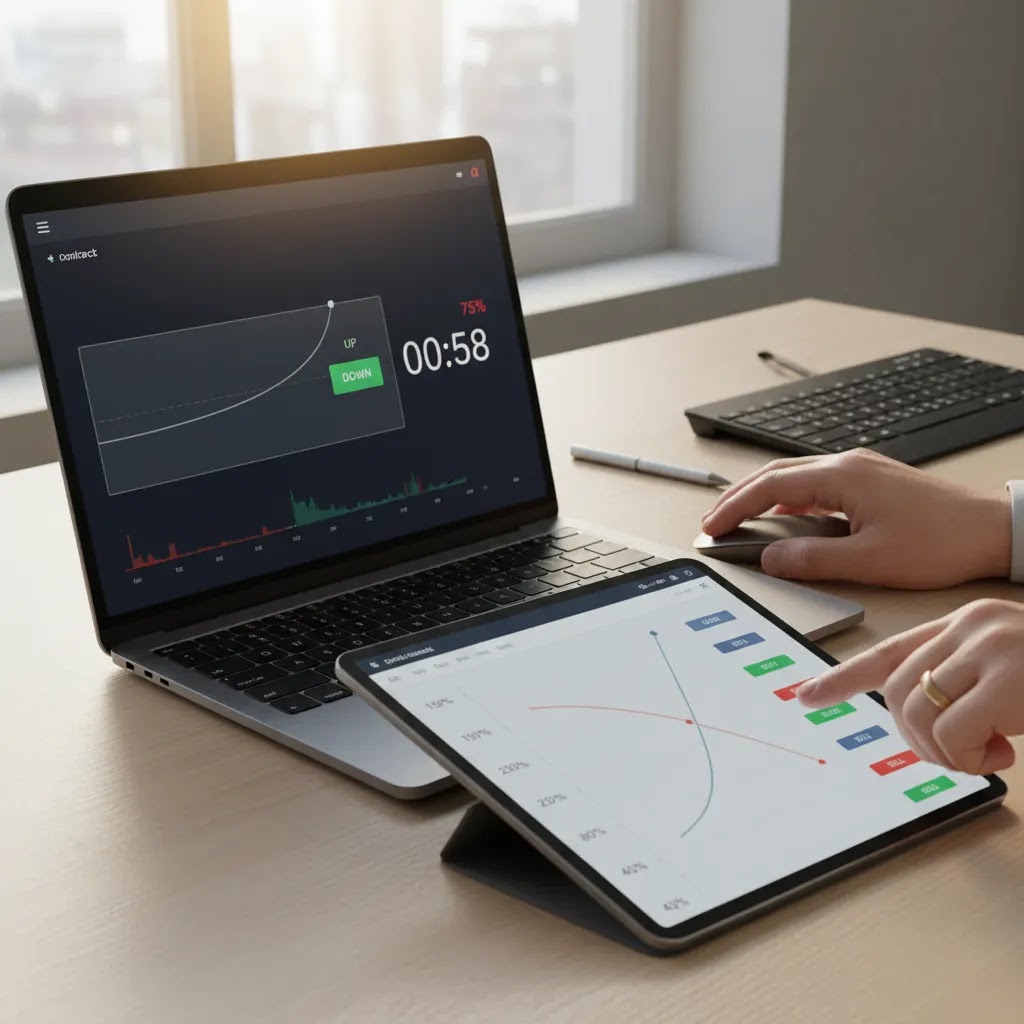
Here’s the thing, the fastest way to spot the difference is to look at how the payoff is quoted and how it settles at expiry. The examples below are simplified and do not reflect every broker’s exact implementation, but they show why the same asset and expiry can produce different quoted returns depending on whether the contract is fixed-return or strike-selected and variable-quoted. Binary options trading involves significant risk of capital loss, so treat these examples as education on mechanics, not a way to “hunt” higher payouts.
Example A: A standard fixed-return binary-style contract
Assume you place a $100 trade on an “Up” contract with a fixed 80% return. If the price finishes above the platform’s reference level at expiry, you typically receive your $100 stake back plus $80 profit, for a total return of $180. If it finishes below, you typically lose the $100 stake.
From a practical standpoint, you are mostly making a direction call with a known payoff profile, win and you gain $80, lose and you lose $100.
Example B: A strike-selected “digital” style contract with a variable quote
Now assume the same asset and the same expiry time, but the platform lets you choose a strike price. If you choose a strike that is very close to the current market price, the platform may quote a lower payout because the outcome is more likely. For example, your $100 might be quoted at 35% return. If the price is above the strike at expiry, you might receive $135 total, and if not, you might lose the $100.
If you choose a strike farther away, the platform may quote a higher payout because the outcome is less likely. Your $100 might be quoted at 95% return. If the price is above the farther strike at expiry, you might receive $195 total, and if not, you might lose the $100.
Think of it this way, in many “digital” implementations you are not only choosing direction. You are effectively choosing probability by selecting how difficult the strike is to reach within the expiry window, and the platform prices that into the quoted return. That is why two trades can share the same asset and expiry but show very different payout percentages.
The reality is that short expiries and fixed-outcome settlement can magnify losses quickly, especially if you treat a high payout quote as a shortcut. The safer goal is to understand what the contract requires to finish in the money, and what you stand to lose if it does not.
Why Broker Terminology Can Be Confusing
One of the biggest issues for UAE traders is that platform language is not standardized. A broker may call a contract a digital option even if it functions very similarly to a high/low binary trade. Another platform may reserve the term for strike-based contracts with variable returns.
This matters because traders often compare headline payout figures without checking the exact rules. A fixed-return binary contract and a variable-return digital contract should not be judged only by the maximum advertised percentage. The contract terms, execution window, and settlement logic may differ in ways that affect actual outcomes.
The same caution applies when comparing these products to other leveraged instruments. If you are also deciding between fixed-outcome contracts and broader market products, it helps to review binary options vs CFDs so you do not mix very different risk models together.
At BinaryOptionsAE, broker analysis is based on a weighted methodology that looks at platform experience and usability, payout structure and return rates, regulation and safety, deposits and withdrawals, asset availability and trade types, account types including Islamic accounts, and customer support. That framework is especially useful when product labels are inconsistent.
“Digital” in Professional Markets vs Broker “Digital Options”
What many traders overlook is that “digital option” has a fairly standard meaning in professional derivatives markets. In that context, a digital option often refers to a contract that pays a fixed amount if a condition is met at expiry, and pays nothing if it is not met. That is essentially a cash-or-nothing payoff, which looks very similar to how many retail traders understand a binary-style contract.
Now, when it comes to retail broker platforms, “digital” is sometimes used differently. A broker may use “digital options” to mean a strike-selected contract where the return is quoted dynamically based on the strike you choose and current market conditions. In other words, the professional-market definition may be technically correct, but it may not match how a specific platform has implemented the product you are about to trade.
This mismatch matters because UAE traders often search online, read a definition, and assume the platform they are using must work the same way. The outcome is predictable, they focus on the label instead of the settlement rule and quote mechanics that actually determine risk.
Before you deposit, do three checks inside the platform or its contract specification:
First, confirm the settlement condition, for example, “above the strike at expiry” or “below the strike at expiry,” and whether the strike is the current price or a level you select. Second, confirm whether the payout is fixed at order entry or whether it can change with strike selection and market conditions. Third, confirm how the platform handles quote updates right before execution, since small timing differences can matter more on short expiries.

How UAE Traders Should Evaluate the Difference Between Digital and Binary Options
For UAE-based readers, the better question is often not “which name is better?” but “how does this contract actually behave on the platform I am using?” There are several practical checks that may help.
Check whether the payout is fixed or variable
If the return can change based on strike price or market conditions, you are likely dealing with a digital-style contract rather than a basic binary one. This could affect how you compare trade setups across assets.
Review expiry choices carefully
Very short expiries may increase noise and execution sensitivity. Even when a contract offers a high potential return, a short time frame could make results less predictable.
Look at platform transparency
A trustworthy broker should explain how returns are quoted, how contracts settle, and what happens if pricing changes before execution. If this information is unclear, that is a concern.
Consider demo access first
Because terminology varies, a demo account may be the safest place to test whether a so-called digital option is truly different from a standard binary contract on that broker’s interface.
Assess regulation and withdrawal reliability
Product structure is important, but platform safety is just as important. Clear contract terms do not remove counterparty risk if the broker has weak oversight or inconsistent withdrawal handling. Readers researching broader safety issues can review our Risk resources and the wider Fundamentals section.
Break-Even Win Rate: How Payout Percentages Change the Math
Consider this, payout percentages are not just marketing numbers. They change the win rate you need just to break even over time. This does not make trading “easier,” and binary options trading still involves a high risk of capital loss, but it does give you a practical way to compare fixed-return contracts.
A simple break-even formula is:
Break-even win rate = 1 / (1 + payout)
In this formula, “payout” is expressed as a decimal. So 80% becomes 0.80.
Here are a few quick examples using a typical fixed-stake structure where a win earns the payout percentage and a loss loses the stake:
If the payout is 70% (0.70), the break-even win rate is 1 / (1 + 0.70) = 58.82%. That means you would need to win about 59 out of 100 trades just to cover losses, before fees, slippage effects, and any other friction.
If the payout is 80% (0.80), the break-even win rate is 1 / 1.80 = 55.56%.
If the payout is 90% (0.90), the break-even win rate is 1 / 1.90 = 52.63%.
Higher payouts reduce the break-even threshold, but they typically come with trade-offs. The platform may offer that higher payout on outcomes that are harder to achieve, or during conditions where execution is more sensitive. That is why a higher percentage should be treated as a pricing signal, not a free advantage.
This also connects back to digital options. If the payout quote changes trade to trade based on strike selection, your break-even win rate is not fixed. It can shift depending on how far the strike is from the current price and how the platform is pricing probability at that moment. From a practical standpoint, comparing “digital” contracts requires more than scanning a headline return, you have to understand what you are being asked to predict and what probability the quote is implying.
Where This Matters on Real Platforms
Based on available product data, IQ Option is one of the brokers UAE traders may encounter while researching these contract types. The platform is presented as offering multi-asset trading, advanced charting tools, customizable indicators, a $10,000 demo account, mobile and desktop access, and fast deposit and withdrawal methods. Those features may make it useful for learning how different fixed-outcome products are displayed and managed in practice.
Still, features alone should not be confused with suitability. A platform can offer charting depth and a polished interface while still presenting high-risk short-duration contracts. Before registering anywhere, it is sensible to compare how the broker describes expiry, strike logic, available assets, and account terms, then test the interface on demo where possible.
BinaryOptionsAE is designed for this exact research step. You can compare brokers side by side using our tool, review platform-specific strengths and limitations, and read the full broker analysis before opening a live account. For beginners, a demo-first approach is the most responsible starting point, especially when a broker uses terms like digital options and binary options in different ways.
Pros and Cons
Strengths
Considerations
Who This Comparison Is For
This comparison is most useful for beginners in the UAE who keep seeing “digital options” and “binary options” used as if they mean exactly the same thing. It is also relevant for intermediate traders comparing payout structures across brokers and trying to understand whether a higher return quote reflects better value or simply a lower-probability strike.
If you care about platform safety first, this distinction should be part of your research rather than the whole decision. Regulation status, withdrawal handling, demo availability, and account transparency may matter more than the label on the trade ticket. For Muslim traders, it is also worth checking whether the broker provides account terms that align with their personal requirements before any live deposit is considered.
Selection Guide: How to Choose Between Digital vs Binary Options
If you are deciding whether digital options are preferable to standard binary contracts, focus on the structure, not the marketing. These five checks may help.
1. Understand the payoff before you enter
If the platform does not clearly show the maximum return, total risk, and settlement condition before order confirmation, pause. In most cases, lack of clarity is a more serious problem than a lower payout quote.
2. Match complexity to experience level
Beginners may be better served by simpler binary structures first. Digital options can introduce extra variables such as strike distance and dynamic return pricing. More settings may create more confusion if you have not yet built a consistent understanding of expiry-based trading.
3. Test execution and interface on demo
A broker may describe a contract well on paper, but real usability shows up in the platform itself. Check whether charting, expiry selection, order entry, and results history are clear enough to follow without guesswork.
4. Compare broker quality, not just contract labels
BinaryOptionsAE reviews brokers using weighted criteria: 20% platform experience and usability, 20% payout structure and return rates, 20% regulation and safety, 15% deposits and withdrawals including UAE payment methods, 15% asset availability and trade types, 5% account types including Islamic accounts, and 5% customer support. That approach may give you a more reliable basis for comparison than product names alone.
5. Keep risk management central
No naming convention changes the fact that these are high-risk instruments. A contract with a more attractive quoted return could still be the weaker choice if it relies on a low-probability strike, poor execution quality, or a platform with unclear withdrawal practices. Responsible use of demo access and careful position sizing remain essential.
If you are moving from education to broker research, use BinaryOptionsAE to compare platforms side by side, check full reviews, and verify the details that matter for UAE traders such as payment methods, demo access, and safety factors. Read the broker review before registering, and treat a live deposit as a later step after platform testing rather than the starting point.
Frequently Asked Questions
Are digital options and binary options the same thing?
Not always. On some platforms, digital options are marketed as a branch of binary-style trading. On others, they use different strike-price logic and variable payout structures. Based on available information, the safest approach is to review the contract rules on each broker rather than assuming the label means the same thing everywhere.
What is the main difference between digital vs binary options?
The main difference often comes down to payout calculation and strike flexibility. Standard binary options usually have a fixed outcome structure. Digital options may allow multiple strike choices and returns that change with market conditions. That may offer more flexibility, but it also adds complexity and does not reduce trading risk.
Which is easier for beginners to understand?
In many cases, standard binary options are easier for beginners because the payoff logic is more direct. You typically predict direction at expiry and receive a fixed return if correct. Digital options may require more interpretation because payout quotes can shift based on strike selection and probability.
Do digital options have higher payouts than binary options?
They may, but higher quoted returns should be interpreted carefully. A digital option could show a larger potential payout because the selected strike is harder to reach. That does not automatically make it the better contract. Traders should weigh return against probability, execution quality, and platform transparency.
Are digital options safer than binary options?
No product label makes fixed-outcome trading safe. Both digital and binary options involve significant risk, especially over short expiries. Safety depends more on broker transparency, regulation status, withdrawal handling, and whether the trader fully understands the contract terms before committing real funds.
What is an example of a digital option?
On many retail platforms, a “digital” option example is a strike-selected contract where you choose a specific level above or below the current price, then the platform quotes a payout that changes with the strike you choose. If price finishes on the correct side of that strike at expiry, the contract typically pays the quoted return. If not, the stake is typically lost. Because quotes can change trade to trade, it is important to confirm the exact settlement rule and whether the payout is fixed at execution.
What is an example of a binary option?
A common binary option example is a fixed-return high/low contract. You select “Up” or “Down” for a chosen expiry, and the platform shows a fixed payout percentage before you confirm the trade. If price finishes in the predicted direction at expiry, you typically receive your stake back plus the fixed return. If not, you typically lose the stake. This structure is simple, but it still carries a high risk of loss, especially on short expiries.
Is binary options a form of gambling?
Some people describe it that way because the outcome is fixed at expiry and short-term price movement can feel like chance, especially if decisions are made without a tested process. In practice, these are financial contracts with defined settlement rules, but that does not reduce their risk. If you are trading without understanding payout math, strike logic, and execution conditions, results can resemble gambling behavior. UAE traders should treat binary options as high-risk speculation and focus on education and demo testing before using real funds.
Are binary options illegal in the US?
In the US, binary options are heavily restricted. Some binary options products are legal only when offered on regulated exchanges, and many offshore platforms are not permitted to solicit US clients. If you are a UAE resident this may not apply directly, but it is still a useful reminder that regulation differs significantly by jurisdiction. Always check whether the broker is properly authorized for the markets it serves and do not assume global availability means strong oversight.
How can UAE traders avoid confusion between product names?
Start by reading the contract description, checking whether the payout is fixed or variable, and using a demo account if available. It also helps to compare the broker’s educational materials with independent explanations from a UAE-focused resource rather than relying only on platform marketing language.
Should I use a demo account before trying digital options?
Yes, in most cases that is the more responsible path. A demo account may help you understand how strike prices, expiry choices, and payout quotes behave without immediate capital risk. This is especially useful if the platform uses both digital and binary terminology in ways that are not immediately clear.
Does regulation matter if I already understand the contract type?
Yes. Product knowledge is only one part of broker selection. Even if you understand the difference between digital options and binary options, you still need to assess fund handling, dispute processes, withdrawal reliability, and the quality of oversight. Contract clarity does not replace platform due diligence.
Where can I learn more before choosing a broker?
You can continue with the Fundamentals section for core concepts, review the Risk category for safety guidance, and use BinaryOptionsAE’s broker comparison tools before registration. For first-time traders, education and demo practice should come before any live deposit decision.
Key Takeaways
Conclusion
The difference between digital options and binary options is real on some platforms and mostly semantic on others. That is why UAE traders should look past the label and examine the contract mechanics, payout method, strike flexibility, and broker transparency. A simpler binary structure may be easier for beginners to understand, while digital contracts may appeal to traders who already grasp how strike selection changes both probability and return. Neither format removes the high-risk nature of fixed-outcome trading. Before opening an account, use BinaryOptionsAE to compare brokers side by side, review platform terms carefully, and start with a demo account where available. Independent research is a safer first step than reacting to headline payout figures or product names.
Binary options trading involves a high level of risk and may not be suitable for all investors. You may lose some or all of your invested capital. Past performance does not guarantee future results. This content is for informational purposes only and does not constitute investment advice. BinaryOptionsAE may receive compensation when you register with a broker through links on this site. This does not influence our editorial rankings or assessments.
About the Author
Braden Chase is an investor, trading specialist, and former research specialist for Forex.com who helps aspiring investors develop the confidence and habits they need to make an income from the market. Braden has served as a registered commodity futures representative for domestic and internationally-regulated brokerages and has also spoken & moderated numerous forex and finance industry panels across the globe.