
Digital Options vs Binary Options (2026 Guide)


Digital options vs binary options is a common point of confusion for new traders in the UAE because many platforms use the terms differently. On some platforms, a digital option is simply a variation of a binary-style contract. On others, it refers to a product with more flexible strike pricing and a payout that changes with market conditions.
Risk warning
Binary options trading carries a high level of risk, and short expiry contracts can increase the chance of fast losses. The CMA, DFSA, and FSRA have not authorised any binary options broker for retail clients.
What digital options and binary options mean
A standard binary option usually has a fixed outcome. You choose whether the price will finish above or below a level at expiry, and if your prediction is correct, the contract pays a pre-defined return.
A digital option may look similar at first, but the payout structure can be more dynamic. On some platforms, the return changes depending on the strike price selected and how likely that outcome appears in current market conditions. Two trades on the same asset and expiry could carry different potential returns.
Main differences
- Payout structure. Binary options usually offer a fixed return. A digital option may offer a payout that moves with strike selection and volatility.
- Strike price flexibility. Many binary options use the current market level. Digital options may let you select from several strike prices.
- Pricing logic. A plain binary contract is easier to understand. A digital contract may require assessing whether the quoted payout compensates for the probability.
- Ease of use. Standard binary contracts are often simpler for beginners.
- Risk perception. Both products are high risk. More flexibility does not reduce the underlying risk.
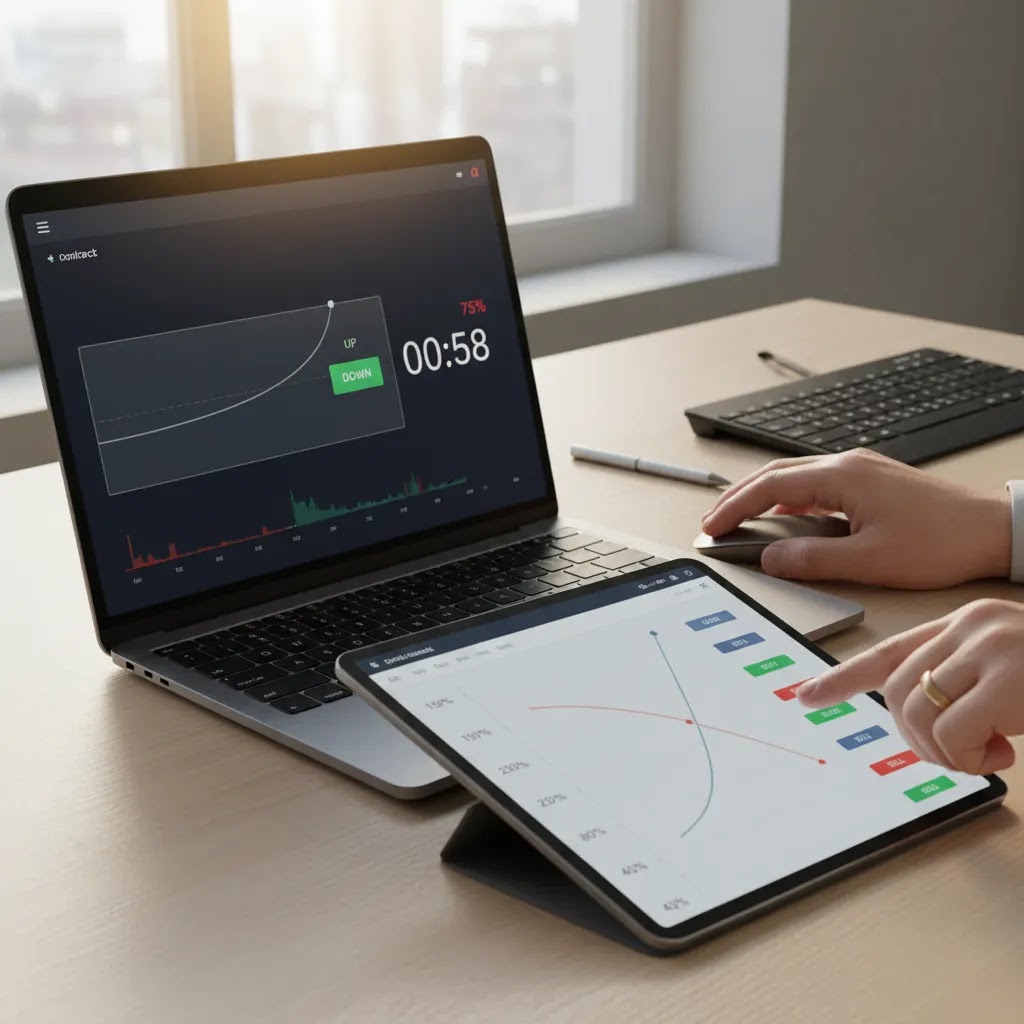
A simple payoff example
Example A — fixed-return binary-style contract: $100 trade with fixed 80% return. If price finishes above the strike, you receive $180 total. If not, you lose the $100.
Example B — strike-selected digital contract: Same asset, same expiry, but choose a strike. Strike close to current price might quote 35% return ($135 total if right). Strike farther away might quote 95% return ($195 if right). In either case, a wrong outcome typically loses the $100.
In many "digital" implementations you are not only choosing direction. You are choosing probability by selecting how difficult the strike is to reach within the expiry window.
Why broker terminology can be confusing
Platform language is not standardized. A broker may call a contract a digital option even if it functions similarly to a high/low binary trade. Another platform may reserve the term for strike-based contracts with variable returns.
A fixed-return binary contract and a variable-return digital contract should not be judged only by the maximum advertised percentage. The contract terms, execution window, and settlement logic may differ in ways that affect actual outcomes.
"Digital" in professional markets vs broker "digital options"
In professional derivatives markets, a digital option often refers to a contract that pays a fixed amount if a condition is met at expiry. That is essentially a cash-or-nothing payoff, similar to how many retail traders understand a binary-style contract.
On retail broker platforms, "digital" is sometimes used differently — meaning a strike-selected contract where the return is quoted dynamically. Before depositing, confirm: the settlement condition, whether the payout is fixed at order entry or can change, and how the platform handles quote updates right before execution.

How UAE traders should evaluate the difference
- Check whether payout is fixed or variable. If return changes based on strike or market conditions, you are likely dealing with a digital-style contract.
- Review expiry choices carefully. Very short expiries may increase noise and execution sensitivity.
- Look at platform transparency. A trustworthy broker should explain how returns are quoted and how contracts settle.
- Consider demo access first. A demo account may be the safest place to test whether a digital option is truly different from a standard binary contract.
- Assess regulation and withdrawal reliability. Product structure is important, but platform safety is just as important.
Break-even win rate: how payouts change the math
Break-even win rate = 1 / (1 + payout). At 70% (0.70), break-even = 58.82%. At 80% (0.80), break-even = 55.56%. At 90% (0.90), break-even = 52.63%.
Break-even win rate by payout
| Payout | Break-even win rate |
|---|---|
| 70% | 58.8% |
| 80% | 55.6% |
| 90% | 52.6% |
Higher payouts reduce the break-even threshold but typically come with trade-offs. The platform may offer that higher payout on outcomes that are harder to achieve. If the payout quote changes trade to trade based on strike selection, your break-even win rate is not fixed.
Where this matters on real platforms
Based on available product data, IQ Option offers multi-asset trading, advanced charting tools, a $10,000 demo account, mobile and desktop access, and fast deposit and withdrawal methods. The IQ Option binary options offering is provided through IQ Option LLC (St Vincent and the Grenadines), and the CySEC-licensed entity does not offer binary options to retail clients due to the ESMA prohibition.
Pros and cons
Strengths:
- Understanding the difference may help you avoid comparing products by name alone.
- Digital options can offer more strike-price flexibility.
- Standard binary options are usually easier for beginners.
- Demo testing can reveal whether a broker's digital contract is meaningfully different.
Considerations:
- Broker terminology is inconsistent.
- Variable-return digital options can be harder to evaluate.
- Neither product reduces the high-risk nature of short-term fixed-outcome trading.
- Product understanding does not solve platform-level concerns.
Selection guide: how to choose between digital and binary options
- Understand the payoff before you enter. If the platform does not clearly show the maximum return, total risk, and settlement condition, pause.
- Match complexity to experience level. Beginners may be better served by simpler binary structures first.
- Test execution and interface on demo. Real usability shows up in the platform itself.
- Compare broker quality, not just contract labels. Use weighted criteria covering platform usability, payouts, regulation, withdrawals, assets, and support.
- Keep risk management central. Responsible use of demo access and careful position sizing remain essential.
Frequently asked questions
Are digital options and binary options the same? Not always. On some platforms, digital options are marketed as a branch of binary-style trading. On others, they use different strike-price logic and variable payout structures.
What is the main difference? Often comes down to payout calculation and strike flexibility. Standard binary options usually have fixed outcomes; digital options may allow multiple strike choices and variable returns.
Which is easier for beginners to understand? Standard binary options because the payoff logic is more direct.
Do digital options have higher payouts than binary options? They may, but higher quoted returns should be interpreted carefully — a digital option could show a larger payout because the selected strike is harder to reach.
Are digital options safer than binary options? No product label makes fixed-outcome trading safe. Both involve significant risk.
Is binary options a form of gambling? Some describe it that way because the outcome is fixed at expiry and short-term price movement can feel like chance.
Are binary options illegal in the US? In the US, binary options are heavily restricted. Some are legal only on regulated exchanges.
Key takeaways
- Digital options vs binary options is not always a naming difference only.
- Standard binary options usually have simpler fixed-outcome logic; digital options may involve variable payouts.
- Higher potential returns may reflect lower-probability setups, not better value.
- Platform transparency, demo access, withdrawals, and regulation matter alongside product structure.
Related reading
About the Author
Braden Chase is a trading specialist and former research specialist at Forex.com. He writes about market mechanics, trading instruments, and the regulatory landscape to help readers research financial markets with a clearer understanding of risk. Braden has previously served as a registered commodity futures representative for domestic and internationally-regulated brokerages. Articles are educational analysis and do not constitute investment advice. Binary options are high-risk speculative instruments and are not regulated in the UAE.