
Binary Options Demo Accounts: Practice Without Real Capital (2026)

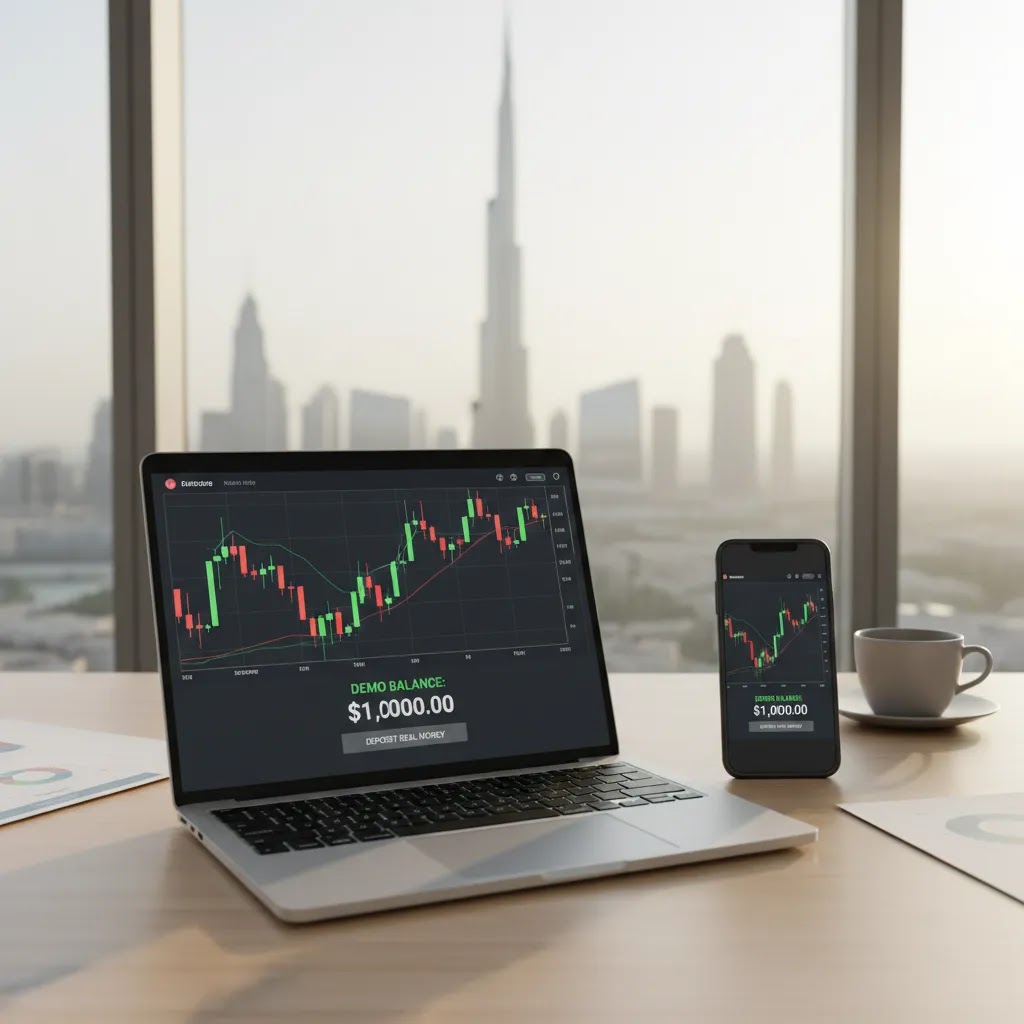
Capital is at risk. Demo accounts allow platform testing without capital commitment but do not replicate the behavioural pressures of live trading. This article documents what demo accounts can and cannot test, how to use them effectively, and where their limitations matter most.
Affiliate disclosure
BinaryOptionsAE may receive affiliate commissions when readers click outbound broker links and open accounts. Compensation does not influence the demo account analysis, broker observations, or behavioural-finance references cited below. All references to specific broker demo offerings are sourced from observable broker terms.
Risk warning
The UAE Capital Market Authority (CMA, successor to the SCA from 1 January 2026 under Federal Decree-Laws 32 and 33 of 2025), the Dubai Financial Services Authority (DFSA), and the Financial Services Regulatory Authority (FSRA) of ADGM have not authorised any binary options broker for retail clients. Demo accounts are useful for platform testing but should not be relied upon as evidence of likely live-trading outcomes. The behavioural and emotional dynamics of live trading differ materially from demo trading.
Why demo accounts are useful — and where they fall short
Demo accounts are virtual-money trading environments offered by most major offshore binary options brokers. They allow a prospective trader to:
- Test the platform's interface and functionality without depositing
- Place virtual trades to understand contract mechanics
- Practice indicator and chart usage on the broker's specific platform
- Observe execution behaviour, payout display, and order flow
These uses are legitimate and valuable for UAE residents evaluating brokers and learning the product structure.
What demo accounts do not effectively test:
- Live behavioural dynamics. Demo trading does not produce the loss aversion, overconfidence, or emotional pressure of risking real money. Many traders profitable in demo become loss-making in live trading because the behavioural component is missing from demo testing.
- Withdrawal mechanics. Demo accounts do not test the withdrawal process — the operational stage where most broker-related disputes occur. A broker with smooth demo trading may have problematic withdrawal practices.
- Account verification mechanics. Demo accounts typically have minimal KYC requirements; live account KYC is materially more demanding.
- Payment-method handling. Demo trading does not test deposit reliability, currency conversion, or method-specific friction.
- Regulatory protection. Demo trading produces no regulatory exposure for the trader because no real funds are at stake; the protection (or absence) of regulatory frameworks is irrelevant to demo activity.
- Customer support quality under stress. Demo users typically receive different support handling than live clients with active disputes; demo support quality is not a reliable indicator of live support.
The composite picture: demo accounts are excellent for platform-testing and product-learning purposes. They are inadequate for predicting live-trading outcomes or assessing broker operational reliability beyond the demo environment.
For UAE residents, the practical implication is to use demo accounts for what they are good for (platform familiarity, contract mechanics, technical analysis practice) and not to rely on them for what they cannot do (predict live-trading profitability, validate broker withdrawal practices).
What demo accounts typically include
Most major offshore broker demo accounts share substantially similar features:
Virtual balance. Typically $10,000 in virtual currency, often refillable by request. The balance is fictitious; gains and losses are not real.
Same trading platform as live accounts. Demo accounts typically use the same web, desktop, and mobile interfaces as live accounts. The exception is some brokers' simplified "demo" environments, which may be marketing previews rather than functional platform tests.
Real-time market data. Demo accounts typically use the same market data feeds as live accounts, allowing realistic chart analysis and price tracking.
Standard asset coverage. Most demos include the broker's full asset range (forex pairs, commodities, indices, cryptocurrencies, stocks where applicable).
Standard expiry options. Demos typically allow the same expiry choices as live accounts (60-second turbo through to multi-day options, depending on the broker).
Educational tooling. Many brokers integrate educational content, video tutorials, and webinar access into the demo experience.
Variations by broker. The major broker demos differ in:
- Refill policy. Some allow unlimited refills; others limit refills to specific amounts or frequencies.
- Time limits. Some demos expire after a period (typically 30 days) requiring account re-registration; others are permanent.
- Feature parity. Some demos disable certain features (advanced order types, copy trading, etc.) compared to live accounts.
- KYC requirements. Some brokers allow demo access with minimal information (email and password); others require full KYC before demo access.
The demos most useful for UAE residents are those with full feature parity, refillable balances, and minimal KYC for demo access. The major brokers' demos generally meet these standards.
How to use a demo account effectively
For UAE residents using demo accounts as a learning and broker-evaluation tool:
Step 1: Use multiple demos before selecting a broker.
Comparing 2-3 demos provides perspective on what is normal in the sector versus what is genuinely better or worse on specific dimensions. UAE residents should not over-weight a single demo experience.
Step 2: Test platform features against actual analytical requirements.
A trader using simple support/resistance analysis on 5-minute charts should test the platform's 5-minute charts and basic indicator support. A trader using multi-timeframe analysis should test the multi-timeframe synchronisation. Demo testing should be specific to the trader's intended approach.
Step 3: Test order entry and payout display specifically.
These are the highest-stakes interaction points. Verify:
- Payout is visible before order confirmation
- Order ticket is unambiguous about asset, expiry, direction, stake
- Order confirmation is distinct from order placement
- Order history is accessible and clear
Step 4: Practice the trading approach intended for live trading.
Use demo time to practice the specific entries, expiries, and position sizing that will be used in live trading. Demo provides a low-cost environment to identify execution issues before they cost real money.
Step 5: Track demo results over a meaningful sample.
A sample of fewer than ~100 trades is generally too small to distinguish skill from variance. Demo testing should produce enough trades to provide meaningful data on win rate, average gain, and average loss. If a demo strategy is unprofitable over 200+ trades, it is unlikely to become profitable in live trading.
Step 6: Resist the temptation to over-extrapolate from demo results.
A profitable demo session is not predictive of live profitability. The behavioural component of live trading — loss aversion, overconfidence, disposition effect — typically degrades performance from demo levels. UAE residents should treat demo profitability as the upper bound of likely live performance, not the typical case.
Step 7: Use demo time to test broker support and withdrawal information.
While demo cannot test live withdrawal mechanics, the trader can test broker support by asking specific questions about:
- Withdrawal verification requirements
- Typical withdrawal processing times
- Supported deposit and withdrawal methods for UAE residents
- Bonus terms and turnover requirements
The clarity and specificity of broker responses is informative about the broker's overall communication standards. Vague or evasive responses to specific questions are predictive of similar quality in live disputes.
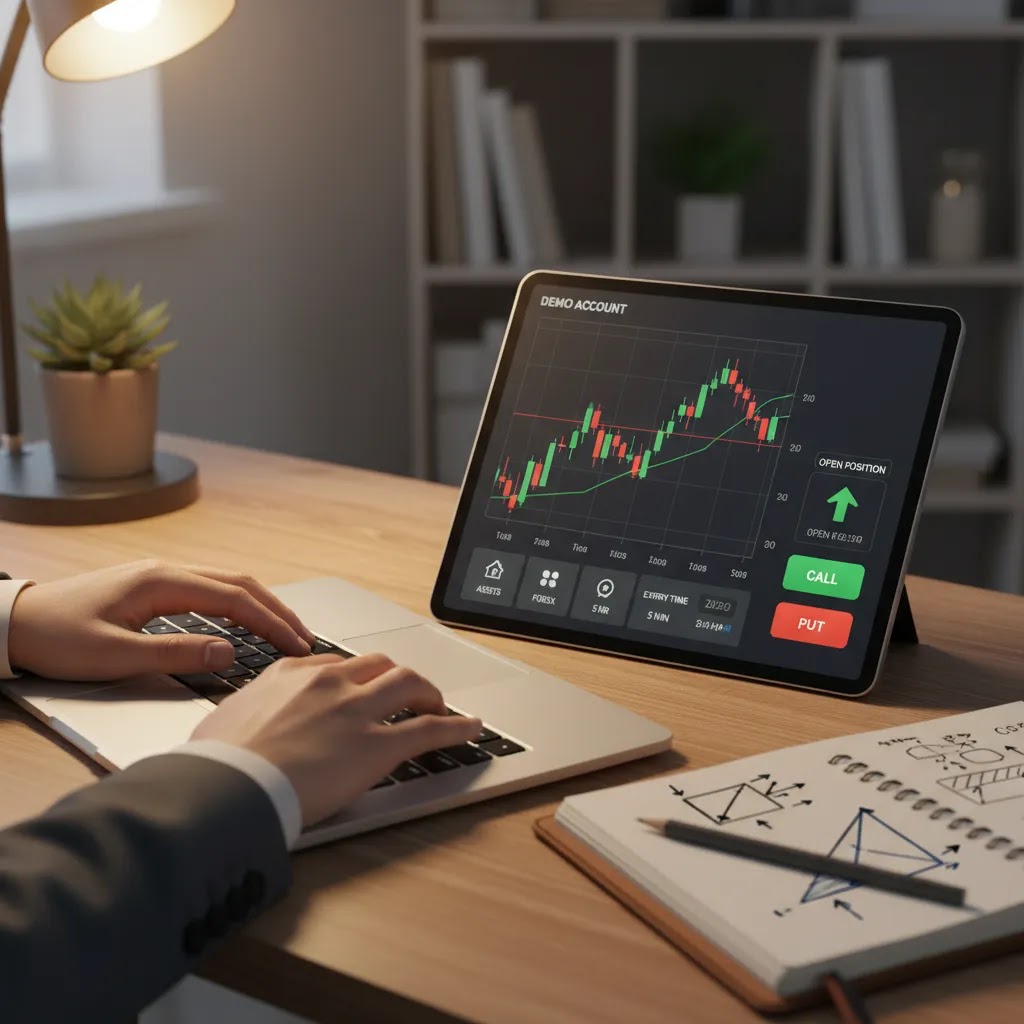
What demo trading specifically does not test
Several aspects of live trading are systematically under-tested by demo trading:
Loss aversion
The behavioural-finance literature documents that losses produce stronger emotional responses than equivalent gains. In demo trading, virtual losses produce minimal emotional response; in live trading, real losses produce real emotional response, which affects subsequent decisions.
The empirical pattern: traders who are disciplined in demo (taking losses without escalation, sticking to position sizing rules) often become loss-chasing in live trading. The behavioural shift is documented and substantial.
Overconfidence after wins
In demo trading, virtual wins do not produce the same emotional response as live wins. Live wins commonly produce overconfidence, leading to position-size escalation and reduced selectivity in subsequent trades. Demo trading does not produce this dynamic.
The empirical pattern: traders who maintain steady position sizing in demo often increase position sizes after live wins, leading to outsized losses when the inevitable losing streak occurs.
Disposition effect
The tendency to close winning trades too early and hold losing trades too long. In demo, this tendency is muted because the emotional stake is lower. In live trading, the tendency is stronger and more damaging.
In binary options specifically, the disposition effect manifests differently than in continuous-payoff trading (since binary options have fixed expiries and outcomes), but related patterns appear in trade selection (avoiding obvious setups for fear of losing on a "good" trade) and in session management (continuing to trade after losses to "make back" recent damage).
Variable reinforcement effects
The win-or-lose-then-bet-again rhythm of short-expiry trading produces gambling-like behavioural reinforcement. Demo trading produces some of this dynamic, but the absence of real money mutes the effect. Live trading exposes the trader to the full reinforcement cycle, with implications for session length, position sizing, and decision quality.
Stress responses
Major news events, unexpected price movements, and account drawdowns produce different responses in live trading than in demo. Demo accounts cannot effectively test how a trader will respond when an unexpected event causes a real-money drawdown of 20%, 30%, or more in a session.
Real-time decision pressure
Demo trading is typically conducted in a relatively low-pressure environment. Live trading, particularly during volatility, may produce decisions made under time pressure, fatigue, or competing demands. Demo testing does not effectively simulate these conditions.
The composite implication is that demo trading systematically under-estimates the difficulty of live trading. UAE residents should expect their live performance to be materially worse than their demo performance, often substantially so.
Why demo accounts are still worth using
Despite the limitations, demo accounts remain the recommended starting point for UAE residents evaluating binary options trading:
Cost-effectiveness for platform learning. The alternative to demo learning is paying for the same lessons through live-account losses. Demo learning is materially cheaper.
Broker comparison without commitment. Multiple demos can be tested without depositing or providing extensive personal information. This allows broker comparison at minimal cost.
Identifying platform issues early. Platforms with unclear order entry, ambiguous payout display, or technical issues can be identified in demo, before real money is at stake.
Strategy testing. Specific entry and exit approaches can be tested in demo, with the caveat that demo profitability is the upper bound of likely live performance.
Familiarity with contract mechanics. Beginners can learn how binary options work — fixed payoffs, expiry mechanics, payout calculations — without risking funds. Detailed mechanics treatment at Can You Make Money From Binary Options?.
Demo as gatekeeper. A trader who cannot achieve break-even in demo over a meaningful sample of trades has strong evidence that live trading will be loss-making. Demo provides a low-cost negative-screening tool.
Demo as alternative to no-deposit bonuses. For platform-testing purposes, demo accounts are categorically better than no-deposit bonuses. Demos provide platform access without KYC commitment, marketing engagement, or withdrawal-restriction traps. UAE residents should generally prefer demo testing over no-deposit bonus claims for platform evaluation. Bonus treatment at No-Deposit Bonuses.
How long to spend in demo before live trading
There is no single answer; the right duration depends on the trader's prior experience, the complexity of the intended approach, and the trader's risk tolerance. General guidance:
Minimum: 100-200 trades over multiple sessions. Below this sample, results are dominated by variance rather than signal. A trader profitable in demo over 50 trades has not provided meaningful evidence of skill.
Typical: 200-500 trades over 2-4 weeks. This sample is large enough to provide some signal (though variance still dominates at this level) and exposes the trader to multiple market conditions.
Substantial: 500+ trades over 2+ months. This sample is more informative for a trader with no prior trading experience, providing exposure to varied market conditions and time for behavioural patterns to develop.
The key question is not "how long" but "what does the demo data show". A demo period that produces consistent profitability over 200+ trades, across varied conditions, with stable behavioural patterns, is informative. A demo period of equivalent length showing inconsistent results, large variance, or dependence on specific conditions is informative in the opposite direction — strong evidence that live trading will not be profitable.
UAE residents should resist transition pressure from brokers (or the trader's own impatience) and remain in demo until the data supports a live-trading decision. A trader who is unprofitable in demo will be more unprofitable in live trading, given the behavioural degradation.
When demo testing has met its limit
Demo testing has limits beyond which additional time provides diminishing information. Indicators that the demo testing phase has reached its useful limit:
Consistent results over a sufficient sample. If demo results have stabilised — same win rate, same profit/loss profile, similar to recent results — additional demo trades will provide marginal information.
Familiarity with the platform. If the trader can navigate the platform without confusion, knows where features are located, and can place orders confidently, the platform-familiarity goal of demo has been met.
Strategy clarity. If the trader has identified the specific entries, expiries, position sizing, and risk-management approach intended for live trading, the strategy-development goal of demo has been met.
Behavioural challenges identified. If the trader has identified personal behavioural challenges in demo (impulsive trading, loss-chasing patterns, etc.), additional demo time will not resolve them — these patterns are typically more pronounced in live trading.
When these conditions are met, additional demo time has limited marginal value. The next decision is whether to proceed to live trading or to recognise that the demo evidence does not support live trading.
If the demo evidence indicates likely live profitability — sustained results above break-even win rate over substantial samples, stable behavioural patterns, clear strategy execution — the trader has a basis for measured live trading. The first live deposit should still be modest, and the live experience should be evaluated against the demo evidence.
If the demo evidence does not support live profitability — break-even or loss-making results, unstable patterns, behavioural challenges — the realistic next step is not "try live and see" but to recognise the product is not aligned with the trader's likely outcomes. The behavioural degradation in live trading typically widens, not narrows, the gap from break-even.
Demo testing is not a substitute for due diligence
A common error: using demo testing as the primary or sole broker-evaluation criterion. Demo testing provides limited information about:
- The broker's regulatory standing
- The broker's withdrawal practices
- The broker's complaint patterns
- The broker's entity structure for UAE residents
- Tier-one regulator warnings against the broker
These factors require separate evaluation through the frameworks at Regulated Brokers, Binary Options Blacklist, and the individual broker reviews. UAE residents should not select a broker on demo experience alone, however positive.
The combined evaluation: demo testing for platform suitability + regulatory and operational due diligence for broker selection + live-account validation for actual operational reliability.
Frequently asked questions
What is a binary options demo account?
A virtual-money trading environment offered by most major offshore binary options brokers. Demo accounts use real-time market data and the same trading platform as live accounts, allowing the trader to test the platform and practice trade placement without risking real funds. Virtual balances are typically $10,000, often refillable.
Are demo accounts free?
For most major brokers, yes. Demo accounts typically require minimal information (email, password) and no deposit. Some brokers may require a verified email or phone number; few require full KYC for demo access.
Can I make real money in a demo account?
No. Demo accounts use virtual currency. Gains and losses are not real, and demo balances cannot be withdrawn or converted to real money. The purpose is platform testing and learning, not income generation.
How realistic is demo trading compared to live trading?
Demo trading uses the same platform and market data as live trading, so the platform mechanics and chart behaviour are realistic. The behavioural and emotional component is materially different — virtual losses do not produce the loss aversion of real losses, and virtual wins do not produce the overconfidence of real wins. Live trading is typically more difficult than demo trading suggests.
Should I trust demo profitability as evidence of live profitability?
No. Demo profitability is the upper bound of likely live performance, not the typical case. The behavioural component of live trading — loss aversion, overconfidence, disposition effect — typically degrades performance from demo levels. UAE residents should expect live performance to be worse than demo, often substantially.
How long should I spend in demo before live trading?
There is no single answer, but a minimum of 100-200 trades over multiple sessions is typical. The substantive question is whether demo results support a live-trading decision: consistent profitability across varied conditions over a sample of 200+ trades is more informative than a quick "successful" session. UAE residents should resist transition pressure and remain in demo until the data supports a live-trading decision.
Are demo accounts the same as no-deposit bonuses?
No. Demos provide virtual money for platform testing without commitment; no-deposit bonuses provide real money credit subject to turnover requirements that compound trading losses. For platform-testing purposes, demos are categorically better — no KYC commitment, no marketing engagement, no withdrawal-restriction trap. Bonus treatment at No-Deposit Bonuses.
Do all major brokers offer demos?
Most do. The major brokers (Deriv, IQ Option, Pocket Option, Quotex, Olymp Trade, ExpertOption) all offer demo accounts as of April 2026. Specific terms (refill policies, time limits, KYC requirements) vary; UAE residents should verify each broker's demo specifications.
Can I use multiple broker demos simultaneously?
Yes. UAE residents are not constrained to a single demo. Comparing multiple demos provides useful broker-evaluation information at minimal cost.
What if I cannot make money in demo?
The realistic interpretation is that the trader is unlikely to make money in live trading. The behavioural degradation from demo to live typically widens the gap, not narrows it. A trader who cannot achieve break-even in demo over a meaningful sample has strong evidence that live trading will be loss-making. The realistic response is not "try live and see" but to recognise the product is not aligned with the trader's likely outcomes.
Are demo accounts a substitute for broker due diligence?
No. Demo testing provides limited information about regulatory standing, withdrawal practices, complaint patterns, and entity structure. UAE residents should not select a broker on demo experience alone. Combined evaluation — demo testing for platform suitability plus regulatory and operational due diligence for broker selection — is the appropriate framework.
What features should I test in a demo?
Substantive features depend on the trader's intended approach. General areas to test: chart access across required timeframes, indicator support, payout transparency at order entry, order-ticket clarity, order-confirmation flow, account management interface, mobile-web-desktop synchronisation, and demo support quality. UAE residents should specifically test the features they intend to use in live trading.
Are demo accounts a way to identify scam brokers?
Partially. Demos do not directly test the operational characteristics where scam brokers fail (withdrawal practices, account verification, support quality during disputes). However, demo communication can identify red flags: unclear platform behaviour, evasive support responses, vague terms of service. A broker that is opaque about its demo is unlikely to be transparent about live-account practices. Detailed scam-pattern treatment at Binary Options Scam.
Should I deposit immediately after a positive demo experience?
No. The demo experience should be combined with broker due diligence (regulatory standing, complaint patterns, withdrawal track record) before depositing. UAE residents should also start with a small live deposit to validate the actual operational experience, not scale to substantial deposits based on demo confidence alone.
Will the new UAE CMA framework affect demo account access?
The CMA framework (effective 1 January 2026 under FDL 32 and 33) does not directly address demo account features. The framework's expanded scope under FDL 33 Article 2 over persons targeting UAE clients may eventually affect how offshore brokers offer demos to UAE residents, but this is regulatory development that will become clearer over time. Current demo offerings remain accessible.
Final risk warning
Binary options are speculative products with a high probability of loss. Demo accounts are useful for platform testing and product learning but do not effectively predict live-trading outcomes. The behavioural and emotional component of live trading — loss aversion, overconfidence, disposition effect — typically produces materially worse performance than demo trading suggests. UAE residents trading binary options through offshore platforms are not protected by any UAE-authorised investor compensation scheme. The Capital Market Authority (effective 1 January 2026), the Dubai Financial Services Authority, and the Financial Services Regulatory Authority have not authorised any binary options broker for UAE retail clients. Demo profitability is the upper bound of likely live performance, not the typical case. Capital is at risk and total loss of deposit is a frequent outcome.
This article is informational only and does not constitute legal advice or financial advice.
Related reading
About the Author
Braden Chase is a trading specialist and former research specialist at Forex.com. He writes about market mechanics, trading instruments, and the regulatory landscape to help readers research financial markets with a clearer understanding of risk. Braden has previously served as a registered commodity futures representative for domestic and internationally-regulated brokerages. Articles are educational analysis and do not constitute investment advice. Binary options are high-risk speculative instruments and are not regulated in the UAE.