
Stochastic Oscillator Binary Options (2026 Guide)


The stochastic oscillator binary options traders use is a momentum indicator designed to show whether price may be moving into overbought or oversold territory. For UAE traders, it can be useful for timing short-expiry decisions, but it should not be treated as a standalone trigger. Binary options are high risk, and a fast indicator can produce false signals in volatile sessions or around news events. If you are still building your indicator framework, it helps to start with a broader foundation in binary options indicators before using stochastic signals in live conditions. This guide explains how stochastic works, how overbought and oversold readings are commonly interpreted, where the indicator may fail, and how to use it more carefully alongside trend and volatility filters.
Disclosure: BinaryOptionsAE may earn affiliate commissions when readers register with brokers through links on this site. That does not influence our rankings or editorial assessments. Based on the available brand information, broker evaluations are intended to follow a weighted methodology covering platform experience, payout structure, regulation and safety, deposits and withdrawals, asset availability, account types, and customer support.
Contents
What the Stochastic Oscillator Measures
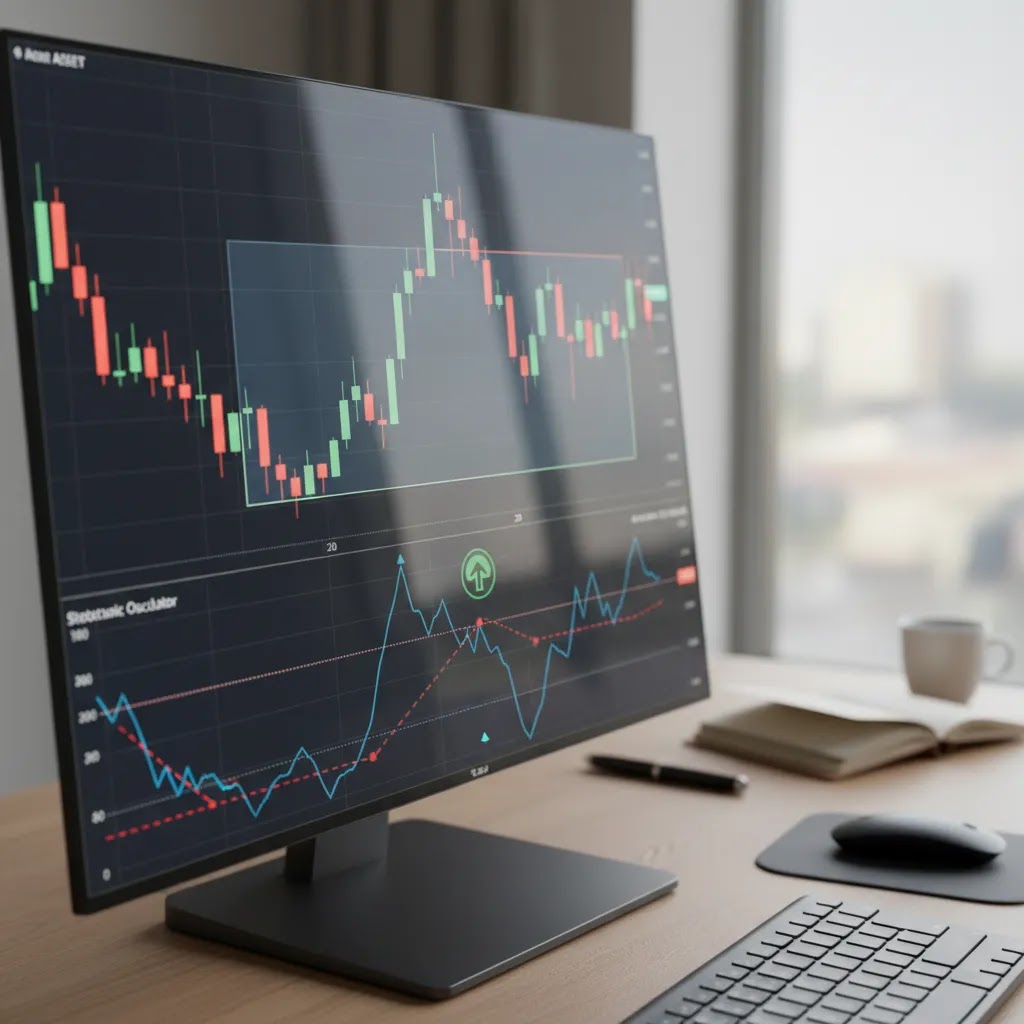
The stochastic oscillator compares the latest closing price with the recent price range over a chosen period. In practical terms, it asks whether the market is closing near the top or bottom of its recent range. That makes it a momentum tool, not a direct trend indicator.
The classic version uses two lines, %K and %D. Traders often look for line crossovers, movement above 80, and movement below 20. Those levels are commonly treated as overbought and oversold zones. In binary options, that may sound attractive because entries often depend on short-term direction, but the reading alone does not confirm that price will reverse before expiry.
This matters because binary options outcomes are fixed. You are not rewarded for being generally correct over time. You need price to be on the right side of the strike level at expiry. A stochastic signal that arrives too early may still result in a losing trade even if the broader idea eventually plays out.
For that reason, many traders combine stochastic with structure, trend, and volatility context. Some also compare it with setups based on a MACD and RSI strategy or volatility-based frameworks such as a bollinger bands strategy. The goal is not to stack indicators blindly, but to reduce weak entries that could otherwise look convincing on a fast chart.
A Simple Break-Even Reality Check for Indicator Signals
Here’s the thing, even if your stochastic rules look “right” on a chart, binary options still come down to payout math. Because your downside is usually your full stake and your upside is a fixed payout, you typically need a win rate above a break-even threshold just to avoid losing money over a large sample. Binary options trading involves significant risk of capital loss, so it helps to treat indicator signals as probabilities, not promises.
From a practical standpoint, the break-even win rate depends on the payout percentage offered on the specific asset and expiry you are trading. A simplified way to think about it is: if you risk $1 to win $0.80, you need to win more often than if you risk $1 to win $0.95. The higher the payout, the lower the win rate you typically need to break even, and the lower the payout, the higher the win rate you typically need to break even.
Consider this example using generic payouts only. If a platform offers an 80% payout on a trade, a trader often needs to win at a noticeably higher rate than 50% to break even over time. If the payout were 95% instead, the break-even win rate is closer to a coin flip, though still above 50% in most cases. This is why “good signals” can still fail as a trading approach if the payout is low or if the rules allow too many marginal entries.
What many traders overlook is how signal frequency interacts with this math. A very sensitive stochastic setup on low time frames can generate lots of crossovers. More signals can feel productive, but they can also increase the number of low-quality trades and make short expiry timing mistakes more frequent. Even with a decent hit rate, a small drop in accuracy can become expensive quickly in a fixed-payout product. In most cases, this is a reason to be stricter with confirmations, not looser.
Overbought vs Oversold in Binary Options
Overbought does not mean price must fall immediately. Oversold does not mean price must rise immediately. In binary options, that distinction is critical.
When stochastic moves above 80, it suggests price has been closing near the upper end of its recent range. That may indicate strong buying momentum, but it could also precede exhaustion. When the reading drops below 20, it suggests recent closes have been near the lower end of the range. That may indicate heavy selling pressure, but not necessarily an immediate rebound.
In strong trends, the oscillator may remain overbought or oversold for longer than many beginners expect. This is one of the main reasons traders misread the tool. They assume the level itself is the signal. In most cases, the reading is better treated as a condition that requires confirmation.
Examples of more cautious interpretation include:
For UAE traders using mobile platforms or fast web terminals, the practical issue is timing. Even small delays in execution or price movement can affect a short-duration binary trade. That is why a signal that looks precise on a chart may still produce inconsistent results in live conditions.
How to Use Stochastic Oscillator Binary Options Signals More Carefully
A more disciplined approach usually starts with market context. Ask whether price is trending, ranging, or reacting to news. Stochastic tends to behave differently in each environment.
1. Identify the market condition first
In ranging markets, stochastic may be more useful for spotting repeated swings between local highs and lows. In trending markets, fade signals become riskier because overbought and oversold conditions can persist.
2. Use support and resistance
If stochastic leaves oversold territory near a well-tested support level, that may carry more weight than the same crossover in the middle of a random price range. The same applies to overbought readings near resistance.
3. Match expiry to chart context
A one-minute chart with a five-minute expiry may behave very differently from a five-minute chart with a fifteen-minute expiry. The shorter the setup, the more market noise may distort the signal. Binary options traders should be especially careful here because timing error can be costly.
4. Avoid major news windows
Momentum indicators can become unreliable around economic releases or sudden sentiment shifts. A clean crossover may be invalidated almost instantly. That does not mean the indicator is flawed, but it does mean the setup environment matters.
5. Test on demo first
Before using real funds, monitor how the signal behaves across assets and expiries on a demo account. This may help you spot whether your rules are too loose, too reactive, or too dependent on hindsight.
Advanced Stochastic Indicators and Filters
The phrase advanced stochastic indicators can refer to several variations, including slow stochastic, full stochastic, and custom smoothing settings. These versions try to reduce noise or make crossovers easier to read, but they do not remove market risk.
Common enhancements include:
These additions may improve signal quality in some conditions, but too many filters can also create confusion. A practical rule is to know what each filter is meant to exclude. If you cannot explain why a rule exists, it may not be helping your process.
Some traders compare stochastic setups with volatility-based approaches in the broader Strategies section to understand how momentum and range signals differ. Others review risk-focused guidance in the Risk section before testing short-expiry methods. That may be especially useful for beginners, because binary options losses can accumulate quickly when signals are taken without a clear plan.
Stochastic Settings for Binary Options
Stochastic settings matter more in binary options than many traders realize, because small changes in responsiveness can change when a crossover appears. On short expiries, a signal that arrives one or two candles earlier or later can be the difference between expiring in the money or out of the money. Binary options are high risk, so treat settings as something to test and validate, not something to copy blindly from social media.
Most stochastic inputs you see on platforms refer to three components:
Two presets you will often see discussed are 14, 3, 3 and 5, 3, 3. Think of 14, 3, 3 as a more traditional setting, it tends to be slower, and it may reduce some of the rapid back-and-forth crossovers that show up in choppy markets. The 5, 3, 3 version is much faster, it will usually generate more signals, and it can look impressive in hindsight because it “catches” more small turns. The trade-off is whipsaw risk. In live conditions, especially during volatile sessions or thin liquidity periods, faster settings can cross and re-cross quickly, producing signals that do not hold long enough to match a binary expiry.
What many traders overlook is that a faster oscillator is not automatically better, it is simply more sensitive. If you shorten the lookback too aggressively, you may end up trading noise. If you smooth too heavily, you may end up seeing the crossover after the most favorable part of the move has already happened. The right balance depends on the asset, the time frame, and how stable price action is during the session you trade.
If you want a practical way to test whether a setting is usable for you as a UAE trader, keep it simple and repeatable:
This kind of checklist will not remove risk, but it can help you avoid a common mistake, changing settings after every loss or copying a parameter set that only worked in a specific market phase.
Platform and Broker Considerations
An indicator strategy is only as usable as the platform showing it. Based on the product data available here, IQ Option is the only broker with detailed current information supplied for this article. It is presented with charting tools, 100+ indicators, customizable charts, a $10,000 demo account, mobile and desktop access, and fast deposits and withdrawals. Product data also indicates a regulated platform status, though no specific regulator name, payout figure, minimum deposit, minimum trade size, Islamic account availability, or UAE payment method list was provided in the tool output for article use.
That means any trader evaluating a stochastic-based method should verify the missing details directly before opening an account. This includes payout rates that may apply to selected assets, deposit thresholds, execution quality during active sessions, and whether the account structure fits religious or practical requirements in the UAE.
What to check on a live platform before relying on stochastic signals:
If you plan to test any indicator-led strategy, read the full broker review and compare available platforms side by side before depositing. That step may help you avoid choosing a broker on marketing language alone.
Scam and Safety Red Flags When Using “Indicator Strategy” Marketing
Now, when it comes to stochastic “strategies,” many UAE traders first encounter them through ads, Telegram groups, or influencer-style content. Some of that content is educational, but a lot of it is designed to push you into depositing quickly. Binary options are high risk, and the combination of short expiries and fixed payouts makes exaggerated claims especially dangerous.
Common red flags tied to indicator marketing include:
Think of it this way, “regulated” is not just a badge on a website. Regulation usually means a specific legal entity is licensed under a named regulator, with enforceable rules and a real paper trail. UAE traders should be careful with platforms that imply UAE oversight when they are actually based elsewhere. In the UAE, the Securities and Commodities Authority (SCA) is the local regulator relevant to financial services, and you should not assume a platform is under UAE supervision unless it states this clearly and verifiably.
Before you deposit anywhere, a quick due diligence flow can protect you from the most common problems:
The reality is that indicator education should make you more independent, not more dependent on a promoter or “signal provider.” If the sales pitch is stronger than the transparency, it is usually a warning sign.
Pros and Cons
Strengths
Considerations
Who This Approach May Suit
This approach may suit traders who prefer rule-based chart reading and want a structured way to identify potential exhaustion or momentum shifts. It may also appeal to UAE beginners who are still learning price behavior and want an indicator that is visually straightforward.
It is generally less suitable for anyone looking for one-click certainty. Stochastic is not a shortcut to profitable binary options trading, and it may be particularly risky if used alone on very short expiries. Traders who need Shariah-compliant account features, clear withdrawal terms, or specific UAE funding methods should also screen the broker carefully before focusing on chart tools.
How BinaryOptionsAE Can Help You Evaluate Platforms
BinaryOptionsAE is built for UAE traders who need more than generic indicator advice. If you are considering a stochastic-based approach, the next step should be platform evaluation, not immediate live trading. Use the site to compare brokers side by side, read detailed platform reviews, and check whether a broker offers the charting tools, demo functionality, withdrawal clarity, and safety profile you need.
Before registering anywhere, compare brokers using BinaryOptionsAE’s research process and read the full review for any platform you shortlist. The site’s stated methodology weighs platform usability, payout structure, regulation and safety, deposits and withdrawals, asset availability, account types, and customer support. Based on the available brand information, affiliate compensation does not determine rankings. If you are new to binary options, start with a demo account and educational content before committing real funds.
Broker Selection Guide for Indicator-Based Trading
If you plan to use stochastic signals for binary options, broker choice matters almost as much as indicator settings. A poor platform can undermine even a disciplined process.
1. Charting and indicator flexibility
Check whether the broker offers stochastic settings you can adjust. Some platforms include only a basic version, while others allow smoothing and period changes. For traders comparing advanced stochastic indicators, this flexibility may be essential.
2. Demo account quality
A demo should make it possible to test chart layouts, signal timing, and expiry choices without financial pressure. If demo conditions are too limited, you may not learn much about how your method behaves.
3. Execution and expiry selection
Binary options depend heavily on timing. If execution is slow, expiry windows are too rigid, or charts lag on mobile, your signal quality may not translate well into trade results. This is one reason withdrawal reliability and platform performance both deserve attention.
4. Safety and transparency
Do not treat indicator features as a substitute for due diligence. A broker should clearly explain account verification, withdrawal policy, and any stated regulatory status. If those details are vague, the platform may not deserve your trust regardless of how many indicators it offers.
5. UAE-specific practicality
For UAE readers, it is sensible to confirm payment method compatibility, mobile usability, support responsiveness, and any account features relevant to Islamic finance. Even a technically strong platform may be a poor fit if withdrawals are difficult or account terms are unclear.
As a general rule, build your process in this order: understand the indicator, test it on demo, compare brokers carefully, read the full review, and only then consider whether live trading fits your risk tolerance. That sequence may help reduce preventable mistakes.
Frequently Asked Questions
Is stochastic oscillator good for binary options?
It may be useful, especially in range-bound markets, but it is not enough on its own. Binary options require correct direction within a fixed time window, so a signal can be technically reasonable yet still expire out of the money. Most traders are better served using stochastic with market structure, trend context, and demo testing.
What do overbought and oversold mean in stochastic?
Overbought usually refers to readings above 80, while oversold usually refers to readings below 20. These zones suggest strong recent momentum relative to the recent price range. They do not guarantee reversal. In trending markets, price may stay in those zones longer than many traders expect.
Which time frame works best for stochastic oscillator binary options?
There is no single best time frame. The right choice may depend on asset behavior, your expiry setting, and how much market noise you can tolerate. Very short charts can generate frequent but weaker signals. Testing on demo first is usually the safer approach before risking real capital.
Should beginners use stochastic alone?
Usually not. Beginners often misread overbought and oversold levels as automatic reversal signals. It is generally safer to pair stochastic with support and resistance, a trend filter, and a clear risk framework. Reviewing related methods such as a MACD and RSI strategy may also help build broader indicator judgment.
How is stochastic different from RSI in binary options?
Both are momentum indicators, but they calculate conditions differently. Stochastic compares the close to the recent trading range, while RSI measures the speed and size of price changes. Stochastic may react faster, which can be useful, but that same sensitivity may also produce more false signals on lower time frames.
Can stochastic be used in trending markets?
Yes, but it should usually be used differently. In a trend, overbought and oversold readings may be better treated as signs of momentum than immediate reversal points. Traders often add structure or volatility filters, including ideas related to a bollinger bands strategy, to avoid fading strong moves too early.
What broker features matter if I want to trade with indicators?
Chart quality, indicator customization, demo availability, execution speed, mobile stability, and withdrawal transparency all matter. In binary options, weak execution or limited expiry choices may reduce the usefulness of a good chart setup. Broker safety and payment practicality for UAE users should also be checked before any deposit.
Does BinaryOptionsAE recommend specific stochastic trades?
No. BinaryOptionsAE provides educational content and broker research, not personalized trade recommendations. The goal is to help UAE traders understand tools, compare platforms, and reduce avoidable mistakes. You should make your own independent decisions and use demo practice before considering live binary options trading.
Where should I start if I am new to indicator-based trading?
A sensible starting point is learning the basics of binary options indicators, then reviewing broader educational material in the Strategies section. If risk control is your main concern, the Risk category may also be worth reading before testing any short-expiry approach.
What is the best stochastic setting for binary options?
There is no single best setting that works across all assets and sessions. Many traders start with 14, 3, 3 because it is more stable, while others experiment with faster settings like 5, 3, 3 for short-term signals. The safer approach is to test one setting on demo on one asset, with a consistent time window and expiry, and only keep it if it holds up across 20 to 50 samples. Binary options are high risk, so avoid choosing a setting based only on a few screenshots or hindsight charts.
What is 5-3-3 stochastic settings?
5, 3, 3 typically means a %K lookback of 5 periods, a %D smoothing of 3, and a slowing value of 3 on platforms that support full stochastic inputs. Compared with 14, 3, 3 it reacts faster and can generate more crossovers. In live binary options conditions, that speed can also increase whipsaws and false signals, especially in choppy or news-driven markets.
What is the most profitable binary options strategy?
There is no strategy that is “most profitable” for everyone, and anyone claiming otherwise is usually oversimplifying or selling something. Binary options results depend on payout rates, execution, market conditions, and whether a method can maintain a win rate above its break-even level over a large sample. If you want a realistic process, focus on understanding how the setup works, testing it on demo, keeping rules consistent, and choosing a broker with clear terms and withdrawal policies.
Which indicator has 100% accuracy?
No indicator has 100% accuracy in live markets. Indicators summarize past price behavior, they do not guarantee the next move, and binary options add timing pressure because you need to be right at expiry. If someone markets a “perfect” indicator or guaranteed signal, treat it as a major red flag and do extra due diligence before depositing or sharing personal information.
Key Takeaways
Conclusion
The stochastic oscillator can be a useful part of a binary options process, particularly for identifying momentum extremes and possible turning points in range-bound conditions. Still, it should be treated as one piece of evidence rather than a complete trading system. For UAE traders, the practical risks are not limited to signal quality. Platform execution, chart flexibility, withdrawal reliability, and account transparency may all affect real-world outcomes. Before opening a live account, use BinaryOptionsAE to compare brokers, review platform details, and study the educational material available on strategy and risk. If you are new, begin with a demo account and only move to live trading if you fully understand the risks and the broker terms.
Binary options trading involves a high level of risk and may not be suitable for all investors. You may lose some or all of your invested capital. Past performance does not guarantee future results. This content is for informational purposes only and does not constitute investment advice. BinaryOptionsAE may receive compensation when you register with a broker through links on this site. This does not influence our editorial rankings or assessments. Binary options trading involves significant risk and is not suitable for all investors. You may lose some or all of your invested capital. Past performance is not indicative of future results. This content is provided for informational and educational purposes only and does not constitute investment advice. BinaryOptionsAE does not recommend placing any specific trades. Always trade responsibly and only with funds you can afford to lose.
About the Author
Braden Chase is an investor, trading specialist, and former research specialist for Forex.com who helps aspiring investors develop the confidence and habits they need to make an income from the market. Braden has served as a registered commodity futures representative for domestic and internationally-regulated brokerages and has also spoken & moderated numerous forex and finance industry panels across the globe.