
How Binary Options Trading Works: Step-by-Step Reference (2026)

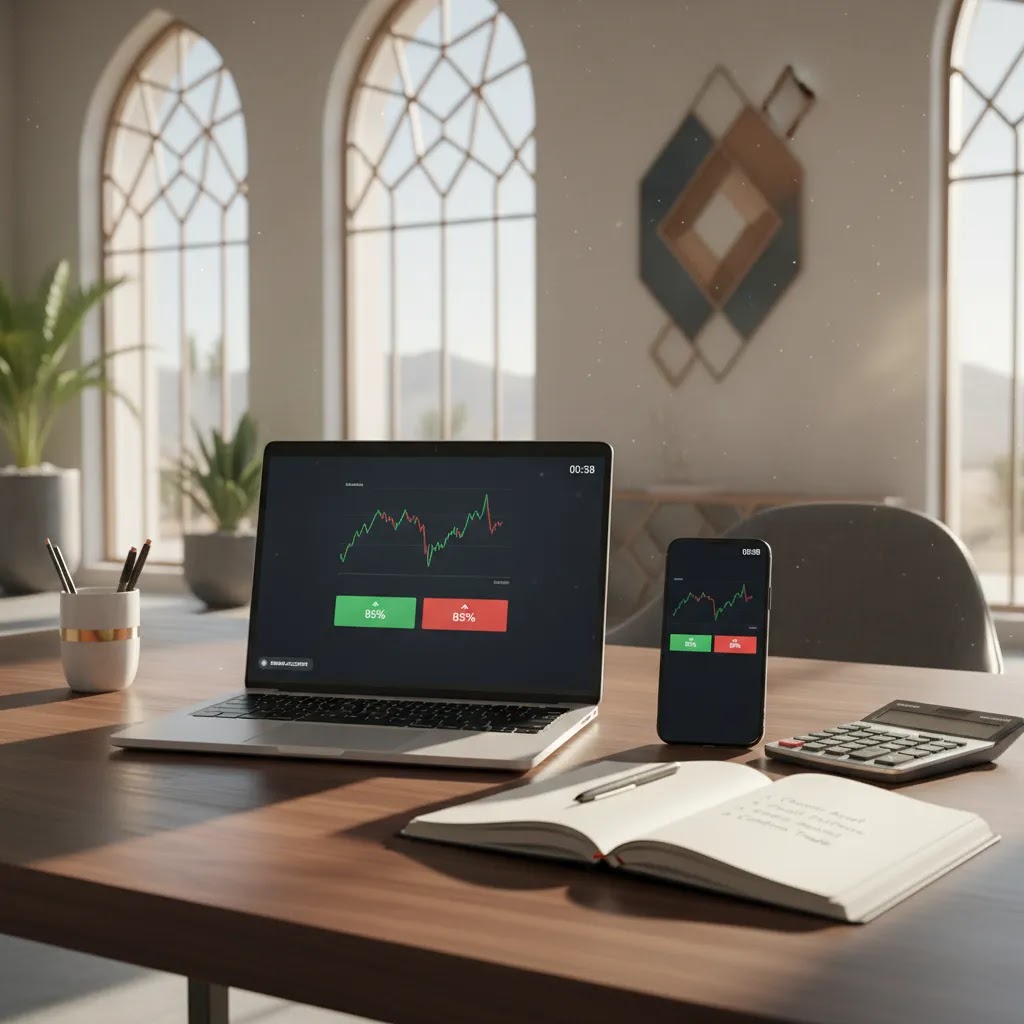
Capital is at risk. This article documents the mechanical sequence of placing a binary options trade — from account selection through contract close — and the operational decisions that affect outcomes. The mechanical sequence is straightforward; the structural mathematics (74–80% retail-loss rates per ASIC's review) is not changed by procedural familiarity.
Risk warning
The UAE Capital Market Authority (CMA, successor to the SCA from 1 January 2026 under Federal Decree-Laws 32 and 33 of 2025), the Dubai Financial Services Authority (DFSA), and the Financial Services Regulatory Authority (FSRA) of ADGM have not authorised any binary options broker for retail clients.
What a binary options trade actually consists of
Contract elements at trade entry:
- Underlying asset — the instrument being referenced (e.g., EUR/USD, gold spot, NASDAQ-100). The trader does not own the asset.
- Direction (call/put). Call/higher means price will be above the strike at expiry; put/lower means below.
- Strike level. The price level against which the contract settles.
- Expiry time. When the contract settles. Typical 30 seconds to 24 hours.
- Stake. Capital committed. Maximum loss equals the stake.
- Payout percentage. Broker-specified return on a winning trade (e.g., 80%).
Contract resolution at expiry:
- The broker reads the underlying asset's price at the exact expiry timestamp
- If correct (in the money): broker credits stake + (stake × payout percentage)
- If incorrect (out of the money): broker retains the stake
- At-the-money: broker rules vary
A winning trade returns less than 100% of stake (typically 70–90%); a losing trade returns 0%. The asymmetry is the source of structural break-even mathematics.

Step-by-step mechanical sequence
- Account selection and funding. KYC documentation typically required before first withdrawal. Initial deposit ($10–200 minimum). The account selection itself is the most consequential decision.
- Asset selection and chart analysis. Major forex pairs during London-NY overlap (4:00–8:00 PM UAE time); gold spot during European/NY morning; major US equity indices during NY session.
- Direction selection. Call (higher) or put (lower) based on analysis.
- Expiry selection. Very short (30s–5min): variance dominates; short (5–30 min): some responsiveness; medium (30 min–4 hr): more meaningful; long (1+ days): closest to typical trading horizons.
- Stake selection and position sizing. Pre-committed percentage of account: 1–2% per trade. Independent of recent results.
- Payout verification. Verify the displayed payout supports the trader's documented win rate above the break-even threshold.
- Trade confirmation. The broker holds the stake; contract is now active.
- Trade observation (optional). The contract settles at the expiry timestamp regardless of intra-trade price movement.
- Trade settlement. At expiry, broker reads price and determines settlement.
- Trade documentation. Date, time, asset, direction, stake, payout displayed at entry, expiry, reason for entry, outcome, resulting balance.
Distinguishing binary options from other speculative trading
- Forex / CFD trading. Profit and loss vary continuously. No fixed expiry. Stop-loss and take-profit standard.
- Listed options. Variable, non-linear payoff. Greeks determine moment-by-moment value. Substantially more complex.
- Binary options. Fixed payoff at expiry. Predetermined expiry. Typically only through offshore brokers.
CFD traders manage variable losses through stop-loss placement; binary options traders cannot. Detailed comparison at Alternatives to Binary Options and CFD vs Binary Options.
Break-even mathematics — the central reality
Break-even win rate by realised payout
| Realised average payout | Break-even win rate required |
|---|---|
| 70% | 58.8% |
| 75% | 57.1% |
| 80% | 55.6% |
| 85% | 54.1% |
| 90% | 52.6% |
A trader at 80% realised average payout needs to win at least 55.6% of trades to break even. ASIC's data shows 74–80% of retail clients are net loss-making, suggesting that most retail traders' win rates fall below this threshold.
Common contract types
- High/Low (Call/Put). The most common type. Most retail trading should focus here.
- One-Touch. Predicts whether price will touch a target level. Higher payouts; lower trigger probability.
- Range / Boundary. Predicts whether price stays within or moves outside a defined range.
- Ladder. Multiple strike levels with different payouts.
- Turbo (very short expiry). Variance dominates outcome.
Demo trading — the substantive first step
- Platform mechanics validation. Verifying that the broker's interface works as advertised.
- Strategy mechanics testing. Determining whether the trader's analytical approach can be implemented.
- Realised payout observation. Recording the broker's realised payouts.
- Empirical win-rate documentation. Generating sufficient trade data (100–300+ trades).
- Behavioural pattern observation. Identifying tendencies that will affect live trading.
Demo performance typically overstates expected live performance by 30–60%. A trader with 60% demo win rate may achieve 50–55% in live trading. Demo testing should run for 4–8 weeks minimum.
Position sizing and risk control
- Per-trade risk: 1–2% of current account balance.
- Daily loss limit: 4–6% of starting-of-day balance.
- Loss-streak stop: 3 consecutive losses.
- Maximum trades per session: 5–10.
- Weekly review threshold: 10% drawdown.
- Pre-commitment, not in-session decisions.

Pre-deposit verification framework for UAE residents
- Verify the broker. Tier-one regulator warning list status (FCA, CySEC, ASIC, BaFin, CONSOB); 12+ months of operational history; documented complaint patterns.
- Read the account terms. Withdrawal terms, KYC requirements, account suspension conditions, discretion clauses, bonus terms.
- Plan the deposit method. Card payments provide chargeback rights (within 120 days). Wire transfers and cryptocurrency provide no recovery mechanisms.
- Decline bonuses on first deposit. Bonus turnover requirements affect withdrawability.
- Make a small first deposit ($200–500). The first deposit is a test of broker operational quality.
- Test withdrawal early. Within 1–2 weeks, request a small withdrawal ($50–100).
- Document realised performance. Per-trade record from day one of live trading.
Withdrawal mechanics and common friction points
- KYC / identity verification. Government-issued photo ID, proof of address, proof of payment method ownership. Verification can take 1–7 business days.
- Withdrawal processing time. Cards: 3–7 business days; e-wallets: same day to 24 hours; bank wires: 3–10 business days; cryptocurrency: same day for most blockchains.
- Same-method-as-deposit rule. Most brokers require withdrawals to use the same payment method as the original deposit, up to the deposit amount.
- Minimum withdrawal amounts. $10–100 typical.
- Bonus turnover requirements. If a deposit bonus was accepted, typically 30–50× the bonus amount in volume.
- Pro-active red flags. Pressure to deposit more to "unlock" withdrawals; vague "compliance review" without specifying triggers; repeated documentation escalation.
Common procedural errors
- Live trading before demo validation
- Stake increases after losses (revenge sizing)
- Stake increases after wins (overconfidence sizing)
- Trading without a documented setup
- Excessive trade frequency
- Chasing high-payout assets without understanding the variance
- Trading during emotional or fatigued states
- Bonus acceptance without understanding turnover requirements
- Late or absent KYC documentation
- Inadequate trade documentation
Frequently asked questions
Are binary options legal for UAE residents to trade? Binary options are not specifically banned but are not authorised by the CMA, DFSA, or FSRA for retail clients. UAE residents trade through offshore brokers without UAE-resident investor compensation scheme protection.
How much capital should UAE residents start with? Start with capital you can afford to lose entirely. Keep first deposit small ($200–500) for broker validation.
How long should demo trading last before live trading? 4–8 weeks minimum, with at least 200 documented trades.
What is a realistic payout to expect? Realised average payouts at offshore brokers are typically 75–85% across all trades, with peak payouts (90%+) on selected contracts.
Is binary options trading profitable for typical retail traders? Documented retail-loss rates are 74–80% (ASIC). Profitability is a low-probability outcome consistent with the broader retail outcome distribution.
What is the safest way to learn binary options? Read educational material, demo trade for 4–8 weeks at multiple brokers, document 200+ trades, compare to break-even threshold, small first deposit, test withdrawal early. Progression takes 2–4 months minimum.
What if my withdrawal is delayed at a broker? Document all communications. Verify whether the broker is on tier-one regulator warning lists. Pursue payment-method-specific recovery (card chargeback within 120 days if applicable). Further deposits to "unlock" funds reliably produce additional losses.
Final risk warning
Binary options are speculative derivative contracts with documented retail-loss rates of 74–80%. The mechanical sequence is straightforward; the structural mathematics are not changed by procedural familiarity. Capital is at risk and total loss of deposit is a frequent outcome.
Related reading
About the Author
Braden Chase is a trading specialist and former research specialist at Forex.com. He writes about market mechanics, trading instruments, and the regulatory landscape to help readers research financial markets with a clearer understanding of risk. Braden has previously served as a registered commodity futures representative for domestic and internationally-regulated brokerages. Articles are educational analysis and do not constitute investment advice. Binary options are high-risk speculative instruments and are not regulated in the UAE.