
Binary Options Course Reviews for UAE Residents (2026)


Risk warning: Binary options are high-risk speculative instruments. Not regulated in the UAE. Capital at risk.
Choosing a binary options course may look simple at first, but UAE residents often find that many programs are either too basic, too promotional, or too disconnected from the risks of live trading. A useful binary options course should explain payout mechanics, expiry selection, chart reading, platform behavior, and capital protection in a way that helps with broker evaluation.
Risk warning
The CMA, DFSA, and FSRA have not authorised any binary options broker for retail clients. Educational courses do not change the structural mathematics of fixed-payout contracts and do not create regulatory protection for offshore broker accounts.
What this comparison covers
This is not a broker review. It is an evaluation of binary options courses as a learning tool for traders in the UAE. Course quality varies widely. Some are free learning libraries built into broker platforms. Others are paid mentorship packages, prerecorded video courses, webinar series, or strategy-focused training communities.
For UAE readers, the central question is not only whether a course teaches chart patterns or trade timing. The more important issue is whether it helps with understanding how binary options actually work in practice: fixed payout structure, all-or-nothing outcomes, short expiry pressure, and broker-specific differences.
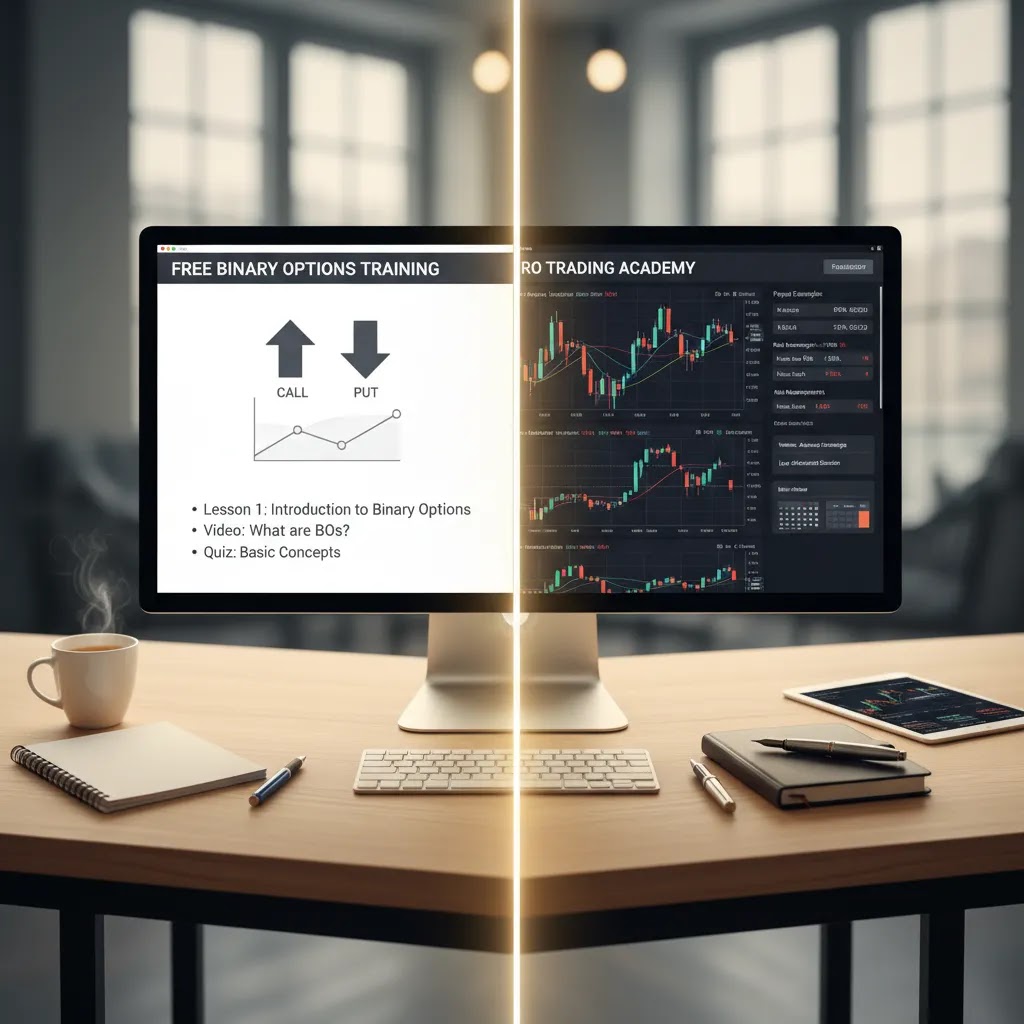
Free vs paid binary options courses
Free binary options courses
Free training usually comes from broker education centres, video-based lessons, webinars, beginner articles, or demo-account tutorials. The main benefit is obvious: vocabulary and platform basics can be learned without adding course fees to an already risky trading activity.
The weakness is that free training is often broad rather than deep. Some lessons may focus more on registration and platform usage than on risk management, loss frequency, or trader psychology.
Paid binary options courses
Paid courses usually promise more structure: a learning path, trading psychology modules, live sessions, chart reviews, strategy breakdowns, and direct mentor access. A higher price does not mean better education. Many paid programs package common information under aggressive marketing.
Where a course spends more time discussing earnings potential than explaining drawdowns, losing streaks, and the need to practice on demo first, that is a warning sign.
How to judge a binary options course
- Does it explain binary options mechanics properly? A course should clearly cover fixed return structure, strike level logic, expiry times, and the difference between High/Low, turbo-style trades, and other structures.
- Does it treat risk seriously? Any course that minimises losing streaks should be treated cautiously.
- Does it use demo trading realistically? Training that pushes immediate live deposits before sufficient practice is often misaligned with user protection.
- Is the course linked too closely to one broker? Broker-hosted education can be useful, but it may naturally emphasise that platform's strengths.
- Does it help with broker evaluation? It should help with understanding regulation status, funding methods, mobile usability, and customer support quality.

How payouts affect break-even (course reality check)
The simplest break-even estimate is: break-even win rate = 1 / (1 + payout rate). At an 80% payout (0.80), the break-even win rate is 1 / 1.80, approximately 55.6%. At a 60% payout, the break-even win rate becomes 1 / 1.60, which is 62.5%. Courses that skip this point often leave beginners with the impression that any strategy that "wins more than it loses" is enough.
"Fixed payout" does not always mean every trade pays the same percentage across the platform. The payout offered can vary by asset, expiry length, market hours, and broker terms. A credible binary options training program should explain that the payout offered on the instrument being traded warrants checking.
Broker and platform context for learners
Course quality and broker quality are not the same thing, but they often overlap. From the current product data, IQ Option is referenced because it combines educational resources, webinars, advanced charting tools, customisable indicators, and a refillable approximately $10,000 demo account.
The IQ Option binary options offering is provided through IQ Option LLC (St Vincent and the Grenadines), and the CySEC-licensed European entity does not offer binary options to retail clients due to the ESMA prohibition that took effect on 2 July 2018.
Course content vs market reality
Course examples are often recorded under conditions that are hard to reproduce exactly. Short expiry binaries are especially sensitive to quote timing and small price fluctuations. A chart setup that looks clean in a video can play out differently in live trading where price moves quickly.
On expiry choice, a course should explain how changing the duration changes the nature of the trade. Very short expiries can behave less like traditional chart analysis and more like a micro-timing exercise. Where a course only teaches one expiry style and presents it as universally "better," it is likely oversimplifying.
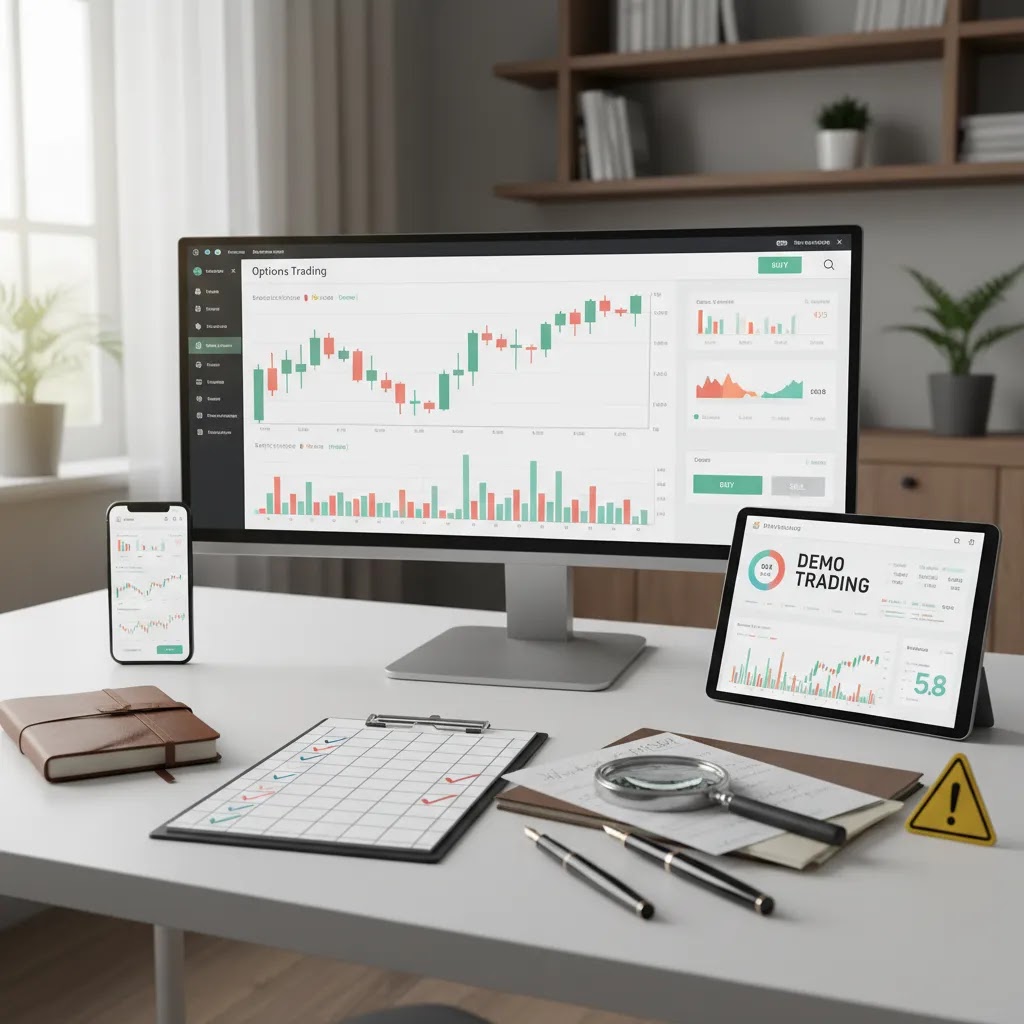
Selection guide for UAE residents
- Define course objective. Some readers need basic literacy. Others need structure, journaling habits, chart interpretation, or a repeatable review process.
- Inspect teaching format. A good course should move from market basics to risk control, then into trade examples and post-trade review.
- Check whether material is platform-agnostic or broker-tied. Platform-specific lessons can help with execution but should not be the only source of broker evaluation.
- Look for evidence of realistic teaching. Does the instructor discuss false signals, quiet market periods, overtrading, and emotional mistakes?
- Match course complexity to trader's stage. For beginners, advanced signal groups and premium mentorship may not help much.
How to spot a "fake course" or scam-adjacent training offer
- Guaranteed-results language. Where an educator promises a specific win rate, monthly income, or claims that losses can be "recovered" quickly, that warrants treatment as a serious credibility problem.
- Core product is signals, not teaching. Signals may be marketed as a shortcut, but they can train traders to follow instructions without understanding payout math.
- Pressure tactics. Where a deposit is required immediately to "unlock" lessons, or readers are rushed into a specific broker, stepping back is the more sensible action.
- Unverified "regulated" claims. No binary options broker is authorised by the CMA, DFSA, or FSRA. Many offerings are offshore.
- No clear refund policy. Where there is no refund policy, or it is written so vaguely that it can be denied for any reason, the course may not be accountable to students.
Frequently asked questions
What is a useful binary options course for beginners in the UAE? A useful starting point is a course that explains core mechanics clearly, uses plain language, and encourages demo practice before live trading.
Are paid binary options courses better than free ones? Not necessarily. Paid programs may offer structure and support, but many free resources already cover fundamentals well.
Do broker education centres count as real binary options training? They can, especially where they include tutorials, webinars, and demo guidance. Broker education is usually designed around that platform's environment.
Is a demo account enough without a paid course? A demo account may be enough for some beginners where it is paired with a structured learning plan.
How long does it take to learn binary options? Learning the basics can be relatively quick, but learning to apply that knowledge consistently is usually much slower.
Is binary trading really profitable? Binary options can produce profits for some traders in some periods, but profitability is not guaranteed. Where any course claims profitability is easy or assured, that is usually a sign to avoid it.
Key takeaways
- A binary options course is worth time only where it improves understanding of risk, payouts, expiry decisions, and broker evaluation.
- Free courses may be enough for beginners, especially when paired with demo practice and structured self-study.
- Paid courses should be judged on teaching depth, realism, and mentor value, not marketing promises.
- For UAE residents, platform terms, withdrawals, regulation status, and account suitability matter just as much as the training itself.
Related reading
About the Author
Braden Chase is a trading specialist and former research specialist at Forex.com. He writes about market mechanics, trading instruments, and the regulatory landscape to help readers research financial markets with a clearer understanding of risk. Braden has previously served as a registered commodity futures representative for domestic and internationally-regulated brokerages. Articles are educational analysis and do not constitute investment advice. Binary options are high-risk speculative instruments and are not regulated in the UAE.