
0DTE Options vs Binary Options (2026 Guide)


0DTE Options vs Binary Options is an important comparison for UAE traders who want very short-term market exposure but may not fully understand how different the risk, pricing, and trade mechanics really are. Although both products can involve rapid outcomes, they are not interchangeable. A binary contract typically offers a fixed all-or-nothing result at expiry, while 0DTE options can gain or lose value continuously before the trading day ends. That difference affects cost, flexibility, capital management, and trader behavior. Binary options trading also carries a high level of risk, and short expiries may increase decision pressure and loss frequency. If you are still building your foundation, it may help to review types of binary options before comparing short-term instruments.
Disclosure: BinaryOptionsAE may earn affiliate commissions when readers register with brokers through links on this site. This does not influence our rankings or editorial evaluations. Based on the brand methodology available, brokers are assessed using weighted criteria that prioritize platform usability, payout structure, regulation and safety, deposits and withdrawals, asset availability, account types, and customer support.
Contents
What This Comparison Covers
This article compares 0DTE options and binary options from a practical trader perspective rather than treating them as the same short-term product. "0DTE" means zero days to expiration. These are standard options contracts that expire on the same trading day. Binary options, by contrast, usually settle to a fixed payout or a full loss depending on whether the contract conditions are met at expiry.
For UAE readers, the main issue is not just speed. It is whether the product structure matches your risk tolerance, your experience level, and the platform protections available to you. The Fundamentals section on BinaryOptionsAE exists for this reason: many traders focus on short-term profit scenarios without understanding how pricing, expiration, and execution may work against them.
This is also where confusion often overlaps with broader product comparisons such as binary options vs CFDs and binary options vs forex. Those are separate instruments with different margin, leverage, and settlement rules. Here, the focus is the difference between options and binary options in a same-day trading context.
0DTE Options vs Binary Options: Core Differences
The biggest distinction is the payoff profile. A binary option generally has a predefined outcome. If the contract expires in the money, the trader may receive a fixed return based on the payout rate offered. If it expires out of the money, the stake is usually lost. That fixed structure is simple to understand, but simplicity should not be confused with lower risk.
0DTE options work differently. Their value can change continuously during the day because they are affected by the underlying asset price, implied volatility, time decay, and the strike selected. You are not limited to one fixed result at expiry. In many cases, you may be able to close the position before expiration, reduce exposure, or lock in gains or losses earlier. That added flexibility can be useful, but it also introduces more complexity.
Vanilla options vs binary options is therefore not only a question of duration. It is a question of pricing mechanics. Binary contracts are typically easier for beginners to grasp at the surface level. Vanilla options, including 0DTE setups, require a stronger understanding of strike selection, premiums, Greeks, and intraday sensitivity. If a trader does not understand those variables, losses may happen faster than expected.
For many UAE beginners, the attraction of binary options is the visible maximum loss and the straightforward expiry outcome. For more advanced traders, 0DTE options may offer more strategic flexibility. Neither product should be treated as suitable by default, and both require disciplined risk control.
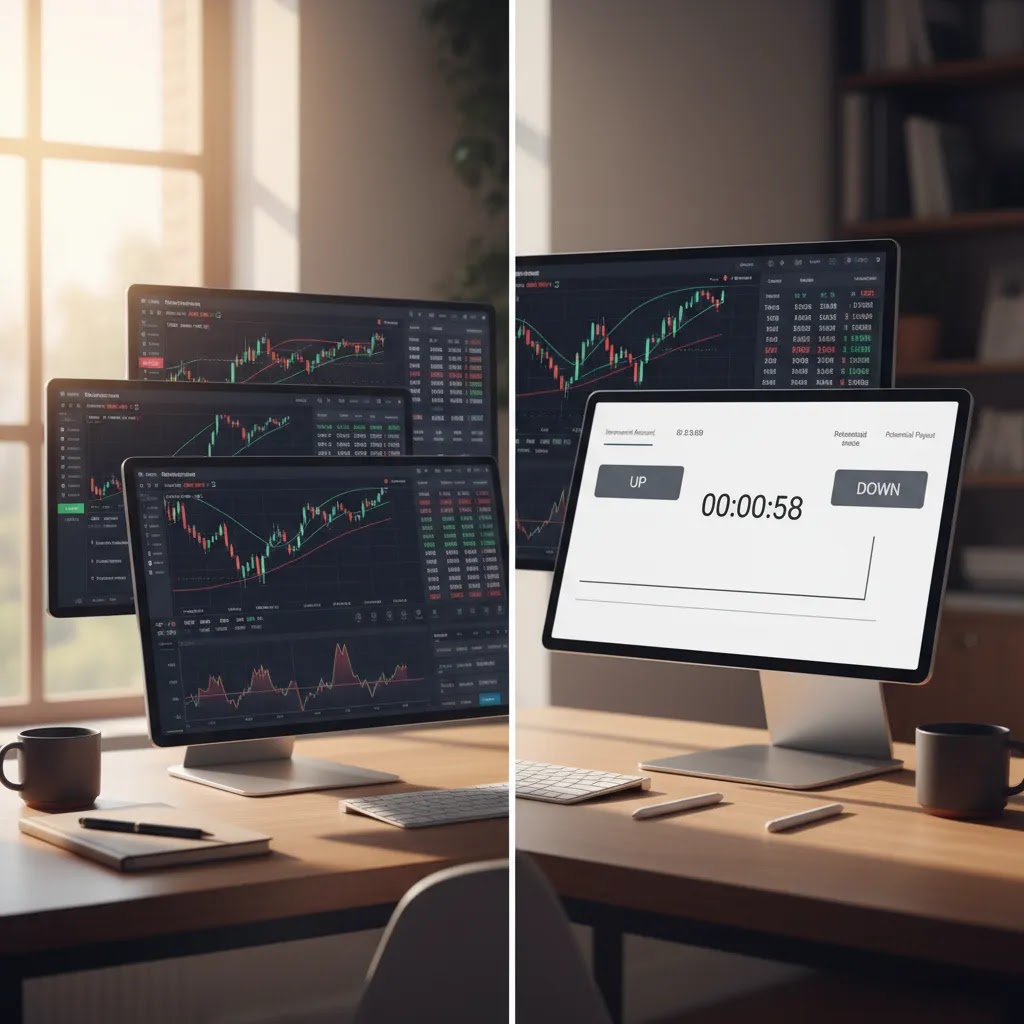
What “Digital Options” Means, and Why It Gets Confused With Binary Options
Here’s the thing, the term “digital options” is often used as a synonym for binary options. In many broker platforms, “digital” simply means the same all-or-nothing structure: you either receive a fixed return if the expiry condition is met, or you lose the stake if it is not.
Confusion happens because “digital option” can also describe a broader category of cash-or-nothing structures that may be priced more like a market instrument rather than a broker-posted fixed payout. In other words, the label alone does not tell you how the contract is priced, where the quote comes from, or how settlement is calculated. For a UAE trader comparing products, that difference matters because it changes what you are really paying for, and how much control you may have before expiry.
Think of it this way. Many broker-style binaries show you the stake and the payout upfront. You see a posted payout percentage, you choose an expiry, and the platform defines the outcome at expiration based on its rules and price source. Market-priced digitals, on the other hand, may be quoted more like an option price. The “fair value” can shift quickly with volatility and time remaining, and the cost to enter could change even if the strike level stays the same. That can make the contract behave less like a fixed deal and more like a tradable instrument where execution and pricing are part of the risk.
Before you deposit, check the terminology at the contract level. Look for the settlement method, how pricing is displayed (fixed payout versus a changing quoted price), whether you can exit early or close out, and where the platform says the price comes from. These details do not remove risk, but they help you avoid comparing two products that share a similar name while behaving very differently in real trading.
Side-by-Side Comparison
| Criteria | 0DTE Options | Binary Options |
|---|---|---|
| Expiration | Expires the same trading day | May expire in minutes, hours, or at a set contract time |
| Payoff Structure | Variable profit or loss based on option price movement | Fixed payout if conditions are met, full stake loss if not |
| Pricing Complexity | Higher, due to premium, strike, time decay, and volatility effects | Lower on the surface, but risk remains high because payout odds may not favor the trader |
| Early Exit | Often possible depending on market access and liquidity | May be limited or unavailable depending on the platform and contract type |
| Capital at Risk | Premium paid, but actual position behavior can be more complex | Usually the full stake on each contract |
| Best Understood By | More experienced options traders | Traders who want simple contract outcomes, though not necessarily beginners |
| Main Psychological Trap | Overtrading due to rapid intraday price changes | Repeated short-expiry entries after losses |
| UAE Research Focus | Broker access, options knowledge, execution quality | Payout transparency, broker safety, withdrawals, and demo availability |
Market Access and Real-World Trading Frictions (Liquidity, Slippage, and Execution)
What many traders overlook is that the “theory” of a product is not the same as trading it live. With short-duration instruments, friction can matter almost as much as direction. This is true for both 0DTE options and binary options, and it is one reason short-term speculation can produce results that feel unpredictable even when your market view is reasonable.
With 0DTE options, liquidity and spreads can be a major variable. Near expiry, option premiums can change very fast because time decay accelerates and the contract becomes highly sensitive to small moves in the underlying. If the bid-ask spread is wide or liquidity is thin, your fill price and your ability to exit may be meaningfully worse than what you expected. Even a small difference in premium can change the risk-to-reward profile quickly when the clock is working against you. This does not make 0DTE “untradeable,” but it does mean execution quality and market access conditions are part of the risk.
Binary options have their own friction points. The settlement is usually determined by a specific price source at a specific expiry timestamp, and platforms may apply rules that affect borderline outcomes. The “at the money” case is a common example. Some contracts may be treated as a push, some may be treated as a loss, and some may be settled differently depending on the broker’s terms. Expiry cutoffs also matter. If a platform uses a particular close price, a snapshot, or a quote feed that differs from what you are watching elsewhere, you can end up with a different result than expected even if your directional call was close.
For UAE traders specifically, the practical checks should happen before funding an account. Read how contract specifications are defined, how execution and settlement are described, and whether the broker clearly explains price sources and expiry rules. Also check how deposits and withdrawals are handled, because platform friction is not only about fills. Withdrawal handling and support responsiveness can be just as damaging as being wrong on the market.

Pros and Cons
Strengths
Considerations
Who Each Product May Suit
Binary options may suit traders who want defined outcomes, fixed expiry times, and simpler contract logic, but only if they understand that a simpler interface does not reduce risk. They may also appeal to those testing very small position sizes on a demo account before moving to live conditions.
0DTE options may suit more experienced market participants who already understand vanilla options, intraday volatility, and the impact of time decay. They could be a better fit for traders who want to manage positions actively during the trading day rather than wait for a fixed binary outcome.
For beginners in the UAE, neither product should be treated casually. A demo-first approach is usually more appropriate. If your main interest is broker selection, payment methods, payout transparency, and account safety in binary trading, reviewing the brokers listed in the Brokers section may be a more useful next step than choosing based on speed alone.
How BinaryOptionsAE Suggests You Evaluate Them
BinaryOptionsAE is designed specifically for UAE traders researching binary options platforms, not general multi-asset speculation. That matters because the key decision is often not "which product is faster?" but "which structure and which platform create the least avoidable risk for my situation?" Based on the stated methodology, the site evaluates brokers across platform experience and usability, payout structure and return rates, regulation and safety, deposits and withdrawals, asset availability and trade types, account types, and customer support.
If you are leaning toward binary trading rather than same-day vanilla options, explore our broker comparison resources before registering anywhere. Compare brokers side by side, read the full review of any platform you are considering, and start with a demo account where available. BinaryOptionsAE states that affiliate compensation does not influence rankings, which is especially important in a high-risk niche where platform quality may affect withdrawals, pricing transparency, and overall trader protection.

Selection Guide: What UAE Traders Should Check First
Whether you are comparing options trading vs binary options or narrowing down binary platforms specifically, the selection process should be practical and risk-aware.
1. Understand the payoff before you trade
With binary options, ask what payout rates may reach on selected assets and how often those headline figures actually appear. A contract offering up to a high percentage payout may still be unfavorable over time if win conditions are difficult or if you trade impulsively. With 0DTE options, focus on how premium pricing behaves before expiration. The presence of more flexibility does not guarantee better outcomes.
2. Match the instrument to your actual skill level
If you do not understand the Greeks, strike selection, and time decay, 0DTE options may be too complex for a first short-term product. If you are new to fixed-odds contracts, binary options may appear simpler, but repeated losses can accumulate quickly. In both cases, short duration increases pressure and may amplify mistakes.
3. Evaluate platform quality, not just marketing
For binary options, this is essential. Check whether the broker provides a usable demo account, transparent contract terms, responsive support, and clear deposit and withdrawal processes. Practical trader experience matters more than slogans. This is one reason BinaryOptionsAE places meaningful weight on platform usability and payment handling in its review model.
4. Review regulatory standing carefully
Regulation does not remove risk, but it may improve accountability and complaint handling depending on the jurisdiction and entity involved. Never assume all short-term products or all brokers offer equal protection. Based on available site data, readers should verify regulatory claims in each broker review rather than relying on broad marketing language.
5. Use a demo and a fixed-loss plan
Before using real funds, test execution, expiry selection, and position sizing in a demo environment. Set a hard daily loss limit and a maximum number of trades. This may help reduce the common cycle of revenge trading that affects both binary traders and 0DTE speculators. Educational comparisons such as binary options vs CFDs and binary options vs forex can also help you identify whether a different product class may fit your objectives better.
Break-Even Math: How Payout Percentages Translate Into the Win Rate You Need
From a practical standpoint, the fastest way to understand binary options economics is to convert the payout percentage into a break-even win rate. This is not a promise of profitability, and it does not reduce risk. It simply shows you the math behind how “fixed payout” contracts can still be structurally difficult if the payout is low or inconsistent.
If a binary contract pays a return of P (for example, 0.80 for an 80% payout) and you lose 1 unit when you are wrong, the approximate break-even win rate is 1 divided by (1 + P). At 80%, that is 1 / 1.8, which is about 55.6%. At 70%, it is 1 / 1.7, which is about 58.8%. The lower the payout, the higher the win rate you need just to avoid losing money over time, before you even factor in slippage-like effects such as unfavorable settlement rules or inconsistent payouts across assets. Binary options trading remains high risk, and the math can work against you if you treat payout as a marketing number instead of a cost of the contract.
0DTE options do not have a posted payout percentage in the same way. Your break-even is linked to the premium you pay and what you can sell the option for later, or what it is worth at expiry. This means spreads, liquidity, and rapid premium swings can affect your effective break-even, especially late in the day when time decay accelerates. In practice, execution and pricing behavior matter as much as being correct on direction.
Consider this when you compare platforms. “Up to” payout figures are not enough. You want consistent contract terms, transparent payout display, and clear settlement rules, because small disadvantages repeated over many short-expiry trades can compound quickly. This is also why BinaryOptionsAE’s review approach places meaningful emphasis on payout structure clarity and real platform conditions, not just headline returns.
Frequently Asked Questions
What is the main difference between options and binary options?
The main difference is the payoff structure. Binary options usually settle as a fixed payout or a full loss at expiry. Standard options, including 0DTE contracts, can change in value throughout the day and may sometimes be closed before expiry. That added flexibility can help with trade management, but it also makes options pricing more complex and may increase the learning curve.
Are 0DTE options safer than binary options?
Not necessarily. 0DTE options may offer more control because they can often be managed before expiry, but they also involve time decay, changing premiums, and more advanced pricing factors. Binary options have simpler outcomes, yet short expiries and fixed-risk stakes can still produce rapid losses. In both cases, short-term trading remains high risk and may not suit inexperienced traders.
Why is 0DTE risky?
0DTE is risky because the contract has very little time left, so the option’s value can change rapidly. Time decay accelerates as expiry approaches, and small moves in the underlying price or implied volatility can cause large percentage swings in the premium. In real trading, spreads and execution quality can also matter more because you may not have time to wait for a better fill. This is one reason 0DTE options can produce sharp losses quickly if you do not understand pricing behavior.
Are 0DTE options good for beginners?
In most cases, they are not ideal for beginners. Same-day options require you to understand premiums, strike selection, and how volatility and time decay interact. A beginner can be correct on direction and still lose money if the move is too small, too slow, or if execution costs are unfavorable. If you are new, a slower learning path and demo-based practice is typically more appropriate than starting with same-day contracts.
Are binary options easier for beginners?
They are often easier to understand at a basic level because the result is usually fixed at expiry. Even so, ease of understanding should not be mistaken for suitability. A beginner may still lose money quickly if they overtrade, misunderstand payout mechanics, or choose a weak platform. Reviewing the types of binary options can help clarify contract structures before using real capital.
Is binary trading like gambling?
Binary options can resemble gambling behavior when it is treated as pure chance, especially with very short expiries and repeated “all-or-nothing” entries. The reality is that binary outcomes are fixed, but the odds are shaped by payout rates, contract rules, and market conditions, so the long-run math may be unfavorable if you trade impulsively or chase losses. If you choose to participate, using a demo, understanding payout break-even math, and verifying platform terms can help you approach it more like a structured high-risk trading activity rather than entertainment, but it still carries a significant risk of capital loss.
How do payouts work in binary options?
Binary options payouts are generally predefined by the broker for each contract. If your contract expires under the required condition, you may receive your original stake plus a return that could reach the advertised payout percentage on selected assets. If not, the stake is usually lost. The exact percentage may vary by asset, expiry, and market conditions, so headline figures should be treated carefully.
Can UAE traders use binary options responsibly?
They may be used more responsibly if the trader starts with a demo account, uses strict position sizing, and researches broker safety before depositing. Responsible use does not remove the possibility of loss. For UAE readers, broker quality, payment processing, and platform transparency are especially important, which is why comparison research should come before any account funding decision.
How is vanilla options vs binary options different for strategy?
Vanilla options allow more strategic variation because traders can choose strikes, expirations, and in many cases exit early. Binary options are more direct, usually focusing on whether a condition is met at expiry. That can simplify decisions, but it also limits flexibility. Traders who want position adjustments may prefer vanilla options, while traders seeking fixed outcomes may lean toward binaries after careful research.
Are binary options banned in the US?
In the United States, binary options are heavily restricted and tightly regulated. Some forms of binary options trading are permitted only on regulated venues, and many offshore binary brokers are not allowed to legally offer services to US residents. If you are a UAE-based trader, the key lesson is not the US rule itself, but the reason behind it: regulators focus on investor protection, marketing practices, and how products are offered. Always verify the legal and regulatory context that applies to your residency and the broker entity you are dealing with.
Should I compare binary options with CFDs or forex too?
Yes, because many traders confuse these products before they understand the core mechanics. Binary contracts, CFDs, and forex involve different pricing, leverage, and risk behavior. If you are still deciding which product class fits your goals, it may help to read binary options vs CFDs and binary options vs forex before opening any live account.
What should UAE traders check before choosing a binary broker?
Check regulation status, payout transparency, minimum deposit, demo account access, UAE-friendly payment methods, and withdrawal handling. Also look for clear contract terms and realistic educational support. BinaryOptionsAE's methodology gives weight to these factors because they affect real user experience, not just marketing appeal. A broker with attractive payouts may still be a poor choice if cash-out processes are unclear.
Key Takeaways
Conclusion
If you are comparing 0DTE options vs binary options, the right question is not which one moves faster. It is which structure you actually understand, and which risks you are realistically prepared to manage. Binary options may suit traders who want defined outcomes and straightforward contract logic. 0DTE options may fit traders who already understand vanilla option pricing and want more flexibility during the trading day. For most UAE readers, the safer first step is further research rather than immediate live trading. Use BinaryOptionsAE to compare brokers side by side, review platform safety and payout structure carefully, and start with a demo account before committing funds. That process may help you avoid common mistakes in a high-risk market.
Binary options trading involves a high level of risk and may not be suitable for all investors. You may lose some or all of your invested capital. Past performance does not guarantee future results. This content is for informational purposes only and does not constitute investment advice. BinaryOptionsAE may receive compensation when you register with a broker through links on this site. This does not influence our editorial rankings or assessments.
About the Author
Braden Chase is an investor, trading specialist, and former research specialist for Forex.com who helps aspiring investors develop the confidence and habits they need to make an income from the market. Braden has served as a registered commodity futures representative for domestic and internationally-regulated brokerages and has also spoken & moderated numerous forex and finance industry panels across the globe.