
Binary Options Trading Complete Guide 2026


You may have seen binary options trading promoted in a social media ad, with a clean app interface, fast expiry times, and eye-catching payout figures. For many UAE traders, that first impression creates more questions than answers. Is the platform regulated, or just well marketed? How much money do you actually need to start? What happens if your first withdrawal takes longer than promised? And if you are completely new, how do you place a trade without making avoidable mistakes in the first hour?
This guide is designed to help you move from curiosity to a more informed first step. You will learn how account setup usually works, how a binary options trade is structured, what to check before depositing funds, and what many beginners misunderstand about payout percentages and expiry times. If you want a broader binary options overview, that is a useful place to start before comparing live platforms. The aim here is not to encourage you to trade, but to help you understand the process clearly so you can judge the risks and decide whether it fits your situation.
Table of Contents
What binary options trading actually means
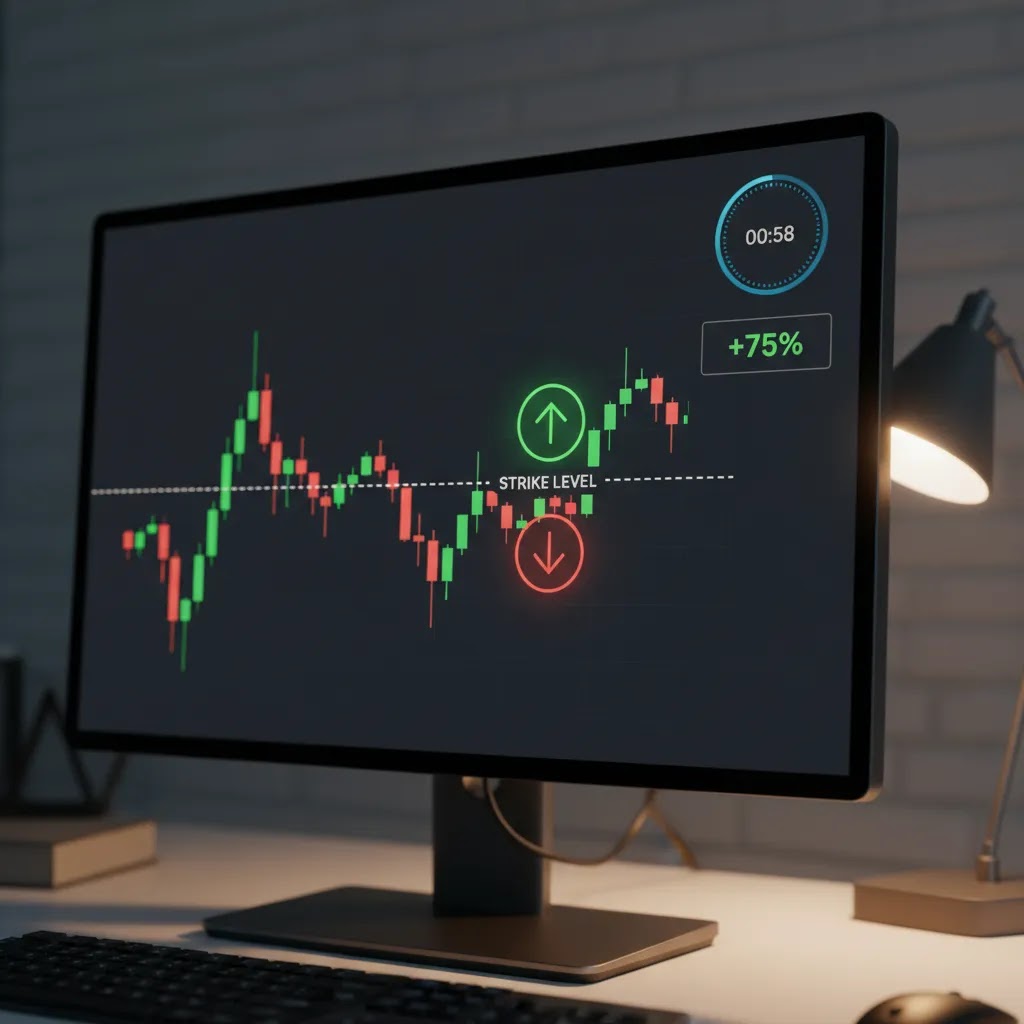
Binary options trading is a fixed-outcome form of options trading. You choose an asset, select an expiry time, and decide whether the price will finish above or below a defined level when that trade expires. If your prediction is correct at expiry, the trade may pay a fixed return. If it is wrong, you typically lose the amount you staked on that position.
That simple structure is one reason beginners are drawn to it. The risk on each trade is usually defined in advance. Still, defined risk does not mean low risk. Short expiry trades can produce losses quickly, especially if you trade too often or increase stake size after a losing streak.
If you are still unclear on the basic mechanism, read what is binary trading before opening a live account. Think of it this way, the format is easy to understand on the surface, but the pressure of timing, payout conditions, and platform quality makes execution much harder in practice.
Common trade types you may see include High/Low, One-Touch, Range, Ladder, and Turbo options. High/Low is the most common starting point. Turbo options use very short expiries, sometimes measured in seconds or a few minutes, and they may be especially risky for inexperienced traders because price noise can matter more than analysis.
Binary options vs digital options vs traditional options
New traders often see the terms binary options and digital options used interchangeably, then assume they work like traditional options trading. Here is the thing, those labels can hide meaningful differences in what you are actually buying.
In most retail platform contexts, binary and digital options refer to a fixed-outcome contract. You are not buying ownership in an asset, and you are not buying a contract that gains value gradually as the market moves. You are placing a time-bound yes or no outcome on a defined rule, such as whether price finishes higher or lower at expiry. If the rule is met at expiration, you may receive a fixed payout. If the rule is not met, you typically lose the stake. The payout may change based on the platform, the asset, and current conditions, but the payoff shape stays essentially fixed in structure.
Traditional options, sometimes called vanilla options, behave differently. They are usually structured around a strike price and can have variable profit and loss depending on how far price moves and when you exit. The value of the contract can change throughout the life of the option, and the outcome is not limited to a single fixed return. That is why traditional options trading tends to involve concepts like option premium, implied volatility, and contract valuation, while fixed-outcome binaries focus more on expiry timing and payout percentages.
It also helps to reset expectations versus spot trading in products like stocks or forex. With spot trading, you are typically exposed to variable profit and loss as the market moves, and the position can usually be managed with tools like stop-loss and take-profit in many markets. In a binary trade, your loss is typically the stake and your potential gain is defined by the quoted payout. You may not have the same level of trade management flexibility once the position is placed, especially on short expiries.
For UAE traders specifically, why this matters is practical. If you think a binary option behaves like a traditional option or a normal buy and sell trade, you may expect more control than the product usually provides. That mismatch can lead to oversizing positions, choosing expiries that are too short, or assuming a few ticks of movement in your favor means the trade is “safe.” Binary options trading remains high risk, and understanding the contract structure upfront helps you judge that risk more realistically.
Choosing a broker before account setup
Before you register anywhere, pause and evaluate the platform itself. This is where many costly mistakes begin. A polished website, a bonus offer, or a claim of fast withdrawals does not tell you much on its own.
From a practical standpoint, a first-time UAE trader should focus on a few points: regulation claims, funding methods, withdrawal terms, platform stability, and whether a demo account is available. BinaryOptionsAE uses a structured review approach that considers platform experience, payout structure, regulation, deposits and withdrawals, asset availability, account types, and customer support. That kind of framework is useful because it keeps you from judging a broker only by marketing or headline payout figures.
The product data available here confirms IQ Option as a currently featured broker and identifies it as best overall. Based on available data, it offers a demo account, educational resources, advanced charting tools, mobile and desktop access, and fast deposits and withdrawals through methods such as Visa, Mastercard, Skrill, Neteller, PayPal, and bank transfer. Even so, no broker should be treated as risk-free simply because it is widely known or heavily featured. You still need to verify whether the platform fits your needs and whether its terms are clear.
For a broader look at platform selection, the binary options platform guide can help you compare what matters before you deposit. You can also browse the wider Platforms section if you want to understand how different interfaces and account features may affect your first trading experience.
If regulation is part of your decision, remember the UAE context. The Securities and Commodities Authority (SCA) is relevant when discussing financial oversight in the UAE, but many binary options platforms used by UAE residents operate under offshore or international structures. A broker may cite a foreign regulator such as the Cyprus Securities and Exchange Commission (CySEC) or another international authority. That does not automatically make it suitable for you, but it may provide more accountability than an unverified platform with no clear licensing information at all.
How account setup usually works
Once you have shortlisted a platform, account setup is usually straightforward. The real issue is not whether you can open the account, but whether you understand the terms before you fund it.
Create the account carefully
You will typically provide your name, email address, country, and password. Some platforms may ask you to confirm your phone number as well. Use accurate information from the start. Mismatched personal details can create problems later if the broker asks for identity verification before a withdrawal.
Complete verification before you need a payout
What many traders overlook is timing. They deposit first, trade immediately, and only think about verification when they want to withdraw. That can lead to delays and frustration. In many cases, the broker may request proof of identity, proof of address, and sometimes payment method verification.
A safer sequence is:
For new users, a binary options demo account is often the best place to start. It gives you space to understand order placement, chart movement, and expiry behavior without exposing real funds immediately.
If you are completely new to the market structure, the beginner trading guide is worth reading alongside this article. It can help you build the basic vocabulary before you move from demo to live conditions.
Check funding methods and minimums
The live data provided for this article does not confirm a minimum deposit figure for all brokers, so you should verify this directly on the platform before funding. Do not assume every broker will accept the same methods or process withdrawals at the same speed. UAE traders often care about bank cards, e-wallet support, and whether local banking friction could affect payout timing.
Before you deposit, look at the funding process the same way you would look at the trading interface. A platform can be easy to trade on and still be difficult when you try to move money in or out. For UAE traders, friction often shows up in a few predictable places.
Card deposits may be quick, but withdrawals can be restricted to the original funding method, and name matching is not optional. In most cases, the trading account name needs to match the cardholder name, and the withdrawal route may depend on the same payment rails used for the deposit. Bank transfers can be more straightforward for larger amounts, but they may involve longer processing windows and additional bank-side checks. E-wallets can be fast for both deposits and withdrawals, but availability varies by broker, and you still need to confirm the wallet is supported for UAE residents, not just listed on a global page.
Currency is another practical detail that affects expectations. Many platforms run accounts in USD. If you deposit in AED, the funds may be converted, and conversion spreads or bank fees can affect the net amount that reaches your trading balance. The same applies on the way out. If you withdraw to an AED card or local bank account, the conversion back may reduce the final received amount. None of this removes trading risk, but it does help you avoid confusion when a deposit or withdrawal amount does not match your initial expectation.
Think of it this way, a withdrawal problem is rarely just one thing. Delays typically come from verification timing, incomplete documents, or method-specific processing windows. Disputes also tend to appear when traders accept bonuses without reading the attached terms, try to withdraw before meeting stated conditions, or attempt to withdraw to a different method than the one used for deposit. If a broker uses bonus language aggressively, read the withdrawal policy twice before you accept anything.
From a risk-control standpoint, many cautious traders prefer to test the process before committing larger amounts. A small deposit followed by a small withdrawal request, after completing any required verification, can reveal whether the platform’s process is clear and responsive. This is not a guarantee that future withdrawals will be smooth, but it may help you identify red flags early, while your exposure is limited.
How your first binary options trade is placed
After setup, the mechanics of your first trade are usually simple. Managing the decision behind it is harder.
Here is the important part. Your trade result depends on where the asset price finishes at expiry, not whether the price moved in your direction at some earlier point during the trade. That distinction causes many beginner mistakes.
Consider this example. You open a High/Low trade on gold with a five-minute expiry. Two minutes later, the price moves in your favor. If it reverses before the trade expires, you may still lose the full stake. That is why short expiries can feel deceptively simple but may be difficult to manage emotionally.
Never treat the quoted payout as a prediction of what will happen. It only tells you the potential return if the trade expires in the money, meaning it closes on the correct side of the strike or reference price according to the broker's rules.

What payouts, expiry, and risk really mean
Many first-time traders focus almost entirely on payout percentages. The reality is that payout is only one part of the equation. A high quoted percentage may look attractive, but it does not reduce the difficulty of making accurate short-term decisions.
What a payout percentage tells you
If a broker quotes an 80% payout on a trade, that usually means a successful trade could return your original stake plus 80% profit on that stake, based on that platform's terms at that moment. Payouts may vary by asset, expiry time, market volatility, and platform conditions. They are not fixed across all instruments or all times of day.
In practice, this means you should compare:
Risk remains high even if the payout looks favorable. To break even over time, your win rate must usually be high enough to offset the trades that lose 100% of the amount staked. That is one reason binary options are speculative by nature and not suitable for every trader.
Why expiry selection matters
Expiry time affects how much random market noise may influence the result. Very short expiries can make trades feel exciting, but they also leave little room for analysis to play out. A beginner who starts with rapid-fire trading may confuse speed with control.
Now, when it comes to learning, a slower pace often helps. A demo account, a small stake, and longer observation time may teach you more than dozens of rushed turbo trades. If you want a broader educational base, the Fundamentals section is a sensible next step before moving deeper into live trading.
Break-even win rate, what payout math implies
Most payout marketing is designed to make the upside feel more important than the downside. The reality is that payout percentages are only useful if you translate them into the win rate required to avoid losing money over time. This is not a strategy, it is basic math, and it helps you interpret platform claims more realistically.
A common binary setup is asymmetrical. When you lose, you typically lose 100% of the stake. When you win, you receive the stake back plus the payout percentage as profit. If the payout is P, your break-even win rate is typically:
Break-even win rate = 1 / (1 + P)
So if the payout is 80% (P = 0.80), break-even is about 55.6%. That means if you win fewer than about 56 trades out of 100, you are losing money over time in that simplified model. If the payout is 60% (P = 0.60), break-even becomes 62.5%. The lower the payout, the higher the win rate you need just to stay flat.
What many traders overlook is that real conditions can push that break-even point higher. Payouts may be lower on the exact asset and expiry you want to trade, or they may change during volatile periods. Some platforms also apply conditions around bonuses that can restrict withdrawal until certain thresholds are met. Execution quality matters too. On short expiries, small differences in pricing, timing, or how the platform defines the closing price can affect outcomes at the margin.
Binary options trading involves significant risk of capital loss, and payout math does not make it safer. It does, however, help you recognize why a headline payout number is not a shortcut. If a platform promotes unusually high payouts but is vague about how it sets them, how it prices expiries, or how withdrawals work, treat that as something to verify, not something to trust.
Common mistakes new traders make
Most beginner losses do not come from one dramatic error. They come from a series of small decisions that stack up quickly.
Here is the thing, emotional pressure is often highest after your first few results. A new trader who wins early may become overconfident. A new trader who loses early may chase the loss with larger positions. Both patterns can damage the account quickly.
For Muslim traders in the UAE, another area that deserves caution is the idea of an Islamic account or swap-free account. Some platforms may offer features described that way, but binary options and Shariah compliance remain debated topics. You should not assume that a marketing label settles the issue. If this matters to you, review the account terms carefully and consider independent religious guidance before proceeding.
If a broker makes regulation claims that are vague, unverifiable, or hidden deep in the site, treat that as a warning sign. Clear ownership details, transparent policies, and accessible support channels matter as much as trading features.

A practical first-trade checklist
If you decide to move forward, keep the process disciplined. Your first goal is not to win quickly. It is to avoid preventable mistakes while learning how the platform behaves.
This is also where BinaryOptionsAE can be useful as a research resource rather than a shortcut. The site focuses on broker comparisons, review methodology, and UAE-specific risk guidance, which may help you narrow your options before you register anywhere. Use that information alongside your own checks, especially if a platform was discovered through an ad or influencer promotion.
Binary options trading should be approached as a high-risk speculative activity, not as a dependable income plan. If your first trade is based only on excitement, the odds are not in your favor. If it is based on patient preparation, you may at least avoid some of the most common beginner errors.
Key Takeaways
Frequently Asked Questions
Is binary options trading legal in the UAE?
Legality depends on the platform structure, the product offered, and the regulatory framework involved. In the UAE, the Securities and Commodities Authority (SCA) is the key body to mention when discussing financial oversight, but many binary options platforms available online operate outside direct UAE supervision. That means you should not assume local protection applies just because a platform accepts UAE users. Before depositing, check the broker's legal entity, stated regulator, and terms of service. If regulation information is unclear or difficult to verify, caution is justified.
What is a binary option trade?
A binary option trade is a time-limited, fixed-outcome contract based on a simple rule, such as whether an asset finishes above or below a defined price level at expiry. You choose the asset, the expiry time, and the direction. If the trade expires in the money under the broker’s rules, you may receive your stake back plus a fixed payout. If it expires out of the money, you typically lose the stake. The risk is defined per trade, but binary options trading still involves significant risk of capital loss, especially when using short expiries or trading too frequently.
How much money do I need to start trading binary options?
The amount varies by broker because minimum deposits and minimum trade sizes are set by the platform. For this article, live product data did not confirm a universal minimum deposit figure across brokers, so you should verify it directly before funding an account. More important than the minimum is your risk threshold. You should only deposit money you can afford to lose entirely. Starting small may help you test the platform, review withdrawal behavior, and understand trade mechanics before putting more capital at risk.
What is the minimum deposit for binary trading?
There is no single minimum deposit across the industry. Each broker sets its own minimum, and it can change based on region, payment method, and account type. Before you deposit, confirm the broker’s current minimum inside the deposit screen and in the funding terms, not only in an ad or a homepage banner. For UAE traders, it is also smart to check the account currency and whether an AED deposit will be converted to USD, since conversion fees can affect how much actually arrives in your balance.
What is the safest way to place a first binary options trade?
There is no completely safe way to place a speculative trade, but there are safer habits. Use a demo account first if the broker offers one. Start with a simple High/Low setup rather than a more complex trade type. Keep your stake small, choose an expiry you can actually observe, and avoid trying to recover losses quickly. It also helps to trade only after reading the platform's withdrawal and verification terms. The goal of a first trade should be learning how the process works, not chasing a fast gain.
Why do so many beginners lose money quickly?
Many beginners lose money because they underestimate how hard timing can be. They may open live trades too soon, use very short expiries, or increase stake size after losses. Some also choose brokers based mainly on marketing, without checking payout conditions or withdrawal policies. A few early wins can create overconfidence, while early losses can trigger impulsive decisions. Binary options have defined trade risk, but repeated poor decisions can still drain an account fast. That is why disciplined position sizing and pacing matter from the start.
What does “in the money” mean in binary options?
“In the money” means your trade expires on the correct side of the broker's strike or reference price according to the trade rules. For a simple Higher trade, the asset needs to finish above the relevant level at expiry. For a Lower trade, it needs to finish below it. The key point is timing. A trade can appear profitable during its life and still finish out of the money if the market reverses before expiry. That is why watching the exact expiration point matters more than temporary price movement.
Is trading binary options profitable?
It can be for some traders, but many people lose money, and there is no reliable way to guarantee profits. Binary options have a payout structure where losses are typically the full stake, while wins pay a fixed return, so profitability depends on maintaining a win rate high enough to overcome that payout math over time. Results can also be affected by payout changes, short-expiry volatility, and platform rules. If you decide to participate, treat it as a high-risk speculative activity and focus first on understanding the product, the broker terms, and your personal risk limits.
Should I trust a platform that offers very high payouts?
Not automatically. A high payout figure may look attractive, but it does not prove the broker is transparent, well regulated, or reliable with withdrawals. Payouts can vary by asset, expiry time, and market conditions, and they may change throughout the day. You should treat payout as one evaluation factor, not the deciding factor. A lower-payout broker with clearer regulation, better support, and more transparent funding rules may be the more practical option. Always verify the full trading and withdrawal conditions before depositing funds.
What is a demo account, and why does it matter?
A demo account lets you practice with virtual funds rather than real money. This matters because it helps you learn the platform interface, see how expiry times work, and understand order placement without immediate financial risk. It will not fully replicate the emotional pressure of live trading, but it can reveal whether the platform is intuitive and whether your process is rushed or organized. For most first-time traders, starting with demo mode is one of the most sensible ways to reduce avoidable mistakes before going live.
Can Muslim traders use Islamic or swap-free binary options accounts?
Some brokers may offer account features described as Islamic or swap-free, but that does not settle the wider Shariah question. Binary options themselves are debated among scholars, and opinions vary on whether the structure meets Islamic finance principles. If this issue matters to you, read the account terms carefully and do not rely only on a marketing label. You may also want to seek guidance from a qualified religious advisor. In practical terms, the phrase “swap-free account” describes a feature, not a universal guarantee of full Shariah compliance.
How do I know if a binary options broker could be a scam?
Warning signs often include vague regulation claims, missing legal entity details, unrealistic promises, aggressive bonus tactics, poor disclosure around withdrawals, and limited customer support. You should also be cautious if a broker pressures you to deposit quickly, avoids clear answers about verification, or appears mainly through social media promotions without transparent company information. A legitimate-looking website alone proves very little. Research the broker independently, test support responsiveness, and review policies before sending funds. If basic ownership or licensing information is hard to verify, step back.
What should I do if I cannot withdraw my funds?
First, review the broker's withdrawal policy, account verification requirements, and any bonus terms that may affect eligibility. Check whether your documents were submitted correctly and whether your payment method matches the account name. Contact support in writing so you have a record of the issue. If the broker claims to be regulated, you may be able to escalate the complaint through the relevant regulator or dispute channel. The best protection, though, starts earlier, by testing the broker with a small amount before making a larger deposit.
Are binary options legal in the USA?
In the United States, binary options are heavily restricted, and many offshore binary options platforms are not permitted to accept US residents. In practice, legal US binary options trading is typically limited to specific regulated venues, and the rules are enforced more strictly than in many other regions. If you are based in the UAE, this does not directly determine what is available to you, but it is a useful reminder that regulatory treatment varies widely by country. Always check the legal and regulatory status that applies to your residency and the broker’s operating entity before opening an account.
Conclusion
Your first experience with binary options trading should begin with caution, not urgency. The process of opening an account and placing a trade may look simple on screen, but the real challenge is choosing a credible platform, understanding expiry and payout mechanics, and managing risk before emotions take over. That matters even more in the UAE, where many traders discover platforms through online promotions rather than through a clear, regulated local pathway.
If you decide to continue your research, compare platforms carefully, read the broker terms in full, and spend time in demo mode before committing real money. The comparison resources on binaryoptions.ae may help you organize that research, especially if you want to review platform features and account types in one place. What matters most is not how fast you can place a trade, but how well you understand the risks, the broker, and the limits you need to set before any money is on the line.
Risk Disclaimer: Binary options trading carries significant risk of capital loss and is not suitable for all traders. This content is for informational purposes only and does not constitute investment advice. BinaryOptionsAE may earn commission from broker referrals, but this does not influence editorial ratings or rankings. Always verify a broker's regulatory status, account terms, and withdrawal policy before depositing funds.
About the Author
Braden Chase is an investor, trading specialist, and former research specialist for Forex.com who helps aspiring investors develop the confidence and habits they need to make an income from the market. Braden has served as a registered commodity futures representative for domestic and internationally-regulated brokerages and has also spoken & moderated numerous forex and finance industry panels across the globe.