
Binary Options Simulator: Practice Environments and Live-Trading Divergence (2026)

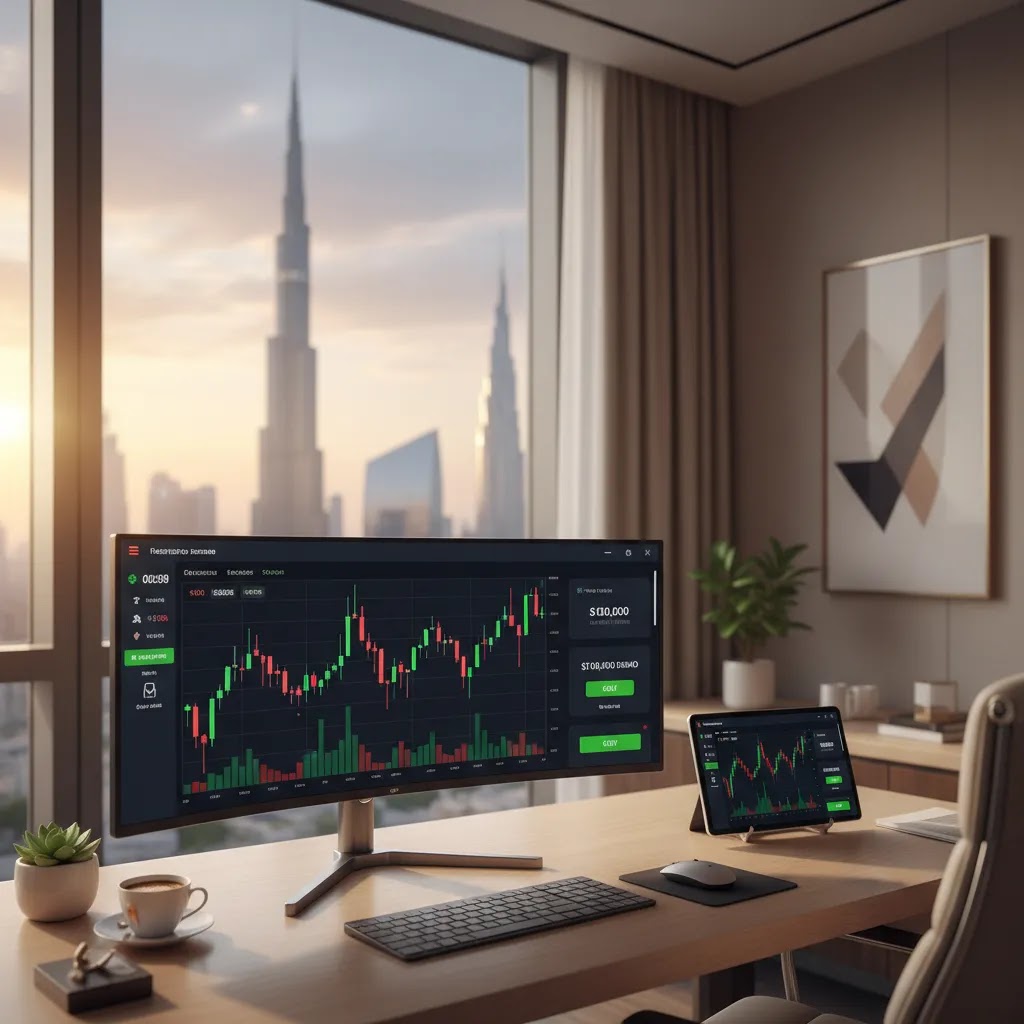
Capital is at risk in live trading. A binary options simulator lets you practise platform mechanics, expiry selection, and order entry without capital exposure. Demo performance is a poor predictor of live performance because the behavioural pressures that produce documented retail-loss rates of 74–80% (per ASIC's binary options review) are largely absent in simulation. This article documents what simulators provide, where simulator results diverge from live outcomes, and what UAE residents should and should not infer from demo performance.
Risk warning
The UAE Capital Market Authority (CMA, successor to the SCA from 1 January 2026 under Federal Decree-Laws 32 and 33 of 2025), the Dubai Financial Services Authority (DFSA), and the Financial Services Regulatory Authority (FSRA) of ADGM have not authorised any binary options broker for retail clients. Binary options simulators are practice tools provided by offshore binary options brokers; they do not change the regulatory framework, the documented retail-loss distribution, or the counterparty risks of live trading. UAE residents should treat simulator performance as the upper bound of expected live performance, not as the typical case.
What a binary options simulator is
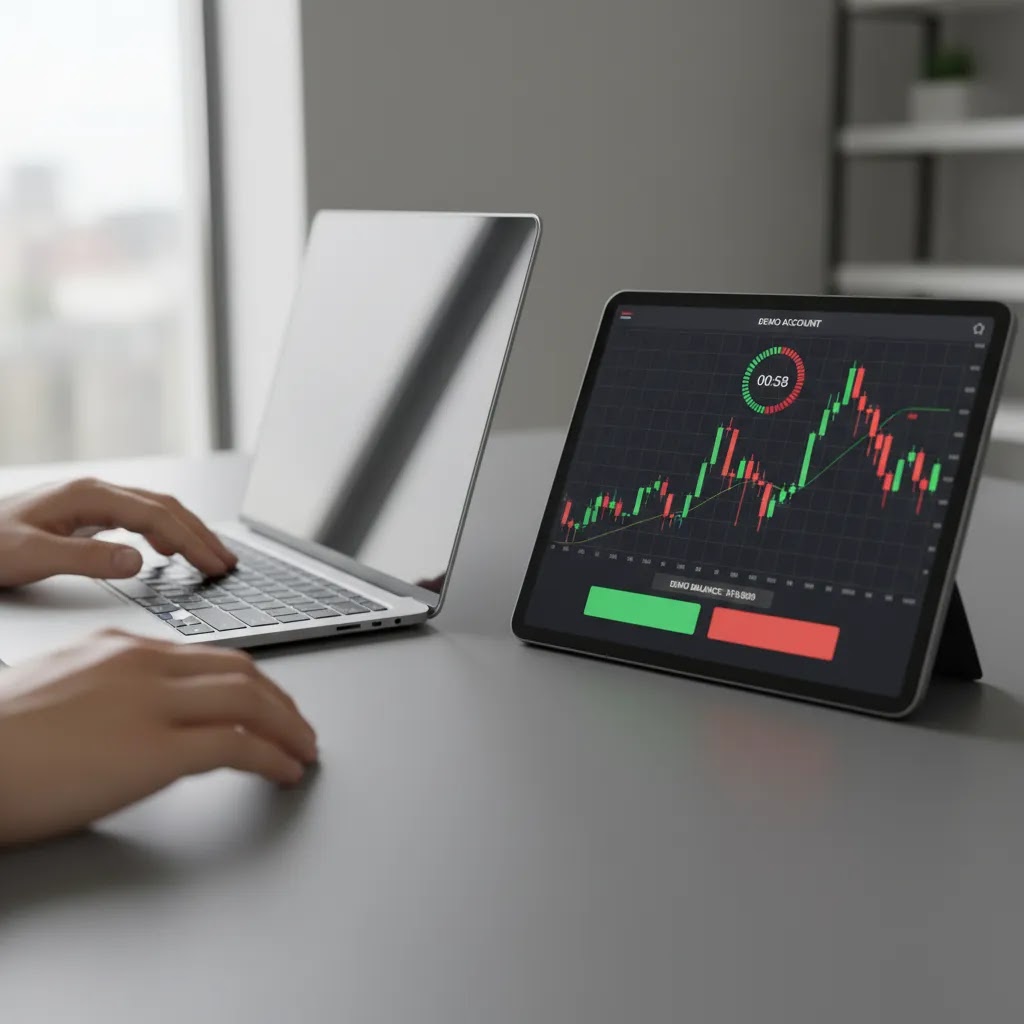
A binary options simulator is a practice environment where users place simulated trades against live or near-live market data, with virtual rather than real capital. The most common form is a demo account provided by a binary options broker, accessible from the broker's standard platform interface.
The simulator typically provides:
- Live or near-live price feeds for the broker's available assets
- The same order-entry interface used for live trading
- Virtual balance (commonly $1,000 – $10,000 starting; some brokers allow refills)
- Trade history with outcomes
- Often the same charting and analytical tools available in live accounts
The simulator typically does not provide:
- Real capital at risk
- The behavioural pressures that affect live trading decisions
- The withdrawal mechanics that affect live capital recovery
- The same execution conditions live trading produces (in some implementations)
- Account-tier benefits that may apply to live accounts
For UAE residents, the simulator's primary value is platform familiarisation — understanding the order entry interface, expiry selection, payout displays, and chart tools — before any live capital is committed. Strong demo performance does not establish that live performance will be profitable; weak demo performance does establish that live performance is unlikely to be profitable. The asymmetric information value of demo trading is worth understanding before relying on demo data as a basis for live trading decisions.
What demo testing genuinely demonstrates
- Platform mechanics validation. Whether you can navigate the platform, place trades, select expiries, and read payouts without confusion.
- Tool functionality. Whether the broker's charting, indicators, and analytical features work as documented.
- Strategy mechanics. Whether a trading approach can be implemented within the platform's order-entry constraints.
- Lower-bound performance estimation. If you cannot achieve profitable performance in demo, you are unlikely to achieve profitability in live trading. Demo performance is an upper bound.
- Broker payout pattern observation. What payouts the broker actually displays at order entry across different assets and sessions.
- Identification of platform limitations. What expiries are available, how the platform behaves during news events, whether order entry is responsive.
- Pre-deposit broker validation. Whether the broker's overall operational quality supports a deposit decision.
Where demo and live performance systematically diverge
Demo performance overstates expected live performance for several systematic reasons:
- Loss aversion is absent. Loss aversion does not engage in demo trading because no real loss occurs. Live trading triggers it, producing position-size escalation after losses, premature exits from winners, and avoidance of objectively favourable setups.
- Overconfidence after wins is muted. A demo win does not produce the dopamine response of a live win, so the overconfidence pattern is reduced.
- Disposition effect operates differently. The tendency to close winning trades early and let losing trades run is partially a function of capital protection instinct.
- Time-pressure decisions differ. Decision quality under time pressure is systematically lower in live than demo, especially on short-expiry contracts.
- Broker conduct may differ. Some brokers provide more favourable conditions in demo than live — better fills, more favourable payouts, fewer execution issues.
- Account-level constraints differ. Demo accounts often have generous virtual balances ($10,000 typical) while live accounts may start at $200–500. Sizing behaviour at smaller balances is meaningfully different.
- External pressure is absent. Family financial pressure, broker account-manager outreach (which typically activates after live deposit), and self-imposed pressure all push live decisions in directions demo decisions are not pushed.
- Withdrawal mechanics are absent. Demo trading does not require capital withdrawal. Withdrawal frictions, KYC, and broker discretion are major risk factors that demo cannot evaluate.
- Recovery behaviours differ. A losing demo session can be paused or refilled. The temptation to "make it back" is meaningfully different when capital cannot be replenished.
- Variance interpretation differs. A 10-trade losing streak in demo is observable but not personally costly. The same streak in live produces capital reduction and behavioural shifts.
The compound effect: demo performance is typically 30–60% better than equivalent live performance for retail traders. A trader achieving a 60% win rate in demo may achieve 50–55% in live; a trader achieving 55% in demo may achieve 45–50% in live. The asymmetry is substantial and consistent across documented retail populations.
For UAE residents, the practical implication: demo profitability that barely exceeds break-even thresholds is unlikely to translate to live profitability. Demo profitability with substantial margin above break-even may translate to roughly break-even or modestly profitable live trading. Strong, sustained demo profitability with documented discipline may translate to modestly profitable live trading for the small subset of traders in the underlying population's profitable distribution.

Break-even mathematics in demo testing
The structural mathematics of binary options applies identically to demo testing.
Break-even win rate by realised payout
| Realised average payout in demo | Break-even win rate required |
|---|---|
| 70% | 58.8% |
| 75% | 57.1% |
| 80% | 55.6% |
| 85% | 54.1% |
| 90% | 52.6% |
Demo data should be tracked as if it were live.
Per-trade record:
- Date and time
- Asset
- Direction (call/put)
- Stake (as percentage of starting demo balance, treated as "real" balance)
- Payout displayed at entry (verbatim)
- Expiry length
- Reason for entry (one sentence)
- Outcome (win/loss/at-the-money)
- Rule-violation flag (if any rule was broken)
After 200–300 demo trades the data is sufficient to evaluate whether your approach is mathematically viable at the broker's realised payouts. If the data shows win rates below break-even thresholds in demo (where conditions favour you), live trading is virtually certain to be loss-making.
Simulator features to verify
- Platform parity. The demo should use the same platform interface, order ticket, and execution flow as live trading.
- Asset universe parity. The demo should include the same assets you will trade live.
- Realistic price feeds. The demo should use live or near-live price data.
- Realistic payout displays. The demo should display payouts as they would appear in live trading.
- Refillable balance. A refillable demo balance allows extended testing across multiple strategy iterations.
- Retention period. Permanent or extensible demo access is preferable to time-limited demos.
- Mobile and desktop parity. If you trade across devices, the demo should support the same devices.
- Risk control availability. Daily loss limits, position size caps, and pause functions should match live availability.
- Customer support access. Demo should provide enough support access to validate broker responsiveness.
Detailed treatment at Demo Accounts.
Distinguishing simulators from third-party "binary options simulator apps"
Third-party applications marketed as "binary options simulators" are distinct from broker demo accounts. They are typically distributed through app stores or websites independent of binary options brokers, often free, may not connect to any specific broker's platform, and may use synthetic price data rather than live market feeds. Some apps include marketing for unregulated brokers, may have unclear ownership and operator information, and may collect user data for marketing or other purposes.
For UAE residents, third-party simulator apps are generally not useful for serious binary options preparation. Broker demo accounts are materially more useful and should be the primary testing environment. If a third-party app is used, verify the developer and ownership, review permissions before installation, avoid providing payment information or broker credentials within the app, and do not infer outcomes from app practice.
Pre-live-trading checklist after demo testing
- Verify demo data shows profitability above break-even thresholds. Compute realised win rate and realised average payout from at least 200 demo trades. The realised win rate should exceed the break-even threshold by a meaningful margin (e.g., 3+ percentage points) to allow for demo-to-live degradation.
- Verify the broker independently. Demo quality does not validate broker operational quality. See Regulated Brokers and Binary Options Blacklist.
- Read the live account terms. Withdrawal terms, KYC requirements, account suspension conditions apply to live accounts whether or not they appeared in demo.
- Plan the deposit method. Card deposits provide chargeback rights; wire transfers and cryptocurrency do not. See Deposit Methods.
- Decline bonuses on first deposit. Bonus turnover requirements affect withdrawability. See No-Deposit Bonuses.
- Make the first deposit small. Treat the first live deposit as a test, not a commitment. $200–500 is typically sufficient to validate the broker through a small test withdrawal before scaling.
- Pre-commit to position-sizing rules. Live position sizing should match (or be more conservative than) demo position sizing.
- Plan a withdrawal test early. Withdraw a small amount within the first 1–2 weeks to validate the broker's withdrawal process before substantial capital is committed.
- Track live performance against demo expectations. If live performance materially diverges, evaluate whether the divergence reflects expected demo-to-live degradation or specific broker conduct issues.
- Maintain pre-commitment to evaluation milestones. Pre-commit to evaluating live performance after defined milestones (100 live trades, 30 days of live trading, 50% drawdown on initial capital) rather than continuing indefinitely.
Frequently asked questions
Is binary options practice the same as live trading? No, materially. Demo trading lacks the behavioural pressures that systematically affect live trading decisions. Demo performance typically overstates equivalent live performance by 30–60% for retail traders.
Can simulators predict whether a strategy will work live? Partially. If a strategy is unprofitable in demo (where conditions favour the trader), it is virtually certain to be unprofitable in live. Borderline demo profitability is unlikely to translate to live profitability.
How long should a UAE resident practice on a simulator? Long enough to generate at least 200 trades, experience multiple market conditions, test platform behaviour during news releases, demonstrate consistent application of risk-management rules, and confirm realised payouts on intended assets. For most retail traders, this is 4–8 weeks of regular demo testing.
Are third-party simulator apps useful? Generally not for serious preparation. They often use synthetic price data, may have favourable outcome distributions that do not reflect real conditions, and do not validate any specific broker's platform.
What is the most important thing demo testing won't tell me? Demo testing cannot evaluate your behavioural response to live capital pressure. Loss aversion, overconfidence, position-size escalation under pressure, and emotional revenge trading all affect live outcomes and cannot be replicated in demo.
Can I use a binary options simulator without depositing? Most major binary options brokers offer demo accounts without requiring live deposits. UAE residents can typically test multiple brokers' simulators without any financial commitment, which is a useful pre-deposit comparison method.
Final risk warning
Binary options simulators allow practice of platform mechanics and strategy testing without capital exposure. Demo performance should be treated as the upper bound of expected live performance, not the typical case. UAE residents trading binary options through offshore platforms are not protected by any UAE-authorised investor compensation scheme. Capital is at risk and total loss of deposit is a frequent outcome.
About the Author
Braden Chase is a trading specialist and former research specialist at Forex.com. He writes about market mechanics, trading instruments, and the regulatory landscape to help readers research financial markets with a clearer understanding of risk. Braden has previously served as a registered commodity futures representative for domestic and internationally-regulated brokerages. Articles are educational analysis and do not constitute investment advice. Binary options are high-risk speculative instruments and are not regulated in the UAE.